- Plants
- ›Vascular Plants
- ›flowering plants
- ›Dicots
- ›sandalwoods, mistletoes, and allies
- ›balanophora family
- ›Corynaea
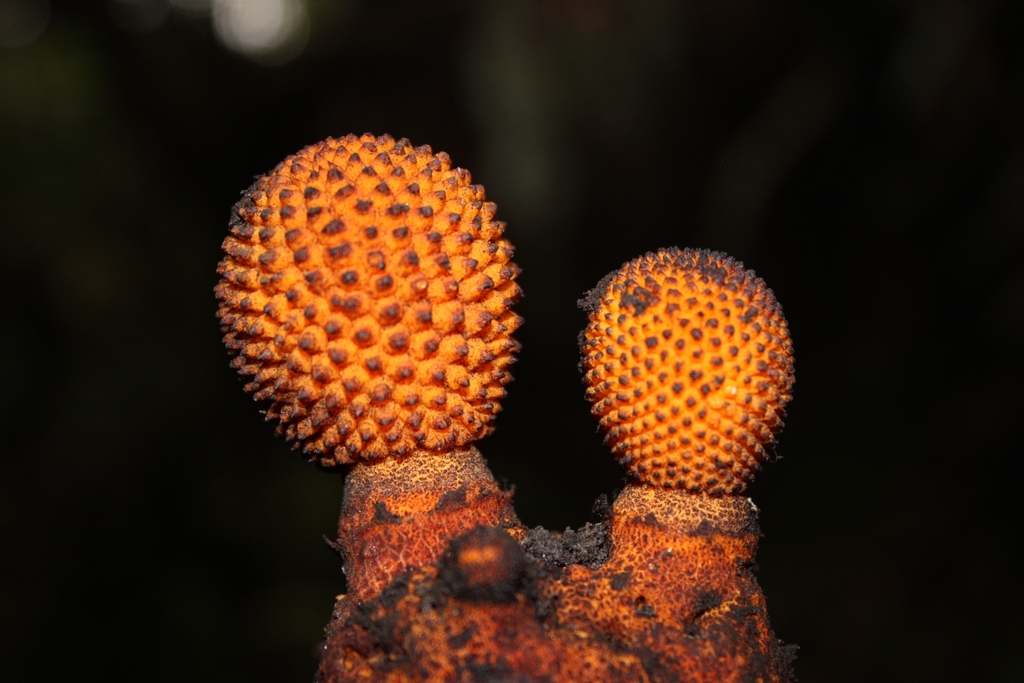
Peruvian Viagra
Corynaea crassa
Corynaea crassa, commonly known as Peruvian Viagra or huanarpo macho is a species of parasitic flowering plant in the family Balanophoraceae found in South and Central America. Described in 1856 by Joseph Dalton Hooker, it is the sole member of the monotypic genus Corynaea.
It is not specialized for a single host species, with a broad variety of plant species that can serve as a host. Across its broad distribution, it has been known to parasitize at least four separate families of plants and grow in association with various other plants depending on its location. Consisting of a single underground haustorial tuber which is physically connected to the host plant, the inflorescences emerge from the ground seasonally. In Peru, its tubers often find use in the context of folk medicine as an anti-inflammatory and aphrodisiac.
From the article Corynaea crassa on Wikipedia (CC BY-SA), quoted section by section
Description
Corynaea crassa is a root hemiparasite of a broad variety of plants, thus requiring no sunlight to gather nutrients and lacking leaves. The vegetative body of the plant, and akin other members of the family Balanophoraceae, consist of an accretion of plant tissue known as a haustorial tuber. It is this haustorial tuber where the inflorescences of the plant develop from. The size of the haustorial tuber is directly correlated to the diameter of the host root from which the tuber derives its nutrients. In addition, the number of inflorescences the tuber produces is directly correlated to the diameter of the tuber itself. The emergence of the inflorescence is seasonal. The individual flowers are pollinated by insects of the orders Hymenoptera and Diptera. The rhizome of C. crassa is irregular in shape, with multiple lobes. It turns a rusty color when dried. The inflorescence is typically pink in color, ranging between a yellowish-brown to an intense purple, with the peduncle, or stalk of the plant, having an irregular short and lobed sheath at its base and having a length of 1.5–2.5 centimetres (0.59–0.98 in). The flower head is globose in shape, tapering to become fusiform in shape. The flower heads have a length of between 2–4 centimetres (0.79–1.57 in) and a diameter of between 1.5–2.0 centimetres (0.59–0.79 in). …
Range & habitat
Corynaea crassa is found in South and Central America, specifically within the countries of Bolivia, Colombia, Costa Rica, Ecuador, Panama, Peru, and Venezuela. Corynaea crassa is found in the Peruvian provinces of Amazonas, Cajamarca, Cusco, La Libertad, Lambayeque, and Pasco.
Wikipedia: “Distribution”
At the table
Corynaea crassa is often used within Peruvian folk medicine as an aphrodisiac and as an anti-inflammatory. It has a strict use as a male aphrodisiac, and is thought to have anti-aphrodisiac properties if used by women. The tubers of the plant are often sold dry or in a powder form at markets. Ethanolic extracts from Corynaea crassa have shown biological activity against the bacteria Staphylococcus aureus. The Philippine Food and Drug Administration has listed an advisory for products containing C. crassa extracts, due to the presence of adulterated Tadalafil. Chemical analysis of dried tubers through chromatography, steroid elucidation, and X-ray crystallography revealed a variety of compounds such as: anthocyanins, cardiotonics, flavonoids, tannins, triterpenes, and steroids, with a lack of alkaloids. The formation of the Triterpenes Lupenone with Β-amyrone and Lupeol with B-Amyrine in a 1:1 ratio that had been uncovered by the survey had never been observed prior. The individual compounds uncovered had been found in other plants with purported aphrodisiac properties. The chemical composition of the tuber can differ based on the host species, with differing hosts across its broad range contributing to different chemical compositions of tubers found in Peru and Ecuador.
Wikipedia: “Human uses”
Where it lives
Recorded sightings
—
geo-referenced records in GBIF, from museums, herbaria and field observers.
Drag the globe to turn it. Dots are where records exist, not a range map; darker means more records.
In the stacks
Searching the stacks…
Every page naming Corynaea crassa in the Biodiversity Heritage Library →
This page is assembled live from iNaturalist, GBIF, Wikipedia, the Source Library and the Internet Archive. It is not yet part of the hand-edited codex. iNaturalist taxon 337651.