- Animals
- ›Arthropods
- ›Hexapods
- ›Insects
- ›Winged and Once-winged Insects
- ›Butterflies and Moths
- ›Owlet Moths and Allies
- ›Underwing, Tiger, Tussock, and Allied Moths
- ›Tussock Moths
- ›Nygmiini
- ›Euproctis
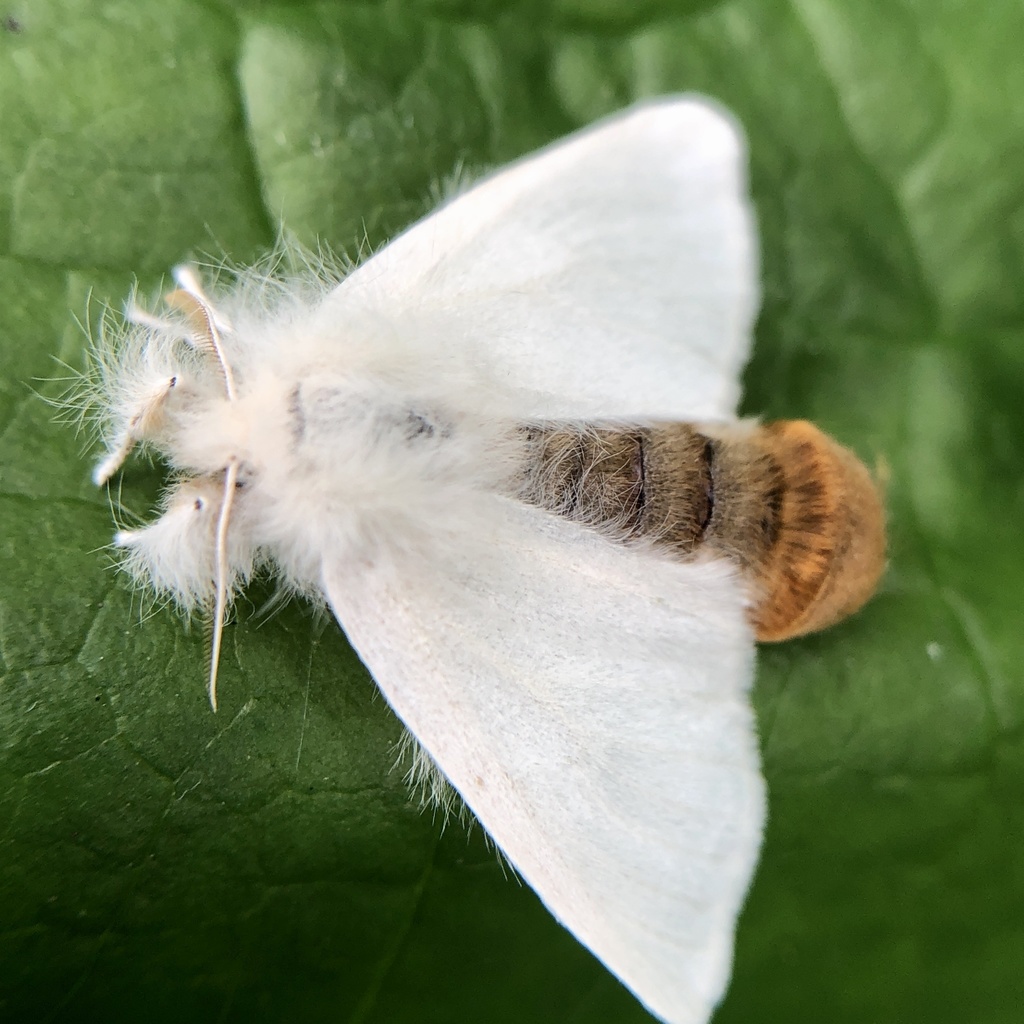
Brown-tail Moth
Euproctis chrysorrhoea
The brown-tail moth (Euproctis chrysorrhoea) is a moth of the family Erebidae. It is native to Europe, neighboring countries in Asia, and the north coast of Africa. Descriptions of outbreaks, i.e., large population increases of several years duration, have been reported as far back as the 1500s. The life cycle of the moth is atypical, in that it spends approximately nine months (August to April) as larvae (caterpillars), leaving about one month each for pupae, imagos and eggs. Larvae (caterpillars) are covered in hairs. Two red spots on the back, toward the tail, distinguish these species from other similarly hairy moth larvae. The winged adults have white wings and a hairy white body with a tuft of brown hair at the tip of the abdomen. Females lay one egg cluster, usually on the underside of a leaf of a host plant. The species is polyphagous, meaning that it feeds on many different species of trees, including pear, apple, maple and oak.
This species was accidentally introduced to the United States in the 1890s. During the early 20th century it was present from eastern Connecticut northward into New Brunswick, Canada, but a subsequent severe population collapse reduced the territory to parts of coastal Maine and Cape Cod, Massachusetts, by the late 20th century. One theory for the decline appeared to be parasitism by a fly introduced to combat spongy moths. Starting in 2015 there has been a population spike and territory expansion in coastal Maine. In Europe, there are multiple parasitic and predator species, yet there is still a history of population outbreaks.
From the article Brown-tail moth on Wikipedia (CC BY-SA), quoted section by section
Description
The upper surface of the wings of this species is pure white. Males may have some brown color on the underside of the forewing. Wingspan is 36–42 millimetres (1.4–1.7 in). The body is very hairy and white except for the tail which is covered in reddish-brown hairs, much more prominent in the females. Males have larger antennae, used to detect pheromones released by unmated females. Females have a larger body. As winged adults, this species is superficially similar in appearance to Euproctis similis (native to Europe) and Hyphantria cunea (native to North America), but female E. similis have a yellow tail tuft and H. cunea lacks tail tuft coloration.
The female lays one cluster of 200 to 400 eggs, typically on the underside of a leaf. The egg cluster is covered with hairs from her anal tuft. The larva is very hairy, brown with white markings, and two prominent red spots toward the tail end. The hairs provide protection from predators; the larva incorporates some into the cocoon within which it pupates. The species overwinters communally as larvae within a tough, silken tent constructed around branch-tip leaves and anchored to twigs. In areas where the species is abundant, these tents are a familiar sight, and can be seen on a huge range of plants, especially in late fall and winter when unaffected leaves have fallen.
What it does
The brown-tail moth produces one generation a year. It has four life stages; egg, larval, pupal, and adult. Eggs are laid in July and hatch in August. The annual cycle is approximately one month as eggs, nine months as larvae, one month as pupae, and one month as imagoes (winged, sexually mature adults).
Eggs are preferentially laid on oak trees. Pre-diapausing larvae: Emerge and feed gregariously starting in August after about three weeks of egg incubation. Diapausing larvae: As a response to shortened periods of daylight, larvae build communal winter nests in the fall, inside of which they overwinter. These involve webbing binding leaves together at tree-top branch tips. Distinct from other communal moth larvae such as eastern tent caterpillar which over-winter as eggs, then create webbed nests in branch crotches during spring and summer. Post-diapausing gregarious larvae: The emerging larvae, approximately one centimeter long, resume feeding in early April synchronized with bud break, and still inhabit the winter nests as their resting places, or else make communal web-nests. …
Wikipedia: “Life cycle”
Listen
Looking for field recordings…
Where it lives
Recorded sightings
—
geo-referenced records in GBIF, from museums, herbaria and field observers.
Drag the globe to turn it. Dots are where records exist, not a range map; darker means more records.
In the stacks
Searching the stacks…
Every page naming Euproctis chrysorrhoea in the Biodiversity Heritage Library →
This page is assembled live from iNaturalist, GBIF, Wikipedia, the Source Library and the Internet Archive. It is not yet part of the hand-edited codex. iNaturalist taxon 337520.