- Plants
- ›Vascular Plants
- ›flowering plants
- ›Dicots
- ›Sunflowers, Bellflowers, Fanflowers, and Allies
- ›Sunflowers, Daisies, Asters, and Allies
- ›chicories, dandelions, and allies
- ›Lettuce, Chicory, Dandelion and Salsify Tribe
- ›Scorzonerinae
- ›Scorzonera
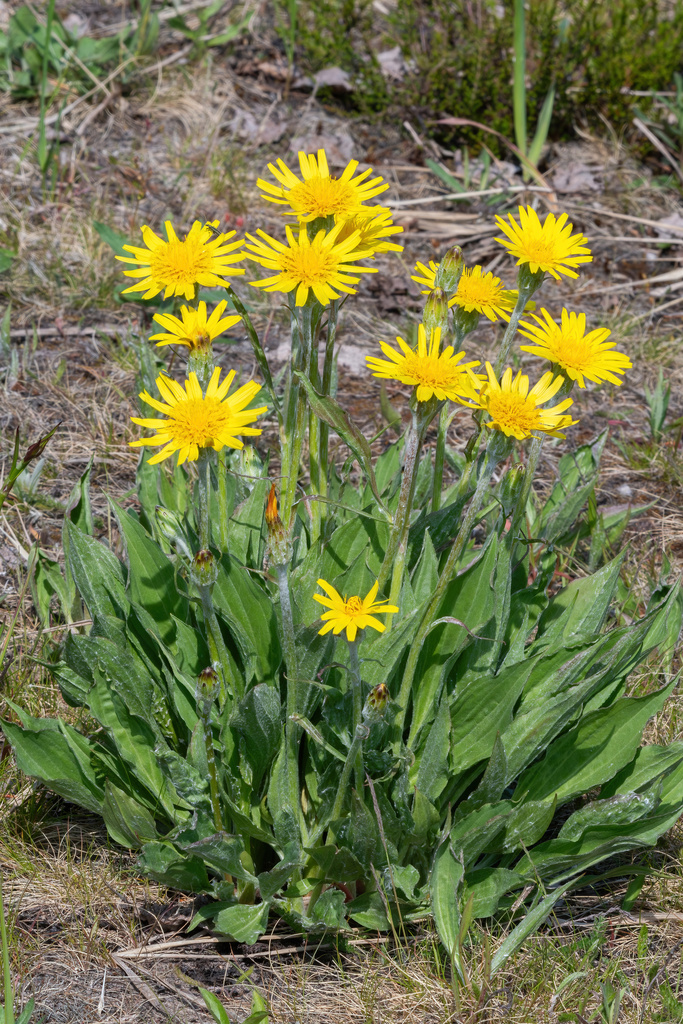
Viper's-grass
Scorzonera humilis
Scorzonera humilis, the viper's-grass, is a species of perennial plant. In Britain it is a rare plant, restricted to moist meadows, in Dorset and Warwick in England, and in South Wales.
One unique class of stilbenoid derivative was first isolated from S. humilis. They were named the tyrolobibenzyls after Tyrol in the eastern Alps, where the plant was collected.
From the article Scorzonera humilis on Wikipedia (CC BY-SA), quoted section by section
Description
It differs from goat's-beard, Tragopogon pratensis, in that it has short, pale green bracts, whereas in Goats Beard they are long and pointed. It grows 7 to 50 cm. The leaves are unbranched, elliptical-lanceolate. The flower heads are 2.5 cm wide, and deep yellow in colour. Flowers from May until July. The achenes are smooth ribbed, beakless, with similar pappus to Tragopogon pratensis. It exudes a milky juice from its stem.
== References ==
Where it lives
Recorded sightings
—
geo-referenced records in GBIF, from museums, herbaria and field observers.
Drag the globe to turn it. Dots are where records exist, not a range map; darker means more records.
In the old herbals & bestiaries

History of Rare Plants of Pannonia
Carolus Clusius · 1576 · p.711

History of Rare Plants Observed in Pannonia
Carolus Clusius · 1583 · p.640

Rariorum Plantarum Historia (with Fungorum Historia)
Carolus Clusius · 1601 · p.520

Rariorum Plantarum Historia (with Fungorum Historia)
Carolus Clusius · 1601 · p.520
In the stacks
Searching the stacks…
Every page naming Scorzonera humilis in the Biodiversity Heritage Library →
This page is assembled live from iNaturalist, GBIF, Wikipedia, the Source Library and the Internet Archive. It is not yet part of the hand-edited codex. iNaturalist taxon 336284.