- Plants
- ›Vascular Plants
- ›flowering plants
- ›monocots
- ›Aroids, Water Plantains, Seagrass, and allies
- ›pondweed family
- ›Potamogeton
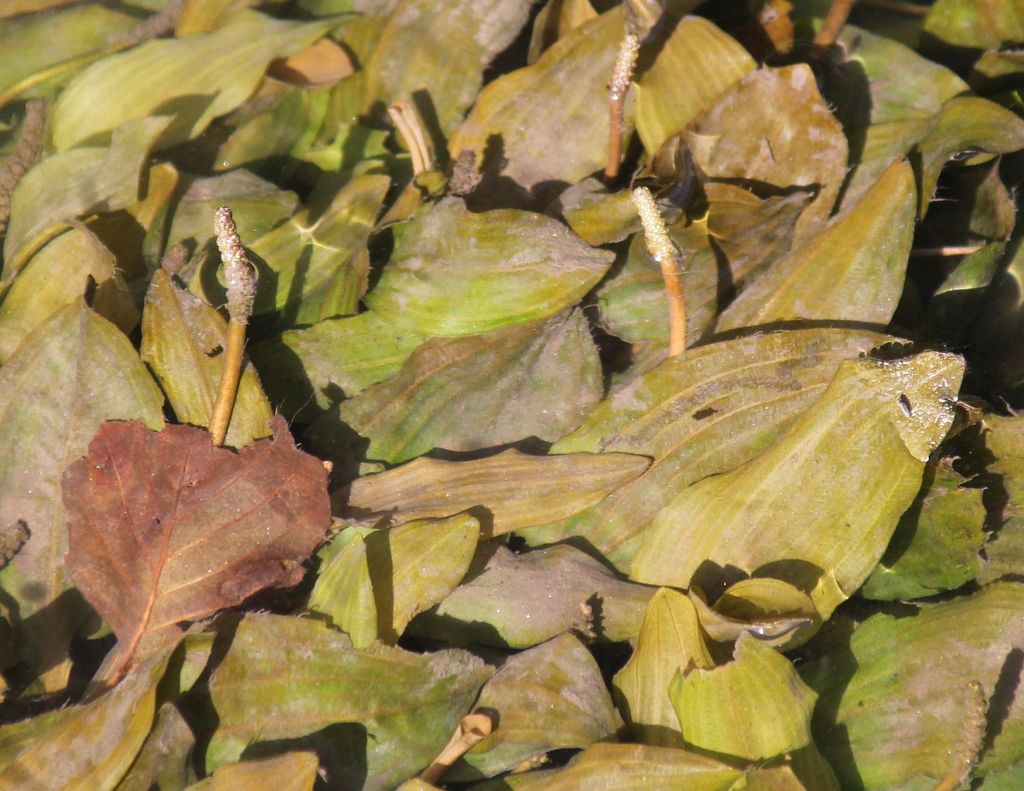
Fen Pondweed
Potamogeton coloratus
Potamogeton coloratus, the fen pondweed, is an aquatic plant in the genus Potamogeton. It is found in shallow peaty calcareous lakes, ponds and ditches, commonly associated with lowland fens.
From the article Potamogeton coloratus on Wikipedia (CC BY-SA), quoted section by section
Description
Fen pondweed grows from perennial, creeping rhizomes. The leaves are broad, thin and translucent with noticeable reticulate veining. Both floating and submerged leaves are produced but the difference between these is often rather indistinct, rather than the marked dimorphism seen in other pondweeds. Often, the leaves of fen pondweed are simply longer and narrower lower down the stem and shorter and rounder towards its apex; the leaves towards the apex of the stem may be floating but often grow just below the surface, giving the plant a distinctive 'drowned' appearance, as though water levels have recently risen. Submerged leaves are 70–175 mm long and 10–30 mm wide. All leaves have the stalk shorter than the blade, and the submerged leaves are almost sessile. The leaves are typically reddish to brownish in colour. Flowers are produced in June to July. Like all pondweeds, they are small and greenish, in spikes up to 45 mm long. The fruits of this species are smaller (1.5–1.9 mm long × 1.0–1.3 mm wide) than broad-leaved pondweed (Potamogeton natans) and bog pondweed (Potamogeton polygonifolius). Turions are not produced. Fen pondweed could be confused with other pondweeds, especially bog pondweed (P. polygonifolius), to which it is closely related. …
Range & habitat
Potamogeton coloratus is restricted to Europe (Britain, Ireland, Netherlands, Belgium, Denmark, Sweden (Gotland only), France including Corsica, Italy including Sardinia and Sicily, Switzerland, Austria, Hungary, Spain (Balearic Islands) and Portugal), Turkey and extreme North Africa (Morocco, Algeria).
Wikipedia: “Distribution”
What it does
Fen pondweed has rather specialised habitat preferences, occurring predominantly on deep peat with nutrient-poor calcareous water and a strong groundwater influence, such as is commonly found in alkaline fenlands. Within this habitat it occurs predominantly in ponds, ditches and drains, flushes and seeps, and the margins of shallow lakes, in water up to about 1 m deep, often in the company of stoneworts and bladderworts. In central Europe, it forms a distinct community with Chara hispida and the aquatic form of Juncus subnodulosus in oligotrophic, calcium-rich, spring-fed streams and oxbow lakes. It will also grow on marl, sand and clay. In Britain and central Europe it has been lost from many sites due to eutrophication or drainage, and most remaining populations are in nature reserves. However, where it is found it can be abundant, such as on the Anglesey Fens in North Wales. Fen pondweed remains widespread in Ireland. A study of the genetic diversity of fen pondweed in the managed ditch systems of the Gordano Valley in southwest England showed that genetic diversity increased with distance from the head of the valley. …
Wikipedia: “Ecology and conservation”
How it is grown
Fen pondweed is not in cultivation, and does not seem particularly easy to grow, reflecting its specialist habitat requirements. It would probably need to be grown in a rather deep, peaty but alkaline substrate.
Wikipedia: “Cultivation”
Where it lives
Recorded sightings
—
geo-referenced records in GBIF, from museums, herbaria and field observers.
Drag the globe to turn it. Dots are where records exist, not a range map; darker means more records.
In the stacks
Searching the stacks…
Every page naming Potamogeton coloratus in the Biodiversity Heritage Library →
This page is assembled live from iNaturalist, GBIF, Wikipedia, the Source Library and the Internet Archive. It is not yet part of the hand-edited codex. iNaturalist taxon 335049.