- Plants
- ›Vascular Plants
- ›flowering plants
- ›Dicots
- ›Legumes, Milkworts, and Allies
- ›Legumes
- ›Acacias, Mimosas, Mesquites, and Allies
- ›Acacia
- ›Plurinerves
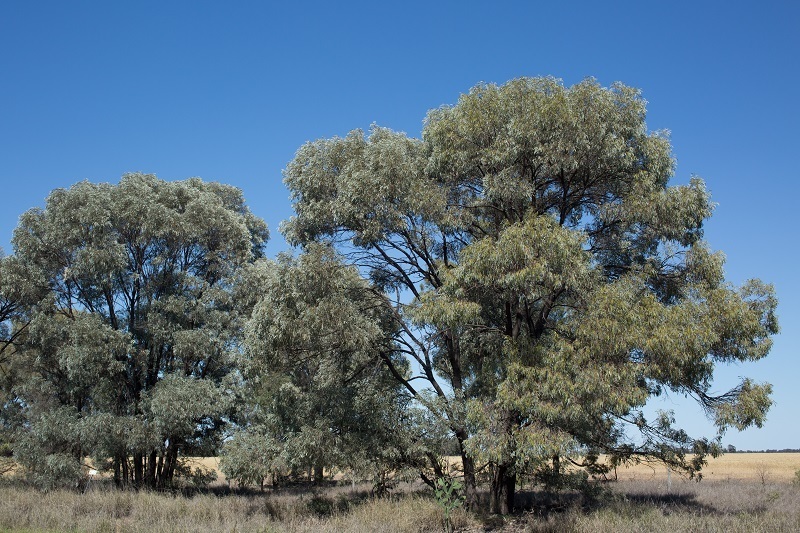
Brigalow
Acacia harpophylla
Acacia harpophylla, commonly known as brigalow, brigalow spearwood, orkor or ogarah, is a species of flowering plant in the family Fabaceae and is endemic to eastern Australia. It is a tree with sickle-shaped phyllodes, spherical heads of golden yellow flowers and subterete straight to slightly curved pods, slightly raised over and constricted between the seeds. The Gamilaraay peoples know the tree as barranbaa or burrii. It is found in central and coastal Queensland to northern New South Wales. It can reach up to 25 m (82 ft) tall and forms extensive open-forest communities on clay soils.
From the article Acacia harpophylla on Wikipedia (CC BY-SA), quoted section by section
Description
Acacia harpophylla is a root-suckering tree that typically grows to a height of up to 25 m (82 ft), and has hard, furrowed and almost black bark. Its branchlets are covered with soft hairs, pressed against the surface, or glabrous. Its phyllodes are sickle-shaped, 100–200 mm (3.9–7.9 in) long, 7–20 mm (0.28–0.79 in) wide, leathery and covered with silky hairs, with many closely parallel veins of which three to seven are more prominent than the rest. Its flowers are borne in spherical heads in two to eight racemes on peduncles mostly 10–20 mm (0.39–0.79 in) long and covered with soft hairs. Each head is 5–8 mm (0.20–0.31 in) in diameter with 15 to 35 golden yellow flowers. Flowering occurs between July and October, and the pods are subterete, straight to slightly curved, up to 200 mm (7.9 in) long and 5–10 mm (0.20–0.39 in) wide, crusty and glabrous, slightly raised over and constricted between the seeds. The seeds are oblong or broadly elliptic, flat but thick, 10–18 mm (0.39–0.71 in) long and soft, with a thread-like attachment but no aril.
Range & habitat
Two species, brigalow (A. harpophylla) and gidgee (A. cambagei) form open woodlands on flat and gently undulating terrain on heavy and relatively fertile clay and clay-loam soils primarily in the 300-700mm annual rainfall region of Eastern Australia. These woodlands extend from a northern extreme of 20° S into northern New South Wales. Brigalow and gidgee occur as mixed communities in some regions and are commonly associated with several other woody species, including overstorey species such as Eucalyptus coolabah, E. cambageana, Casuarina cristata, and a range of understorey species. A. tephrina, A. georginae and A. argyrodendron also occupy similar habitats and have similar habits and growth forms, but are less widespread, while a number of other Acacia species also form structurally similar communities. Brigalow occurs from coastal regions receiving in excess of 900 mm (35 in) rainfall per year through to the semiarid 500 mm (20 in) rainfall region, though it is primarily a semiarid zone species. Gidgee (A. cambagei) replaces brigalow as rainfall drops in western regions and extends from 650 to 300 mm (26 to 12 in). Gidgee, with a maximum height of approximately 12 m (39 ft), is somewhat smaller than brigalow, which can attain heights of 20 m (66 ft). In the north-western regions black gidgee (A. …
Wikipedia: “Distribution and habitat”
Where it lives
Recorded sightings
—
geo-referenced records in GBIF, from museums, herbaria and field observers.
Drag the globe to turn it. Dots are where records exist, not a range map; darker means more records.
In the stacks
Searching the stacks…
Every page naming Acacia harpophylla in the Biodiversity Heritage Library →
This page is assembled live from iNaturalist, GBIF, Wikipedia, the Source Library and the Internet Archive. It is not yet part of the hand-edited codex. iNaturalist taxon 334762.