- Animals
- ›Arthropods
- ›Hexapods
- ›Insects
- ›Winged and Once-winged Insects
- ›Butterflies and Moths
- ›Bagworms, Clothes Moths, and Allies
- ›Fungus Moths, Clothes Moths, & Allies
- ›Nemapogoninae
- ›Nemapogon
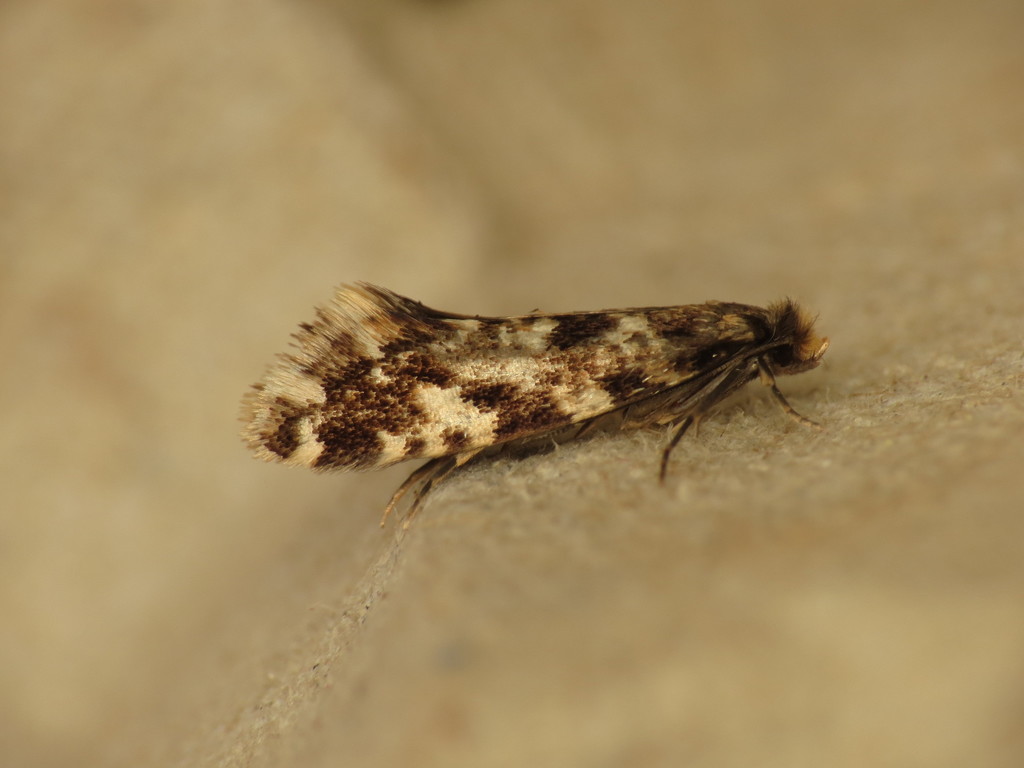
Cork Moth
Nemapogon cloacella
Nemapogon cloacella, the cork moth, is a species of tineoid moth. It belongs to the fungus moth family (Tineidae), and therein to the subfamily Nemapogoninae. Its junior synonym N. infimella was established by G.H. Heydenreich in the 1851 volume of his Lepidopterorum Europaeorum Catalogus Methodicus, but many sources still attribute it to G.A.W. Herrich-Schäffer, who supposedly narrowly beat Heidenreich in (re)describing the species. But as it seems, Herrich-Schäffer was merely one of the first to use the name proposed by Heydenreich, as the volume of his Systematische Bearbeitung der Schmetterlinge von Europa where he discussed the cork moth was not published until 1853 or 1854. That all nonwithstanding, the species had been already validly described by A.H. Haworth in the 1828 volume of Lepidoptera Britannica.
From the article Nemapogon cloacella on Wikipedia (CC BY-SA), quoted section by section
Description
This small moth has a wingspan of 10–18 mm. The forewings are irregularly mottled black, brown, white and grey, resembling close relatives such as the European corn moth (N. granella). The head has a tuft of pale yellow hairs. The antennae are wire-shaped and about two-thirds as long as the front wings. The thorax is grey. The wing fringes on the forewing are alternately grey and white. The hind wings are dark grey-brown. The larva is white to pink with a reddish-brown head. The neck plate is also reddish-brown.
Range & habitat
Nemapogon cloacella is a widespread species, found all across the western Palearctic and North America, where it has recently been recorded from British Columbia. It is reportedly absent from France, but given that it occurs in all surrounding countries, this is unlikely to be correct. Its preferred habitat is woodland with a large amount of dead trees. The crepuscular adults are on the wing throughout the summer and are typically encountered at dusk but sometimes can be seen earlier in the day.
Wikipedia: “Distribution and ecology”
Listen
Looking for field recordings…
Where it lives
Recorded sightings
—
geo-referenced records in GBIF, from museums, herbaria and field observers.
Drag the globe to turn it. Dots are where records exist, not a range map; darker means more records.
In the stacks
Searching the stacks…
Every page naming Nemapogon cloacella in the Biodiversity Heritage Library →
This page is assembled live from iNaturalist, GBIF, Wikipedia, the Source Library and the Internet Archive. It is not yet part of the hand-edited codex. iNaturalist taxon 333906.