- Animals
- ›Arthropods
- ›Hexapods
- ›Insects
- ›Winged and Once-winged Insects
- ›Butterflies and Moths
- ›Flannel, Slug Caterpillar, Leaf Skeletonizer, and Allied Moths
- ›Burnet Moths
- ›Forester Moths
- ›Procridini
- ›Adscita
- ›Adscita
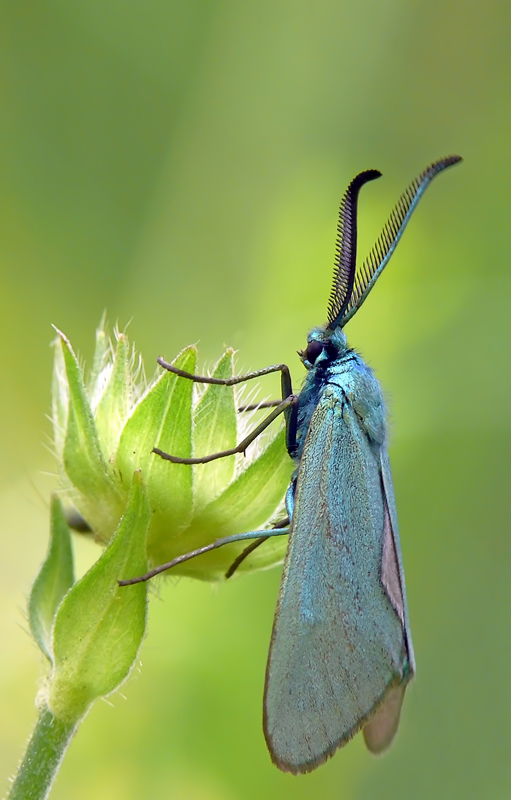
Green Forester Moth
Adscita statices
Adscita statices, (also known as the forester and the green forester), is a day-flying moth of the family Zygaenidae. First described by the Swedish biologist Carl Linnaeus in 1758, it is found in Asia and Europe.
From the article Adscita statices on Wikipedia (CC BY-SA), quoted section by section
Description
The wingspan is 25–28 millimetres (0.98–1.10 in). The antennae, head, thorax, legs and abdomen are shiny green (the thorax is occasionally blue green and shimmering). However, the wings may appear rusty-red in the early morning and evening. The wide forewings are less glossy than the body, mostly blue green, sometimes also green to yellow green. The fringes are blackish grey. The hindwings are moderately wide with a slightly truncated rim, They are slightly transparent, blackish grey and lightened basally. The underside of both pairs of wings is grey. The caterpillars are pale yellowish-green with a central dark stripe and fine white hairs dorsally. The wings of the green forester contain two types of colored scales, of which one contains pores of different sizes. These pores are able to fill with water, which causes the color of the scales to change from green to rusty-red.
In human culture
Adscita from adscitus, meaning adopted or enrolled was originally a Carl Linnaeus name. Linnaeus divided the hawk-moths into four groups, three of which he called the true hawk-moths and the fourth, ″a group of seven hangers-on, in default of a better position″. In 1783 Retzius was the first to use Adscita as a genus and he kept two of these moths in the Adscita, i.e. statices and filipendulae (the six-spot burnet, which was later assigned to Zygaena). Linnaeus gave the moth the specific name statices, which refers to the plant Statice armeria (now Armeria maritimum). Thrift is not the foodplant and Linnaeus never thought it was and quotes Ray and Petiver who both thought the Forester was a butterfly.
Wikipedia: “Etymology”
Listen
Looking for field recordings…
Where it lives
Recorded sightings
—
geo-referenced records in GBIF, from museums, herbaria and field observers.
Drag the globe to turn it. Dots are where records exist, not a range map; darker means more records.
In the stacks
Searching the stacks…
Every page naming Adscita statices in the Biodiversity Heritage Library →
This page is assembled live from iNaturalist, GBIF, Wikipedia, the Source Library and the Internet Archive. It is not yet part of the hand-edited codex. iNaturalist taxon 333243.