- Plants
- ›Vascular Plants
- ›flowering plants
- ›Dicots
- ›Sunflowers, Bellflowers, Fanflowers, and Allies
- ›Sunflowers, Daisies, Asters, and Allies
- ›Thistles and Allies
- ›Cardueae
- ›Thistles and Burdocks
- ›Cirsium
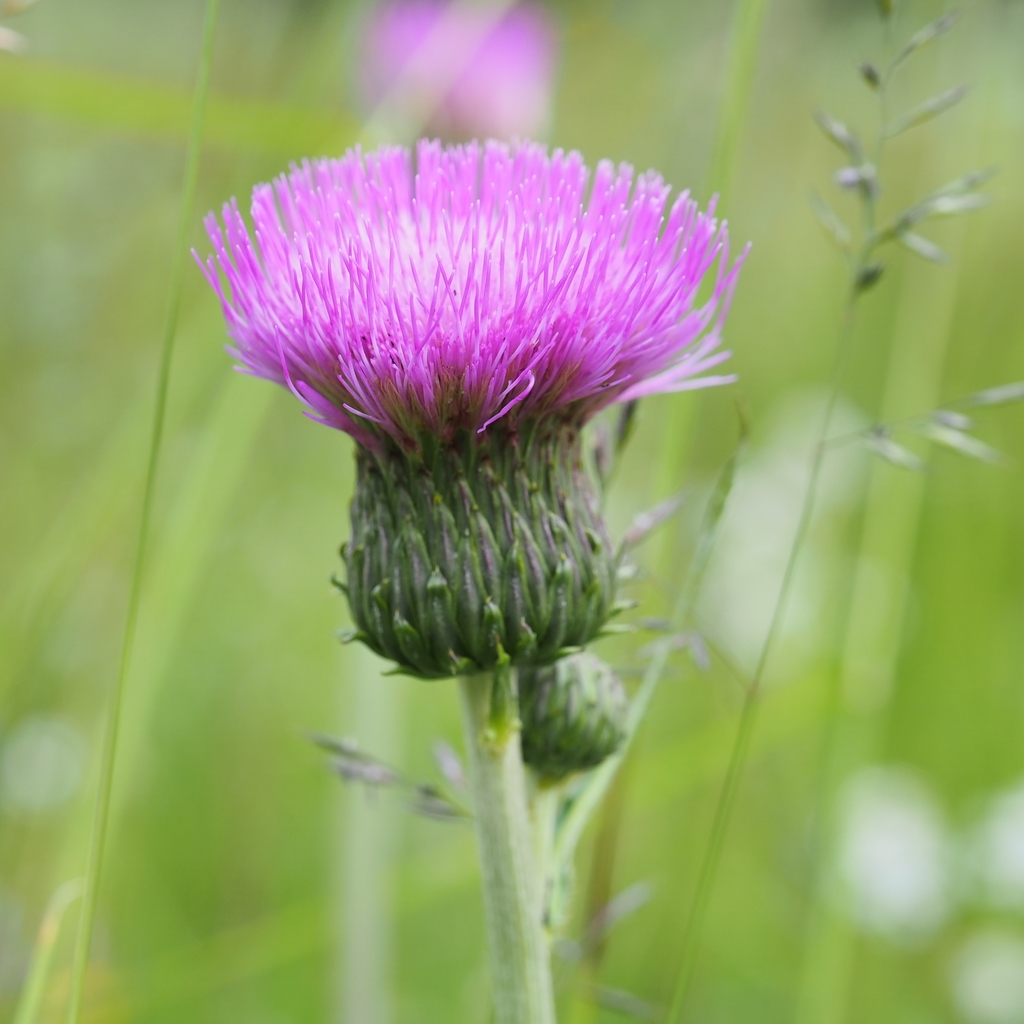
Melancholy Thistle
Cirsium heterophyllum
Cirsium heterophyllum, the melancholy thistle, is an erect spineless herbaceous perennial flowering plant in the family Asteraceae. It is native to Europe and western Asia, where it grows in upland meadows, grasslands, road verges and open woodland.
From the article Cirsium heterophyllum on Wikipedia (CC BY-SA), quoted section by section
Description
Unusually for a thistle, Cirsium heterophyllum lacks spines. Growing 45–120 cm (18–47 in) tall, the plant forms creeping stolons (runners). The stem is grooved but unwinged, more-or-less branchless, and cottony. The leaves are green and hairless above, thick white-felted underneath. The basal leaves are lanceolate with petioles and softly prickly edges, and grow 20–40 cm (7.9–15.7 in) long, and 4–8 cm (1.6–3.1 in) wide. The upper leaves do not have petioles, clasping the stem with cordate (heart-shaped) bases. The flower heads are 3 to 5 cm long and wide, the flowers red-purple, appearing from July to August.
Range & habitat
Cirsium heterophyllum is a species of northern Europe and Central Asia. It is native in upland areas of Scotland and northern England and north Wales, but is rare in other parts of Great Britain and Ireland. It is present throughout Scandinavia, in north central Europe and Russia to about 100 degrees East and in the high mountains of southern Europe. It grows in upland grassland and scrub, open woodland and river valleys.
Wikipedia: “Distribution”
In medicine
The plant was considered a possible cure for sadness. Nicholas Culpepper in 1669 said that it "makes a man as merry as a cricket".
== References ==
Wikipedia: “Medical use”
Where it lives
Recorded sightings
—
geo-referenced records in GBIF, from museums, herbaria and field observers.
Drag the globe to turn it. Dots are where records exist, not a range map; darker means more records.
In the stacks
Searching the stacks…
Every page naming Cirsium heterophyllum in the Biodiversity Heritage Library →
This page is assembled live from iNaturalist, GBIF, Wikipedia, the Source Library and the Internet Archive. It is not yet part of the hand-edited codex. iNaturalist taxon 332681.