- Animals
- ›Arthropods
- ›Hexapods
- ›Insects
- ›Winged and Once-winged Insects
- ›Mantises
- ›Extant Mantises
- ›Schizomantodea
- ›Mantoidea
- ›Mantids
- ›Hierodulinae
- ›Hierodulini
- ›Hierodula
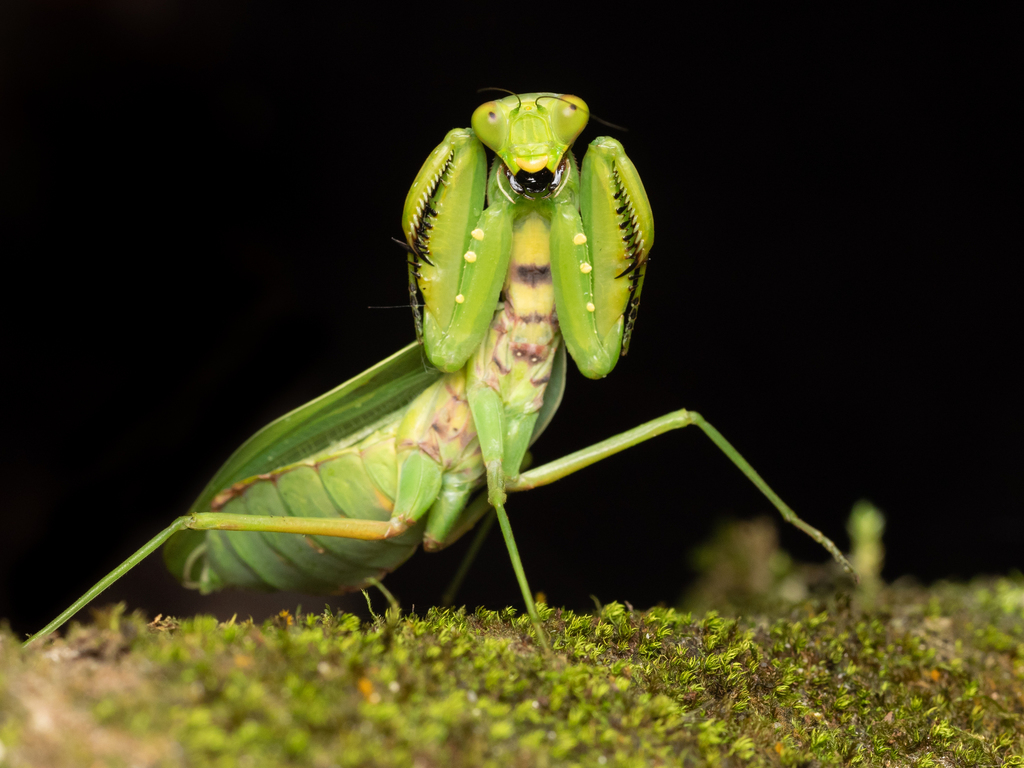
Giant Asian Mantis
Hierodula patellifera
Hierodula patellifera, commonly known as giant Asian mantis, Asian mantis, or Indochina mantis, is a species of praying mantis in the family Mantidae. They are found in Malaysia, Hawaii, India, Nepal, Italy (San Paolo Solbrito), Indonesia (Java, West Sumba,), Korean Peninsula, Philippines, New Guinea, southern China, Taiwan, Vietnam, and Japan (Honshu, Shikoku, Kyushu, Okinawa). H. patellifera lives in trees and in grasslands at the edges of forests.
From the article Hierodula patellifera on Wikipedia (CC BY-SA), quoted section by section
Description
H. patellifera is a species that is part of the subfamily Hierodulinae. A distinct appearance makes this species recognizable owing to its elongated prothorax and slender body, which contributes to an overall stick-like structure. This species can be seen around the southeast Asia region, inhabiting grasslands and forest where it can effectively camouflage. Males are about 5.19 cm long while females range from 6.06 cm long, with individual variation into two different colours, green or brown. Significant morphological diversity has been observed within this species across populations. Research has observed variation of body size, shape of spines in the forelegs and genitalia size in specimens from Korea, Okinawa, Java and Guam. This degree of variation could suggest a high intraspecific variability with genetic cohesion, supporting classification of H. patellifera as a single unit, possibly a species complex.
Range & habitat
The introduction of H. patellifera to countries far away from the peninsula are mostly due to human-linked activities such as cargo transport from Asian countries or its popularity on the exotic trade market. This particular species is native to the South East Asia region, but due to the growing global trade the species has also been found in the Mediterranean countries. Due to the species' ability to adapt accordingly to its new environment, it has enabled itself to establish itself in south region of France. The increasing global trade and the expansion of the exotic trade market has allowed H. patellifera beyond its native ecosystem spreading concerns over the possibility of competing with the native species and destabilizing the overall ecological system.
Wikipedia: “Range expansion”
What it does
In the unique world of insect communication, H. patellifera portray a unique type of behavior that benefits sexual reproduction in their species. According to a study by Perez (2005), virgin female mantis have a unique adaptation that help them attract mates. This type of behaviour is portraying body posture, signalling mates that they are available for mating. This type of behaviour is combined with the arching of the abdomen to expose its dorsal surface and a pumping movement that releases chemical signals such as pheromones which primarily attract males. Perez observed that this posture is linked with the female mantis's nutritional state and reproductive readiness. Males that are attracted to the released pheromones can distinguish between virgin and mated mantises, as only virgin mantises practice this kind of behaviour. Additionally, intricate predatory movement can also have effects in mate selection. Displaying the ability to stalk and ability to successfully capture prey can be used a signal to display over male fitness.
Wikipedia: “Reproductive behavior”
Listen
Looking for field recordings…
Where it lives
Recorded sightings
—
geo-referenced records in GBIF, from museums, herbaria and field observers.
Drag the globe to turn it. Dots are where records exist, not a range map; darker means more records.
In the stacks
Searching the stacks…
Every page naming Hierodula patellifera in the Biodiversity Heritage Library →
This page is assembled live from iNaturalist, GBIF, Wikipedia, the Source Library and the Internet Archive. It is not yet part of the hand-edited codex. iNaturalist taxon 328037.