- Plants
- ›Vascular Plants
- ›flowering plants
- ›Dicots
- ›Gentians, Dogbanes, Madders, and Allies
- ›Dogbane Family
- ›Apocynoideae
- ›Mesechiteae
- ›Mandevilla
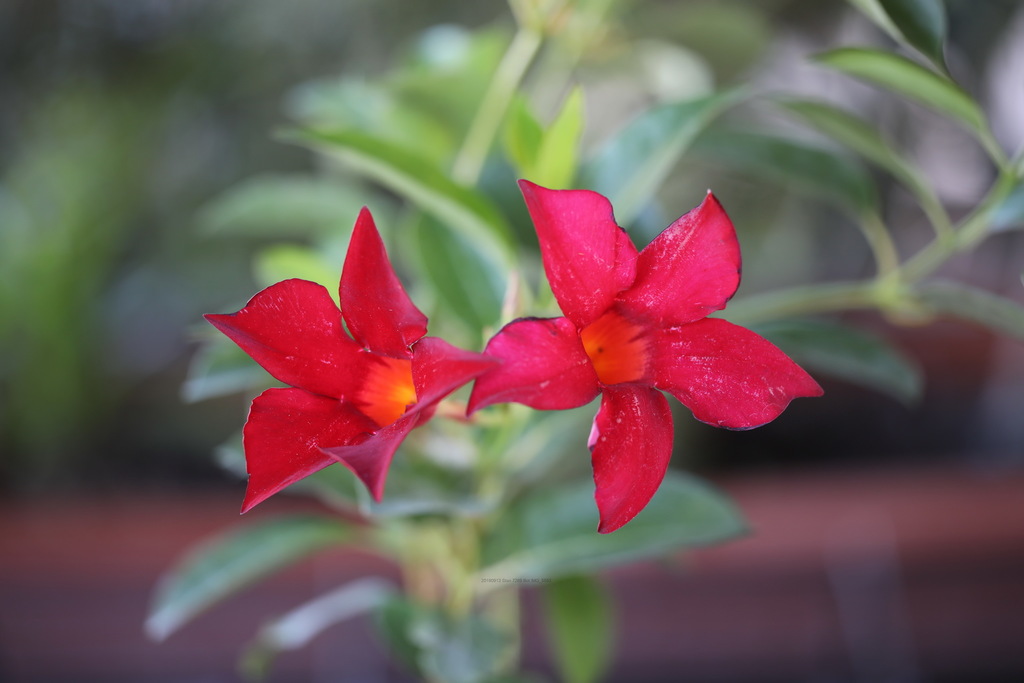
Brazilian jasmine
Mandevilla sanderi
Mandevilla sanderi, the Brazilian jasmine, is a vine belonging to the genus Mandevilla. Grown as an ornamental plant, the species is endemic to the State of Rio de Janeiro in Brazil. It is a rapidly growing, creeping, perennial plant, pruning shoots about 60 cm per year.
Despite its common name, the species is not a "true jasmine" and not of the genus Jasminum.
From the article Mandevilla sanderi on Wikipedia (CC BY-SA), quoted section by section
Description
Mandevilla sanderi is a shrub with a naturally bushy habit, 2–3 meters high, or 4.5 meters (15 feet) if the climate is warm. It is able to develop long, woody stems based on lignin and climbs by twining around some support. This twining growth is characterized by long internodes, small leaves and a stem rarely carrying flowers. The plant contains a white latex, which is viscous, toxic, and can be irritating. In addition to fine roots, it has large tuberous roots that contain starch and a reserve of water, allowing it to withstand drought. The evergreen, petiolate, thick, leathery, dark green leaves are opposite, and grow to 6 cm (2.5 in) long. The blade is ovate-elliptical, 5–6 cm long, with a glossy upper surface and a thick epidermis. The apex is shortly acuminate. The inflorescences are simple racemes, usually terminal (sometimes axillary) that gather at a given moment, 3–4 pimples and a large blooming pink-red flower, 4–7 cm in diameter. Each flower has a chalice in cup with five teeth lanceolate-subulate scarious, a large corolla infundibular pink (funnel-shaped) formed of a cylindrical tube of 4–5 mm in diameter, which widens abruptly in a tube 15–18 × 25–30 mm, terminated by 5 oval lobes, acuminate, spreading, partially overlapping. The five stamens include threads inserted into the tube and connective anthers, forming a ring around the head. …
In human culture
The genus name Mandevilla was awarded by John Lindley, a botanist, in memory of Henri Mandeville (1773-1861), one of his fellow British gardening enthusiasts who was a diplomat in Buenos Aires (Argentina). The sanderi species name refers to Henry Frederick Conrad Sander (1847-1920), a horticulturist and collector from Hertfordshire (in the UK) who brought the plant back from Brazil. In 1896 WB Hemsley of Kew Gardens gave the first botanical description of the plant, which he named Dipladenia sanderi Hemsl. However, in 1933 Robert E. Woodson, who had undertaken a large taxonomic study of the Apocynaceae, made significant changes in the Mandevilla constituency. By including several genres such as Dipladenia inside Mandevilla, the plant ended up with the name Mandevilla sanderi.
Wikipedia: “Etymology”
Where it lives
Recorded sightings
—
geo-referenced records in GBIF, from museums, herbaria and field observers.
Drag the globe to turn it. Dots are where records exist, not a range map; darker means more records.
In the stacks
Searching the stacks…
Every page naming Mandevilla sanderi in the Biodiversity Heritage Library →
This page is assembled live from iNaturalist, GBIF, Wikipedia, the Source Library and the Internet Archive. It is not yet part of the hand-edited codex. iNaturalist taxon 327733.