- Animals
- ›Arthropods
- ›Hexapods
- ›Insects
- ›Winged and Once-winged Insects
- ›True Bugs, Hoppers, Aphids, and allies
- ›True Bugs
- ›Cimicomorph Bugs
- ›Reduvioidea
- ›Assassin Bugs
- ›Ambush Bugs
- ›Phymatini
- ›Phymata
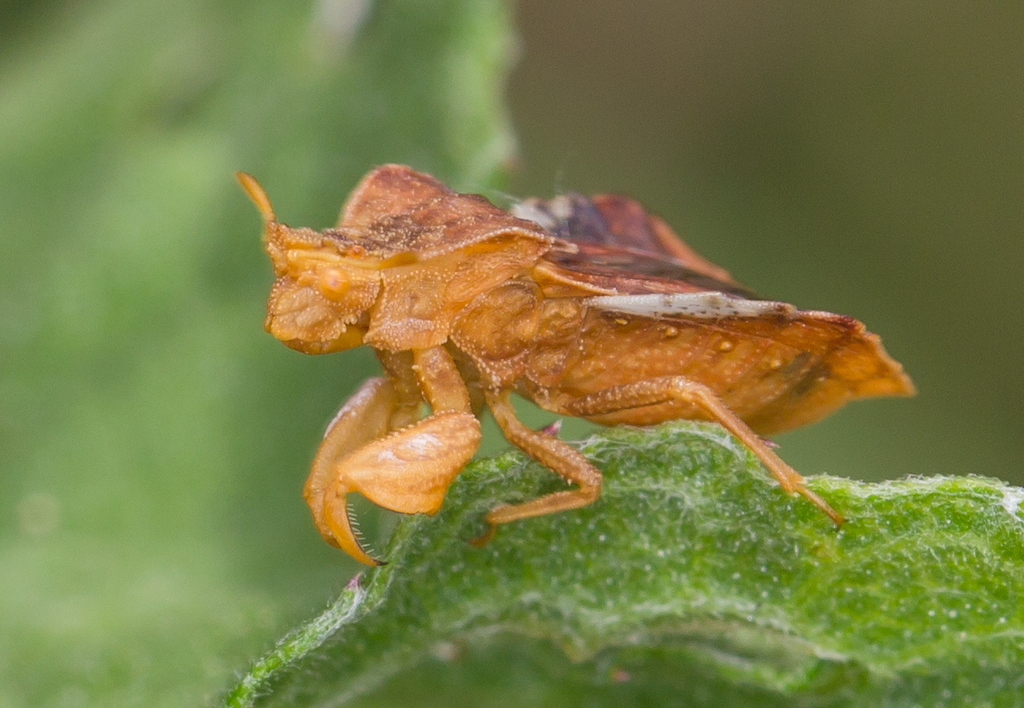
Phymata crassipes
Phymata crassipes is a species of assassin and thread-legged bugs belonging to the family Reduviidae, subfamily Phymatinae.
From the article Phymata crassipes on Wikipedia (CC BY-SA), quoted section by section
Description
Adults of Phymata crassipes can reach a length of about 7–9 mm. The body appear ornamented with some extrusions. Their triangular scutellum is shorter than a pronotum without prominent tubercles. They possess functional wings. They have clubbed antennae and enlarged fore femora and abdomen. The edge of the abdomen expands beyond the edges of the wings. Beautifully camouflaged, they capture their prey using their raptorial fore legs. The basic body color is dark reddish-brown in males, while females are lighter yellow-brown. Moreover, in the males the antennae terminate with a cylindrical joint, thicker and longer than all other segments, while the females antennae are terminated by a more clavate joint, not as long as the preceding ones. This species is rather similar to Phymata monstrosa, present in South West Europe, that shows small bumps on the femora of the median and hind legs.
Range & habitat
This species is widespread in the Palearctic realm. It can be found in the Mediterranean, North Africa, Central Europe eastward to Korea, north of China and Siberia. It is not present in the north-west of Europe and in the Britain Islands.
Wikipedia: “Distribution”
Listen
Looking for field recordings…
Where it lives
Recorded sightings
—
geo-referenced records in GBIF, from museums, herbaria and field observers.
Drag the globe to turn it. Dots are where records exist, not a range map; darker means more records.
In the stacks
Searching the stacks…
Every page naming Phymata crassipes in the Biodiversity Heritage Library →
This page is assembled live from iNaturalist, GBIF, Wikipedia, the Source Library and the Internet Archive. It is not yet part of the hand-edited codex. iNaturalist taxon 327207.