- Plants
- ›Vascular Plants
- ›flowering plants
- ›Dicots
- ›Mints, Plantains, Olives, and Allies
- ›Mint Family
- ›Nepetoideae
- ›Mentheae
- ›balms, mints, and thymes
- ›Mentha
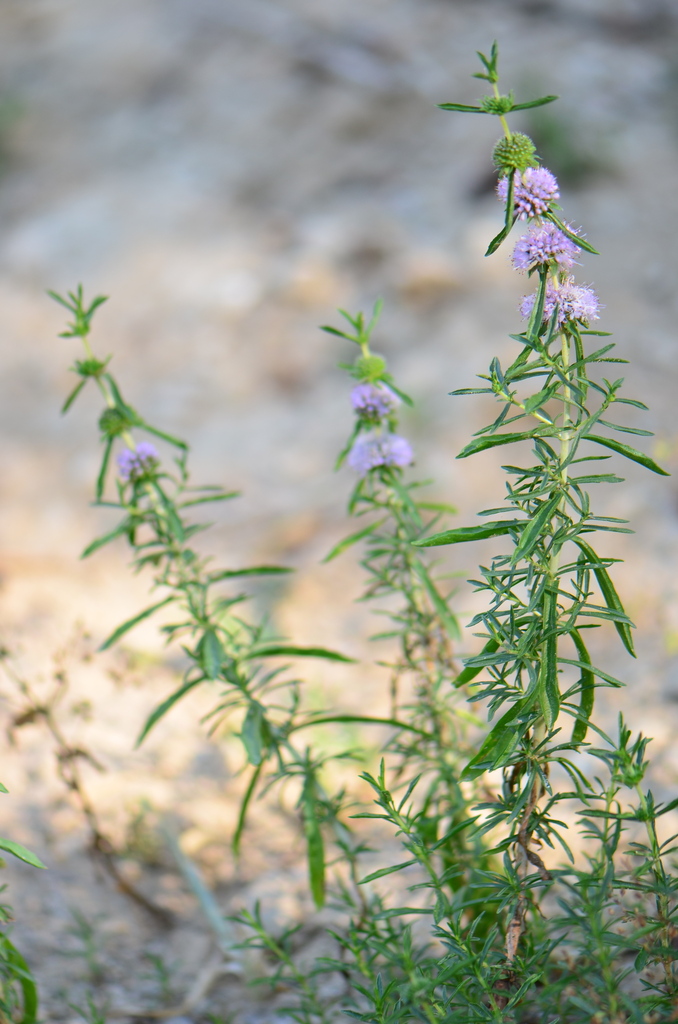
Hart's Pennyroyal
Mentha cervina
Mentha cervina, commonly known as hart's pennyroyal, is a perennial herbaceous plant of the Mentha (mint) genus. It is native to the western Mediterranean Sea region, growing naturally from southwestern France to the Iberian Peninsula, and south to Azores, Morocco and Algeria. Its common name reflects a traditional association with the separate species Mentha pulegium or pennyroyal. The plants were associated due to their shared high pulegone content, which gives them both a distinctive, strong aroma.
A sprawling herb growing up to 30 cm tall, Mentha cervina has been used both whole and as its essential oil in a variety of culinary and traditional medical contexts. More recently, research has examined its constituent chemicals' potential antioxidant, antibacterial and antifungal abilities.
From the article Mentha cervina on Wikipedia (CC BY-SA), quoted section by section
Description
Sources differ whether Mentha cervina grows from 30 centimeters tall or to as much as two feet tall. The plant has slender, lance-shaped aromatic leaves. Its bracts are palmate, with stamina longer than the corolla. It produces pale blue to lilac flowers in large, dense, many-flowered whorls. The plant produces few seeds, so most reproduction is done vegetatively by rhizome. Mentha cervina can be distinguished from other species within the genus Mentha by several traits. Its bractales are digitately lobed, as distinct from other Mentha species which are simple. Whereas most Mentha species have five calyx lobes, Mentha cervina has only four. Most Mentha species have calyx lobes with an acute apex, but Mentha cervina has whitish apical spines on each lobe instead, a trait it shares only with Mentha gattefossei. Mentha cervina may also be distinguished by its fine and small leaves. Phylogenetic studies have determined the plant to have diploid chromosomes. Two different surveys in the 1970s found that Mentha cervina had a gametic chromosome count of 2n = 36. Chambers & Hummer's analysis of the Mentha collection of the USDA concurred with this count. Tucker & Naczi's 2006 work on the other hand suggested a count of 2n = 26. …
Range & habitat
Mentha cervina's contemporary distribution is confined to the western Mediterranean Sea, in the countries of Portugal, Spain, Morocco, Algeria and six southwestern departments of France. It occupies a range of damp land to water (up to 60 cm deep), and overwinters underwater in its native habitat. It is recognized as a central component of the Menthion cervinae alliance. According to the International Union for Conservation of Nature, it is suffering "severe and rapid declines throughout its range" and is therefore assessed as a Near Threatened species on its IUCN Red List. Its risk is considered particularly high due to its limited original habitat range. Its historical range within the Mediterranean was wider, extending to Italy and into Switzerland. Johann Trommsdorff reported wild Swiss populations in 1809. Antoine Gouan likewise mentioned its presence among the mountain lakes of Le Grammont, in the canton of Valais. François-Joseph Cazin described it previously as growing in the Provence region of France. Today, it is confined to only a few areas of that region, in the departments of Bouches-du-Rhône and Vaucluse. It is presumed to be fully extinct in the wild throughout Italy. Within the Iberian Peninsula, M. cervina formerly was recorded in locations such as Benavente, Valdemorillo and Atienza in Spain, and Peso da Régua in Portugal, where it is no longer extant. …
Wikipedia: “Distribution”
Where it lives
Recorded sightings
—
geo-referenced records in GBIF, from museums, herbaria and field observers.
Drag the globe to turn it. Dots are where records exist, not a range map; darker means more records.
In the stacks
Searching the stacks…
Every page naming Mentha cervina in the Biodiversity Heritage Library →
This page is assembled live from iNaturalist, GBIF, Wikipedia, the Source Library and the Internet Archive. It is not yet part of the hand-edited codex. iNaturalist taxon 326747.