- Animals
- ›Arthropods
- ›Hexapods
- ›Insects
- ›Winged and Once-winged Insects
- ›Butterflies and Moths
- ›Owlet Moths and Allies
- ›Underwing, Tiger, Tussock, and Allied Moths
- ›Tiger Moths and Allies
- ›Tiger Moths
- ›Spilosomina
- ›Spilosoma
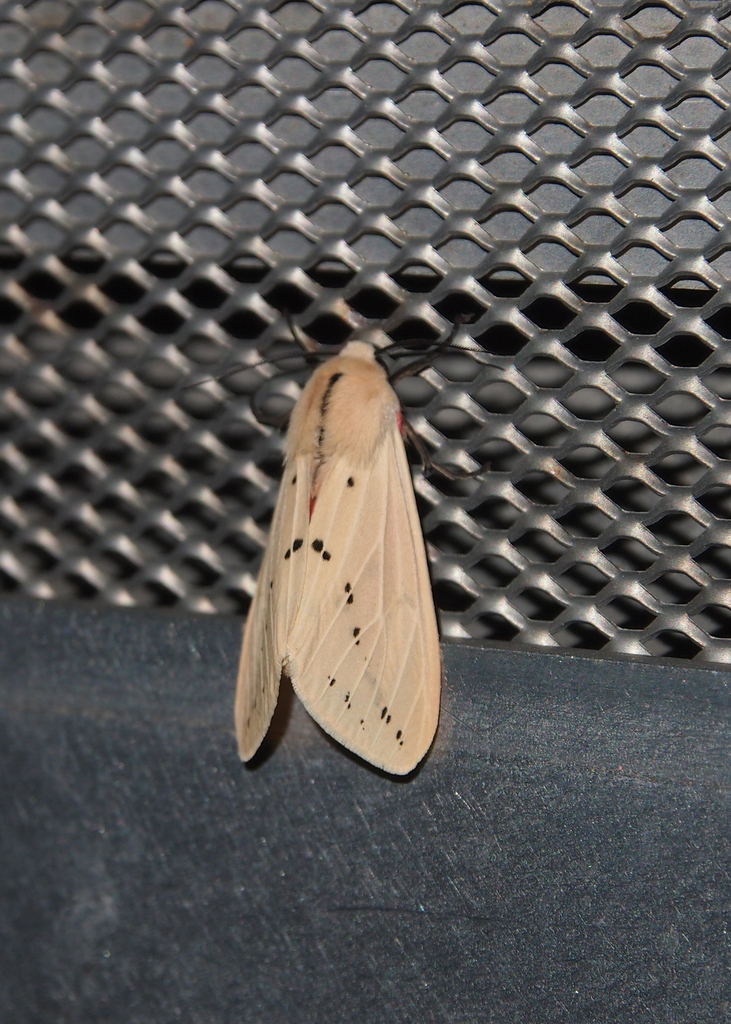
Jute Hairy Caterpillar Moth
Spilosoma obliqua
Spilosoma obliqua, the jute hairy caterpillar or Bihar hairy caterpillar, is a moth of the family Erebidae. It is found in south-eastern Afghanistan, northern Pakistan, India, Bhutan, Bangladesh and Myanmar.
From the article Spilosoma obliqua on Wikipedia (CC BY-SA), quoted section by section
Description
The caterpillar has a black head, tufts of black hairs behind this, and similar tufts of yellow hairs on the remaining portion. The adult wingspan is about 23 mm (0.9 in). The wings are a pale brown colour with a pattern of small black specks, and the abdomen is red.
What it does
Each female lays up to 1000 eggs on the undersides of leaves in several batches. When these hatch, the larvae at first scrape the under surface of the leaf, but as they grow they feed on the edges of the leaves, giving these a net-like appearance. When sufficiently numerous, they may defoliate the plant. There are a number of natural enemies of these caterpillars, and in the jute crop in India, the braconid wasp Protapanteles obliquae is one of these. The wasp lays its eggs in the first instar caterpillar. By the second or third instar, the wasp larvae are fully grown and thrust their way out through the caterpillar's ventral surface, forming small, woolly, white chrysalises. By this time, the caterpillar is moribund or dead.
Wikipedia: “Ecology”
Listen
Looking for field recordings…
Where it lives
Recorded sightings
—
geo-referenced records in GBIF, from museums, herbaria and field observers.
Drag the globe to turn it. Dots are where records exist, not a range map; darker means more records.
In the stacks
Searching the stacks…
Every page naming Spilosoma obliqua in the Biodiversity Heritage Library →
This page is assembled live from iNaturalist, GBIF, Wikipedia, the Source Library and the Internet Archive. It is not yet part of the hand-edited codex. iNaturalist taxon 326321.