- Animals
- ›Arthropods
- ›Hexapods
- ›Insects
- ›Winged and Once-winged Insects
- ›Butterflies and Moths
- ›Geometrid and Swallowtail Moths
- ›Geometer Moths
- ›Waves and Mochas
- ›Scopulini
- ›Scopula
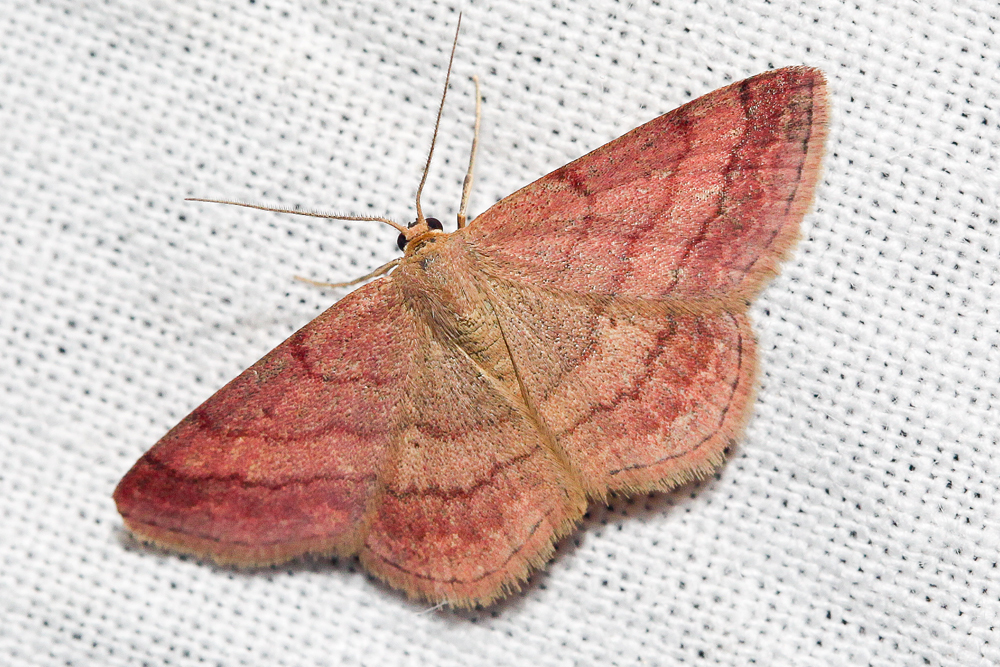
Tawny Wave
Scopula rubiginata
Scopula rubiginata, the tawny wave, is a moth of the family Geometridae. It is found from the Iberian Peninsula up to the Ural. In the North its range extends to Denmark and Southern Sweden and Finland. It is not present in most of the southern part of the Iberian Peninsula (with the exception of Gibraltar), Sicily and the southern Greek islands. In Morocco it is found in the Atlas mountains. Furthermore, it is also present in...
From the article Scopula rubiginata on Wikipedia (CC BY-SA), quoted section by section
Description
Scopula rubiginata has a wingspan of 16–22 mm. These moths are rather small in size in comparison to other geometrids. They present a rather high variability in basic color and drawings. The basic color depends on the humidity. As a matter of fact wings may be tawny, pale brown, violet-reddish, greyish or straw-coloured, with darker brown or darker reddish, transverse and slightly wavy markings (hence the common name of the species) on the upper sides. The inner transverse line is missing on the hind wings. Similar markings are present on the under sides. The apex of the forewings is rounded. The hindwing margin is uniform, almost round. The fringes are paler than the basic color. The eggs are approximately cylindrical. The surface is covered with 16 distinct longitudinal ribs. The caterpillars are relatively slender and a bit thicker towards the rear end. The color is variable, ranging from yellowish, brownish, slightly reddish to gray. The ventral side is greenish. The back shows a relatively thin line, but darker than the basic color, The head is relatively small, roundish and slightly reddish. The pupa is brown, with fine bristles. This species is quite similar to Idaea ochrata, but this last species shows a dented hindwing margin.
Range & habitat
This species is present from the Iberian Peninsula up to the Ural. In the North its range extends to Denmark and Southern Sweden and Finland. It is not present in most of the southern part of the Iberian Peninsula (with the exception of Gibraltar), Sicily and the southern Greek islands. In Morocco it is found in the Atlas mountains. Furthermore, it is also present in North Turkey, the Caucasus and the Crimea. Eastwards, its range stretches through southern Siberia, the northern central Asian mountains up to Mongolia. These moths preferably inhabit sandy terrain, such as sand dunes dry-warm environment, grasslands and heath, at an elevation up to 1,000 metres (3,300 ft) above sea level.
Wikipedia: “Distribution and habitat”
In human culture
The Latin species name rubiginata means "rusty", with reference to the coloration of the wings.
Wikipedia: “Etymology”
Listen
Looking for field recordings…
Where it lives
Recorded sightings
—
geo-referenced records in GBIF, from museums, herbaria and field observers.
Drag the globe to turn it. Dots are where records exist, not a range map; darker means more records.
In the stacks
Searching the stacks…
Every page naming Scopula rubiginata in the Biodiversity Heritage Library →
This page is assembled live from iNaturalist, GBIF, Wikipedia, the Source Library and the Internet Archive. It is not yet part of the hand-edited codex. iNaturalist taxon 324393.