- Animals
- ›Arthropods
- ›Hexapods
- ›Insects
- ›Winged and Once-winged Insects
- ›Butterflies and Moths
- ›Butterflies
- ›Brush-footed Butterflies
- ›Checkerspots, Anglewings, Peacocks, and Allies
- ›Ladies, Anglewings, and Allies
- ›Nymphalis
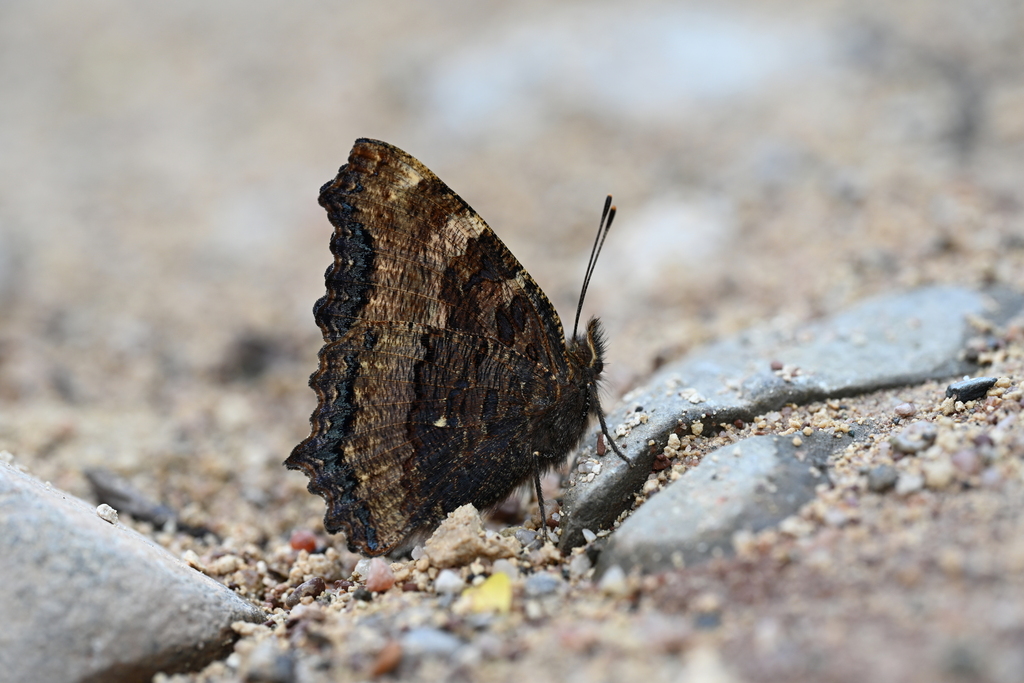
Large Tortoiseshell
Nymphalis polychloros
The large tortoiseshell or blackleg tortoiseshell (Nymphalis polychloros) is a butterfly of the family Nymphalidae.
From the article Large tortoiseshell on Wikipedia (CC BY-SA), quoted section by section
Description
Nymphalis polychloros has a wingspan of 68–72 millimetres (2.7–2.8 in) in males, of 72–75 millimetres (2.8–3.0 in) in females. These medium to large butterflies have orange to red wings with black and yellow patches. Both wings with yellowish submarginal lunules, upon which follows a black band which is likewise composed of lunules and bears on the hindwing small blue spots. The underside of the wings is smoky brown with darker shades and black transverse pencilling. There is no sexual dimorphism. This species looks very similar to the small tortoiseshell (Aglais urticae), but it is more closely related to the Camberwell beauty and Nymphalis xanthomelas It differs from the small tortoiseshell by its larger size (45–62 mm. wingspan in Aglais urticae) and by the more orange ground colour of the upper surface of its wings and the orange base of its hindwings. The forewing is orange-brown, with 3 costal black blotches, 3 large black spots in the disc posteriorly and a narrow blackish terminal band – less bright than those of A. urticae, and lacking the apical white spot and the marginal blue dots of that species. Compared to the yellow-legged tortoiseshell it has yellower interspaces between the black blotches on the costal edges of its forewings and the dark marginal band is narrower. …
Range & habitat
The species is found in North Africa, southern and central Europe, Turkey, southern Russia, the central and southern Urals, Kazakhstan and the Himalayas. In Central Europe it occurs mainly in warmer regions and has become generally rare, while populations remain more numerous in parts of the Mediterranean region and the southern Alps. Large tortoiseshells inhabit open woodland, woodland edges and clearings, as well as orchards, hedgerows and areas of scattered trees. The larvae feed on a variety of deciduous trees including elm, poplar, willow and related species, while adults are often found basking on tree trunks or feeding on sap runs, overripe fruit and honeydew. The species also occurs in Great Britain, where it has recently begun to re-establish itself following a prolonged absence.
Re-establishment in Britain. The large tortoiseshell was formerly widespread throughout England and Wales, but declined during the nineteenth century and disappeared as a resident species by the mid-twentieth century. For many decades it was therefore regarded as extinct in Britain. The species began to reappear in southern England in the early twenty-first century, with notable influxes recorded in 2006 and 2007. …
Wikipedia: “Distribution and habitat”
In human culture
The large tortoiseshell is featured in Eon Productions' James Bond film On Her Majesty's Secret Service. While visiting M (evidently an amateur lepidopterist) in the study at his country home, Bond remarks over M's shoulder on the small size of a Nymphalis polychloros specimen, to M's surprise at his knowledge of lepidoptery, and perhaps his skill in not misidentifying the specimen as the smaller and more common small tortoiseshell (Aglais urticae). However, N. polychloros is not the specimen that M is handling during the exchange, though there is what appears to be a N. polychloros on the microscope slide mounted nearby.
Wikipedia: “In popular culture”
Listen
Looking for field recordings…
Where it lives
Recorded sightings
—
geo-referenced records in GBIF, from museums, herbaria and field observers.
Drag the globe to turn it. Dots are where records exist, not a range map; darker means more records.
In the stacks
Searching the stacks…
Every page naming Nymphalis polychloros in the Biodiversity Heritage Library →
This page is assembled live from iNaturalist, GBIF, Wikipedia, the Source Library and the Internet Archive. It is not yet part of the hand-edited codex. iNaturalist taxon 324088.