- Plants
- ›Vascular Plants
- ›flowering plants
- ›Dicots
- ›Guinea-flowers and allies
- ›Guinea-flower family
- ›Hibbertia
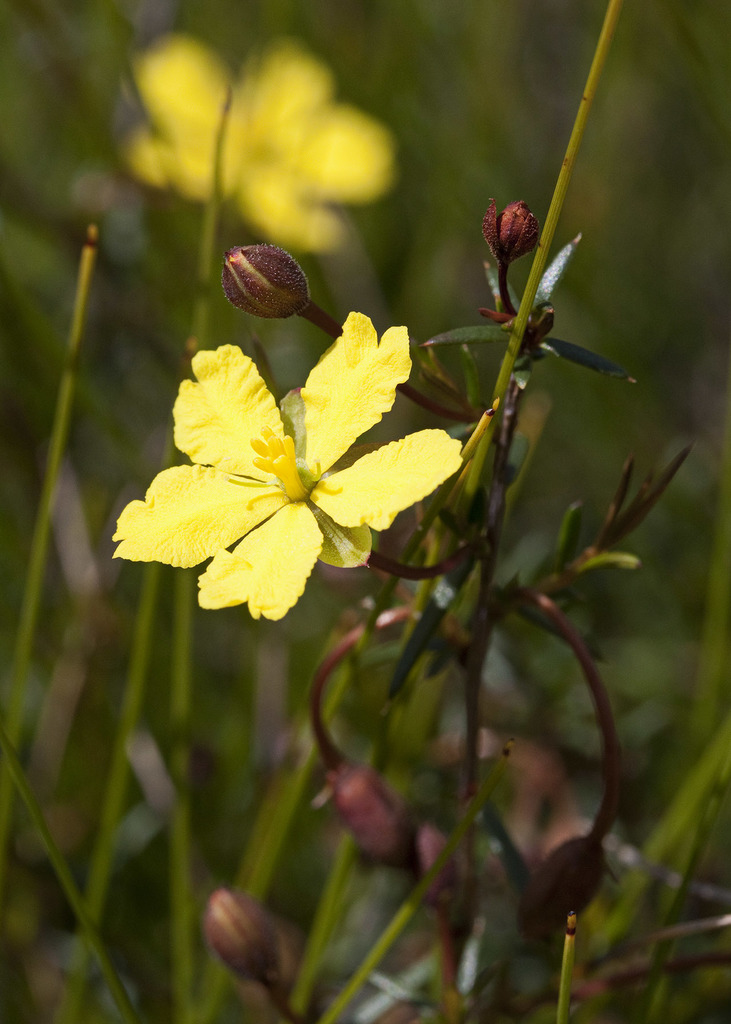
Prickly guinea flower
Hibbertia acicularis
Hibbertia acicularis, commonly known as prickly guinea-flower, is a species of flowering plant in the family Dilleniaceae and is endemic to eastern Australia. It is an erect or prostrate shrub with linear to lance-shaped leaves and yellow flowers arranged singly in leaf axils with the six to eight stamens joined at the base, in a single cluster.
From the article Hibbertia acicularis on Wikipedia (CC BY-SA), quoted section by section
Description
Hibbertia acicularis is an erect to prostrate, openly-branched shrub that typically grows to a height of up to 1 m (3 ft 3 in). The leaves are linear to lance-shaped with an awned tip, mostly 7–9 mm (0.28–0.35 in) long and 0.6–0.7 mm (0.024–0.028 in) wide on a petiole 0.2–0.5 mm (0.0079–0.0197 in) long. The flowers are arranged singly in leaf axils on a thread-like peduncle 2–10 mm (0.079–0.394 in) long with a narrow egg-shaped bract. The sepals are 3.8–6 mm (0.15–0.24 in) long but of unequal lengths. The petals are yellow, 3.9–5 mm (0.15–0.20 in) long and egg-shaped with the narrower end towards the base. The six to eight stamens are joined at the base in a single cluster, all on one side of the two carpels. The carpels are velvety to woolly hairy and there are usually two ovules per carpel. Flowering occurs from September to December.
Range & habitat
Hibbertia acicularis grows in heath, woodland and forest in south-eastern Queensland, the coast and tablelands of New South Wales, east of Port Phillip Bay in Victoria, and in Tasmania.
Wikipedia: “Distribution and habitat”
Where it lives
Recorded sightings
—
geo-referenced records in GBIF, from museums, herbaria and field observers.
Drag the globe to turn it. Dots are where records exist, not a range map; darker means more records.
In the stacks
Searching the stacks…
Every page naming Hibbertia acicularis in the Biodiversity Heritage Library →
This page is assembled live from iNaturalist, GBIF, Wikipedia, the Source Library and the Internet Archive. It is not yet part of the hand-edited codex. iNaturalist taxon 323882.