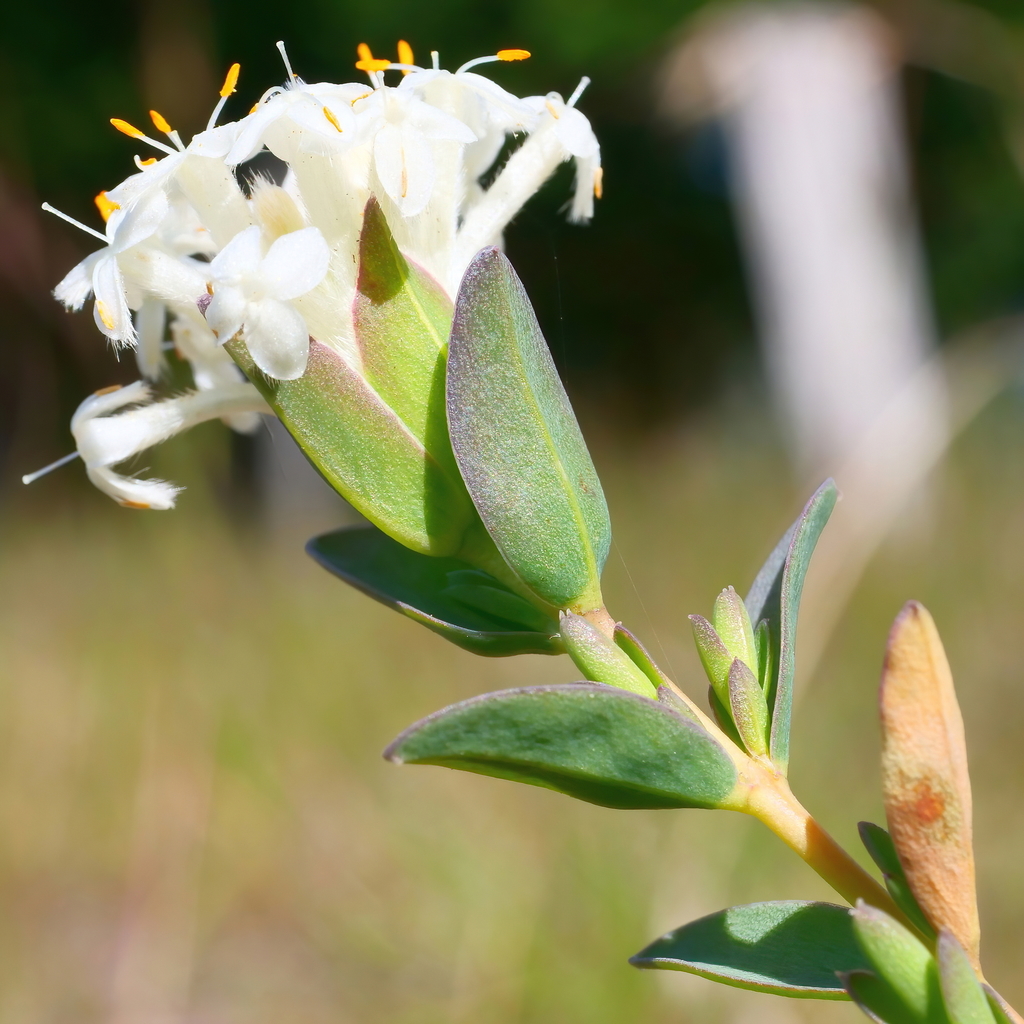
smooth riceflower
Pimelea glauca
Pimelea glauca, commonly known as smooth riceflower, is a species of flowering plant in the family Thymelaeaceae and is endemic to eastern Australia. It has elliptic to more or less lance-shaped or linear leaves and creamy-white flowers arranged in heads of seven or more on the ends of the stems, with four lance-shaped to egg-shaped bracts at the base of the inflorescence.
From the article Pimelea glauca on Wikipedia (CC BY-SA), quoted section by section
Description
Pimelea glauca is a much-branched shrub that typically grows to a height of up to 1 m (3 ft 3 in) and has glabrous stems. The leaves are narrowly elliptic to lance-shaped or linear, 3–15 mm (0.12–0.59 in) long and 1–6 mm (0.039–0.236 in) wide ending with a short, downward curving, sharp point. The inflorescence consists of 7 to 35 creamy-white tube-shaped flowers 8–14 mm (0.31–0.55 in) long arranged in dense clusters at the ends of the branches. The clusters are surrounded by 4 lance-shaped to egg-shaped involucral bracts 6–16 mm (0.24–0.63 in) long and 2–8 mm (0.079–0.315 in) wide. The bracts are smooth on the outside, hairy on the inside and have fringed edges. Flowering mainly occurs from August to December and the fruit is about 4 mm (0.16 in) long. The plant is toxic to livestock.
Range & habitat
Smooth riceflower grows in open forest, grassland, coastal heath and on dunes, in sandy soil. It is found in Queensland, New South Wales, the Australian Capital Territory, Victoria, South Australia and Tasmania. It is widespread in N.S.W., the A.C.T., Victoria and Tasmania. In South Australia it occurs in the south-east of the state, including on the Eyre and Yorke Peninsulas, and on Kangaroo Island.
Wikipedia: “Distribution and habitat”
Where it lives
Recorded sightings
—
geo-referenced records in GBIF, from museums, herbaria and field observers.
Drag the globe to turn it. Dots are where records exist, not a range map; darker means more records.
In the stacks
Searching the stacks…
Every page naming Pimelea glauca in the Biodiversity Heritage Library →
This page is assembled live from iNaturalist, GBIF, Wikipedia, the Source Library and the Internet Archive. It is not yet part of the hand-edited codex. iNaturalist taxon 323852.