- Animals
- ›Arthropods
- ›Hexapods
- ›Insects
- ›Winged and Once-winged Insects
- ›Dragonflies and Damselflies
- ›Damselflies
- ›Coenagrionoid Damselflies
- ›Narrow-winged Damselflies
- ›Ischnura
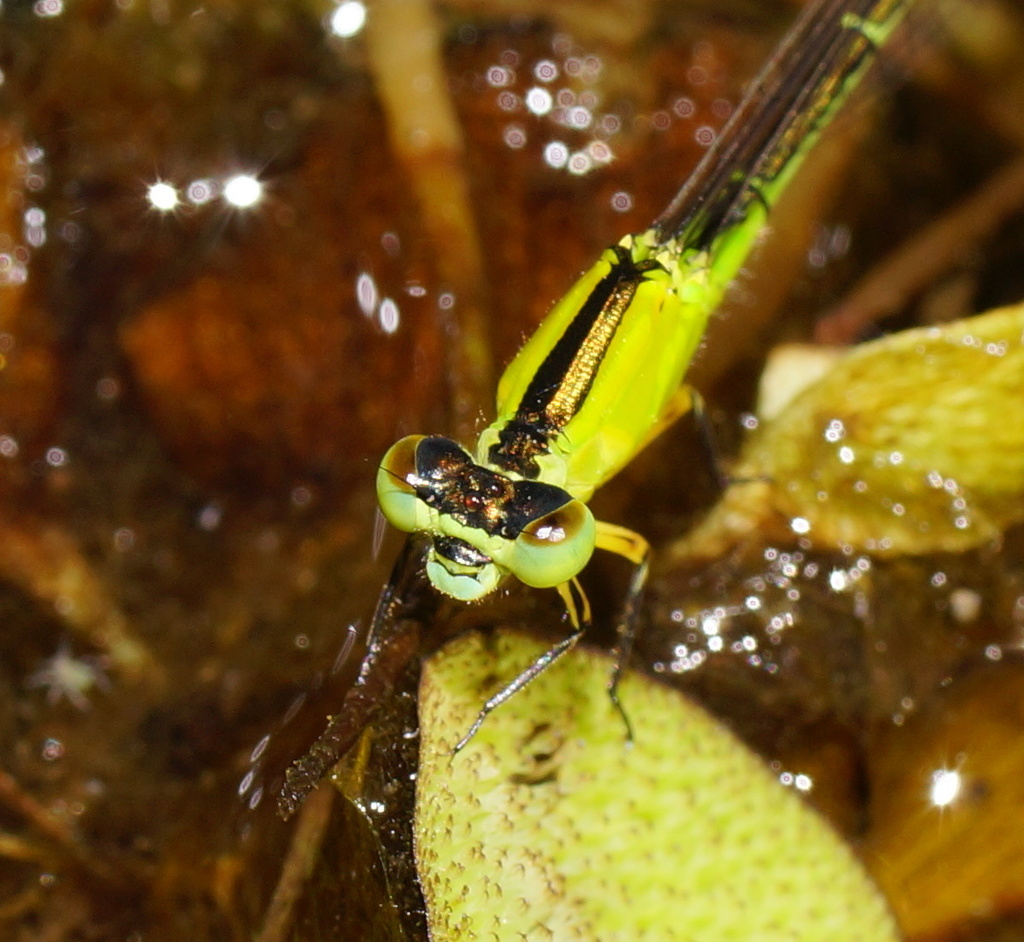
colourful bluetail
Ischnura pruinescens
Ischnura pruinescens is a damselfly in the family Coenagrionidae,
commonly known as the colourful bluetail. The taxon has been assessed for the IUCN Red List as being of least concern and is listed in the Catalogue of Life.
From the article Ischnura pruinescens on Wikipedia (CC BY-SA), quoted section by section
Description
Ischnura pruinescens is a small to medium-sized damselfly with a wing span around 35 to 50mm. Adult males have a pruinose coating on the synthorax and some of the abdomen. The females have bright yellow or orange on the synthorax and legs, pale green under the abdomen, and blue markings on segments eight and nine.
Range & habitat
It is found in Australia and New Guinea. The Australian distribution covers the north-eastern segment of the continent, from the Gold Coast to Cape York Peninsula in Queensland and west to the tropical parts of the Northern Territory.
Wikipedia: “Distribution”
In human culture
The genus name Ischnura is derived from the Greek ἰσχνός (ischnos, "thin" or "slender") and οὐρά (oura, "tail"), referring to the slender abdomen of species in the genus. The species name pruinescens is Latin for "becoming frosty", referring to the bluish-grey bloom on the lower thorax and basal segments of the abdomen.
Wikipedia: “Etymology”
Listen
Looking for field recordings…
Where it lives
Recorded sightings
—
geo-referenced records in GBIF, from museums, herbaria and field observers.
Drag the globe to turn it. Dots are where records exist, not a range map; darker means more records.
In the stacks
Searching the stacks…
Every page naming Ischnura pruinescens in the Biodiversity Heritage Library →
This page is assembled live from iNaturalist, GBIF, Wikipedia, the Source Library and the Internet Archive. It is not yet part of the hand-edited codex. iNaturalist taxon 323690.