- Plants
- ›Vascular Plants
- ›flowering plants
- ›Dicots
- ›Gentians, Dogbanes, Madders, and Allies
- ›madder family
- ›Rubioideae
- ›Anthospermeae
- ›Coprosminae
- ›Coprosma
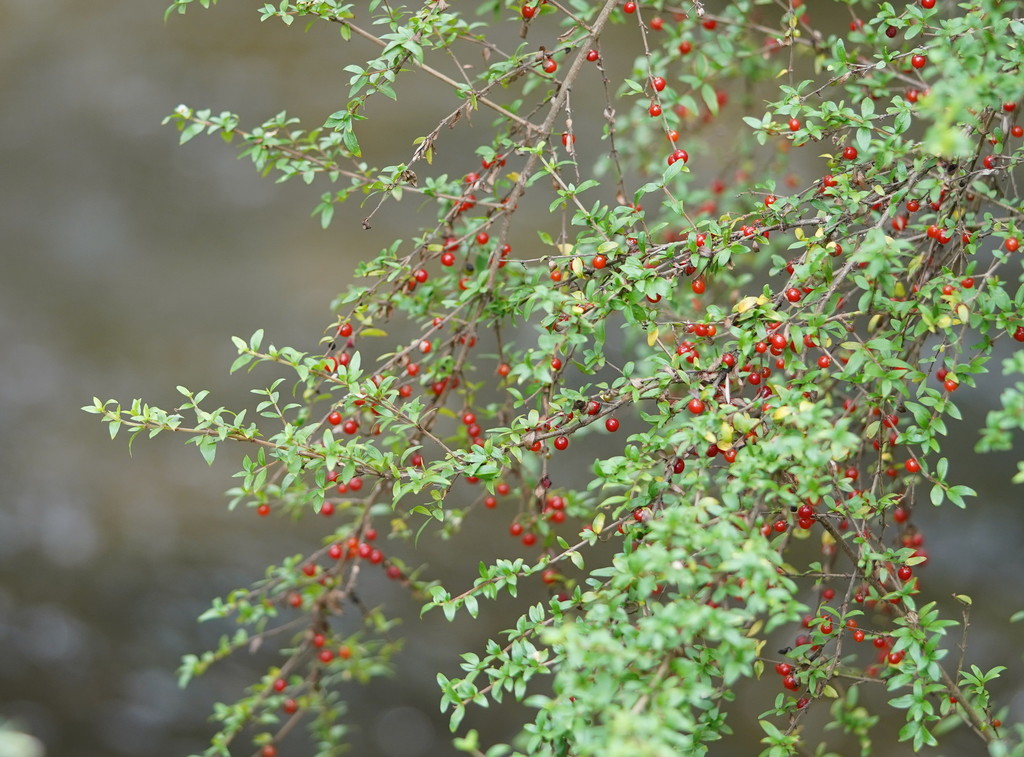
Prickly Currant-Bush
Coprosma quadrifida
Coprosma quadrifida is a dioecious shrub of the family Rubiaceae native to southeastern Australia. First described as Canthium quadrifidum by Labillardiere, it was given its current name by B. L. Robinson in 1910. Typically found at damp sites within woodlands, Eucalyptus forests or cool-temperate rainforests, it prefers sheltered slopes or sites near water sources. They are able to withstand frost and are salt tolerant. The species is also known as the Prickly Currant Bush.
From the article Coprosma quadrifida on Wikipedia (CC BY-SA), quoted section by section
Description
These plants are an erect open to dense shrub that can grow to between 2-5m tall. Seed germination can take over six months, with domestically used seed undergoing stratification to reduce germination to 2–4 weeks. Branches remain slender, often tapering to a spine at the point. Like other related species, such as Coprosma nitida, C. quadrifida also displays pubescent branchlets that are spine shaped.
Leaves. Leaves are of a dull green colouration and lanceolate, or broad ovate, shaped. They are small, typically 5-15mm long and 2-5mm wide. The leaves are also without hairs and display clear reticulate venation underneath. Leaf margins are typically flat or slightly recurved.
Flowers. Flowering occurs from August to January, with flowers of a greenish coloration. The flowers are sub-sessile, and unisexual, with male and female flowers occurring on separate plants. Flowers are often solitary and are terminal on short branchlets. Male flowers have a cup-shaped calyx and a funnel-shaped corolla. Female flowers have a deeply toothed calyx and a tubular corolla.
Fruit. Fruiting occurs in late summer or early autumn, typically January to March, and results in a drupe style fruit. The fruit is small and globular or egg shaped. It is glossy and ranges in colouration from orange to dark red. The fruit is crowned by the remanent calyx of the flower. …
Range & habitat
Individuals of this species have been found in all eastern states of Australia, but it is more common in the south-eastern states (Tasmania, Victoria and in southern New South Wales), due to the more temperate climate.
== References ==
Wikipedia: “Distribution”
Where it lives
Recorded sightings
—
geo-referenced records in GBIF, from museums, herbaria and field observers.
Drag the globe to turn it. Dots are where records exist, not a range map; darker means more records.
In the stacks
Searching the stacks…
Every page naming Coprosma quadrifida in the Biodiversity Heritage Library →
This page is assembled live from iNaturalist, GBIF, Wikipedia, the Source Library and the Internet Archive. It is not yet part of the hand-edited codex. iNaturalist taxon 323305.