- Plants
- ›Vascular Plants
- ›flowering plants
- ›Dicots
- ›Sunflowers, Bellflowers, Fanflowers, and Allies
- ›Sunflowers, Daisies, Asters, and Allies
- ›Asteroideae
- ›asters and allies
- ›Celmisiinae
- ›Olearia
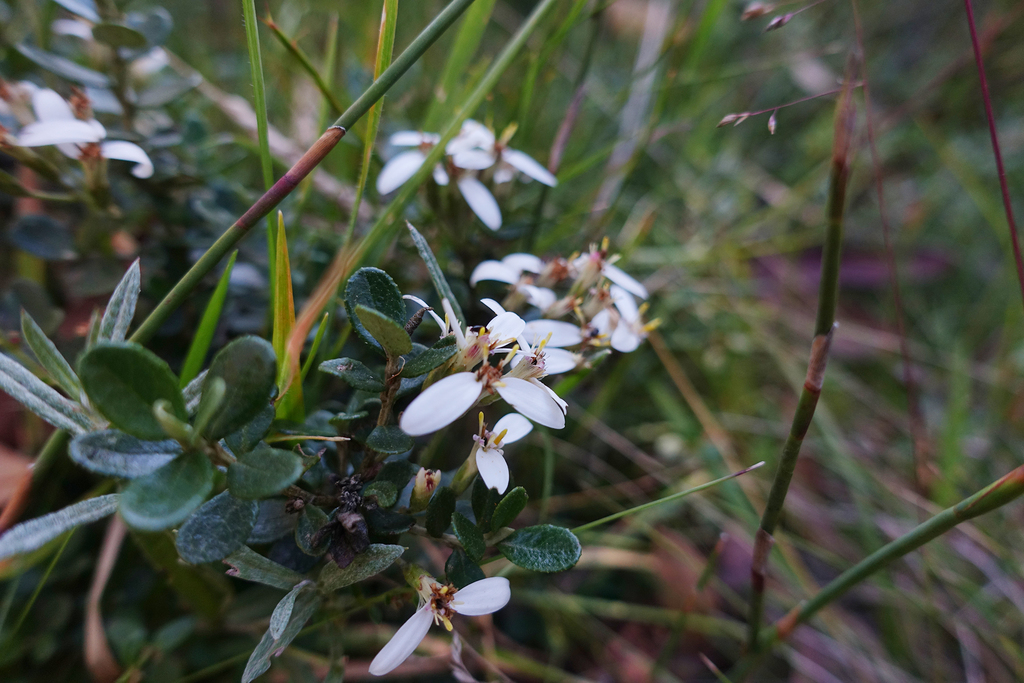
Silky Daisy-bush
Olearia myrsinoides
Olearia myrsinoides, commonly known as Silky Daisy-bush, is a species of flowering plant in the family Asteraceae. It is a shrub to 1.5 metres high with toothed leaves. These are dark green above and tomentose underneath. The flowerheads have 2 to 4 white ray florets and 3 to 4 pale yellow or violet disc florets. These appear between November and March in the species native range. The species was formally described in 1806 in Novae Hollandiae...
From the article Shawia myrsinoides on Wikipedia (CC BY-SA), quoted section by section
Description
Shawia myrsinoides is a spreading shrub that typically grows to a height of 0.8–1.5 m (2 ft 7 in – 4 ft 11 in), its branchlets covered with whitish hairs. The leaves are arranged alternately, egg-shaped with the narrower end towards the base, to elliptic, 4–30 mm (0.16–1.18 in) long and 3–22 mm (0.12–0.87 in) wide with toothed edges. The upper surface of the leaves is dark green and glabrous, the lower side covered with whitish hairs. The heads or daisy-like "flowers" are arranged in leafy panicles in leaf axils and on the ends of branches on a peduncle up to 32 mm (1.3 in) long. The heads are 13–21 mm (0.51–0.83 in) wide with a conical involucre 4–6 mm (0.16–0.24 in) long. Each head has two to four white ray florets, the ligule 6–8 mm (0.24–0.31 in) long, surrounding three or four yellow or mauve disc florets. Flowering occurs from March to November and the fruit is a glabrous achene, the pappus 5–8 mm (0.20–0.31 in) long.
Range & habitat
Shawia myrsinoides grows in forest, woodland, grassland, and swampy areas in eastern New South Wales, southern Victoria and Tasmania.
== References ==
Wikipedia: “Distribution and habitat”
Where it lives
Recorded sightings
—
geo-referenced records in GBIF, from museums, herbaria and field observers.
Drag the globe to turn it. Dots are where records exist, not a range map; darker means more records.
In the stacks
Searching the stacks…
Every page naming Olearia myrsinoides in the Biodiversity Heritage Library →
This page is assembled live from iNaturalist, GBIF, Wikipedia, the Source Library and the Internet Archive. It is not yet part of the hand-edited codex. iNaturalist taxon 323144.