- Plants
- ›Vascular Plants
- ›flowering plants
- ›Dicots
- ›myrtles, evening primroses, and allies
- ›myrtle family
- ›Myrtoideae
- ›Syzygieae
- ›Syzygium
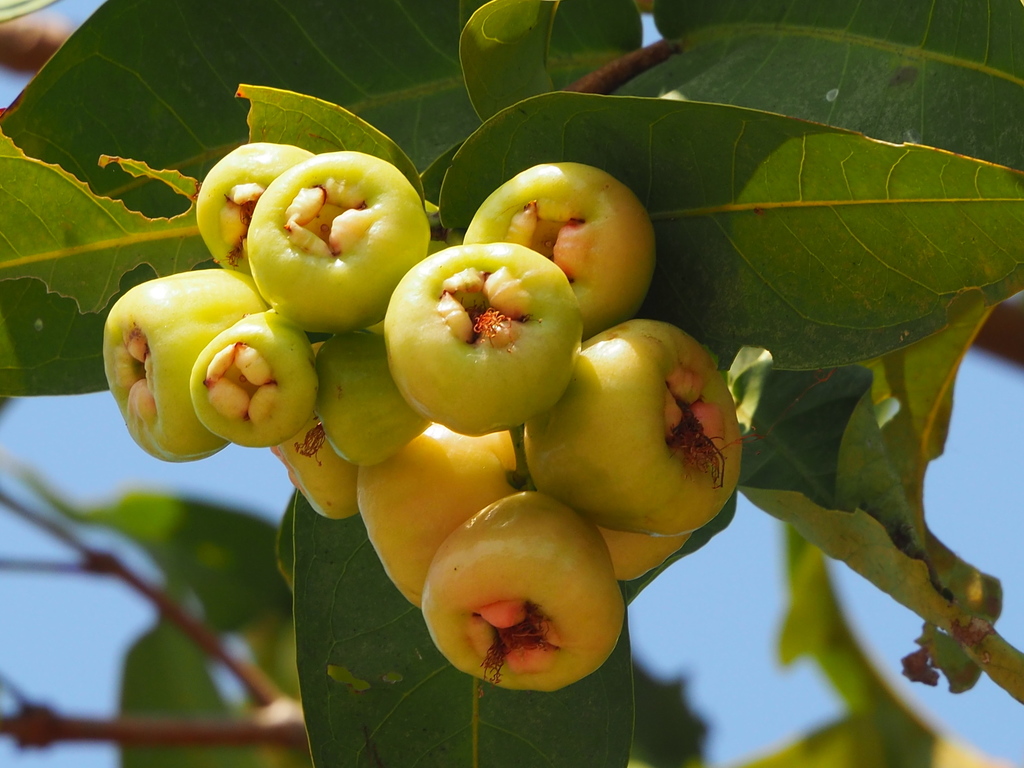
Wax Apple
Syzygium samarangense
Syzygium samarangense is a species of flowering plant in the family Myrtaceae, native to an area that includes the Greater Sunda Islands, Malay Peninsula, and the Andaman and Nicobar Islands, but introduced in prehistoric times to a wider area and now widely cultivated in the tropics. Common names in English include wax apple, Java apple, Semarang rose-apple, and wax jambu.
From the article Syzygium samarangense on Wikipedia (CC BY-SA), quoted section by section
Description
Syzygium samarangense is a tropical tree growing to 12 metres (39 feet) tall, with evergreen leaves 10–25 cm (4–10 in) long and 5–10 cm (2–4 in) broad. The leaves are elliptical, but rounded at the base; they are aromatic when crushed. The trunk is relatively short, with a wide – yet open – crown starting low on the tree. The bark is pinkish-gray in color, and flakes readily. The flowers are white to yellowish-white, 2.5 cm (1 in) diameter, with four petals and numerous stamens. They form in panicles of between three and 30 near branch tips. The resulting fruit is a bell-shaped, edible berry, with colors ranging from white, pale green, or green to red, purple, or crimson, to deep purple or even black. The fruit grows 4–6 cm (1.6–2.4 in) long in wild plants, and has four fleshy calyx lobes at the tip. The skin is thin, and the flesh is white and spongy. Each berry holds one or two rounded seeds not larger than .8 cm (0.3 in). The flowers and resulting fruit are not limited to the axils of the leaves, and can appear on nearly any point on the surface of the trunk and branches. When mature, the tree is considered a heavy bearer, yielding up to 700 fruits in a crop. When ripe, the fruit puff outwards, with a slight concavity in the middle of the underside of the "bell". Healthy wax apples have a light sheen to them. …
At the table
Several cultivars with larger fruit have been selected. In general, the paler or darker the color, the sweeter it is. In Southeast Asia, the black ones are nicknamed "Black Pearl" or "Black Diamond", while the very pale greenish-white ones, called "Pearl", are among the highest-priced ones in fruit markets. The fruit is often served uncut, but with the core removed, to preserve the unique bell-shaped presentation. In the Indian Ocean islands cuisine, the fruit is frequently used in salads, as well as in lightly sautéed dishes. It is mainly eaten as a fruit and also used to make pickles called chambakka achar. In the Philippines, its local name is macopa or makopa. Its precolonial name is dambo. Because of their similarity in appearance, it is often confused with tambis (Syzygium aqueum), although the latter is more commonly cultivated.
Wikipedia: “Culinary”
Where it lives
Recorded sightings
—
geo-referenced records in GBIF, from museums, herbaria and field observers.
Drag the globe to turn it. Dots are where records exist, not a range map; darker means more records.
In the stacks
Searching the stacks…
Every page naming Syzygium samarangense in the Biodiversity Heritage Library →
This page is assembled live from iNaturalist, GBIF, Wikipedia, the Source Library and the Internet Archive. It is not yet part of the hand-edited codex. iNaturalist taxon 322878.