- Animals
- ›Arthropods
- ›Hexapods
- ›Insects
- ›Winged and Once-winged Insects
- ›Butterflies and Moths
- ›Owlet Moths and Allies
- ›Cutworm Moths and Allies
- ›Cutworms and Dart Moths
- ›Phlogophorini
- ›Euplexia
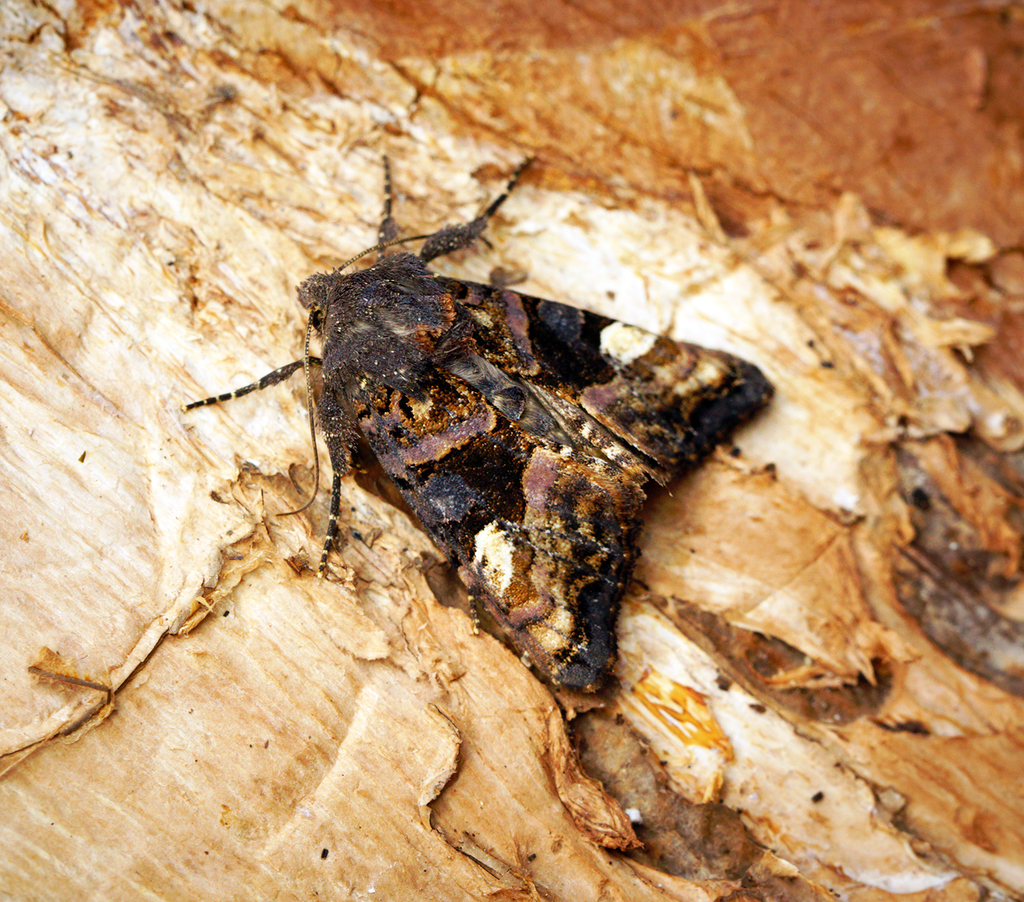
Small Angle Shades
Euplexia lucipara
The small angle shades (Euplexia lucipara) is a moth of the family Noctuidae. It is distributed throughout the Palearctic. The species was first described by Carl Linnaeus in his 1758 10th edition of Systema Naturae.
As the common name suggests, this species is closely related to the angle shades (Phlogophora meticulosa), and is considerably smaller (wingspan 30–35 mm), but does not especially resemble that species. The forewings are dark brown with a broad, pale subterminal band, wider and paler towards the costa. The hindwings are whitish at the base, graduating to brown at the margins. In the British Isles this species flies at night in June and July, with a second generation sometimes emerging in September. It is attracted to light and sugar.
From the article Small angle shades on Wikipedia (CC BY-SA), quoted section by section
Range & habitat
It is found throughout Europe, in Algeria, in western Asia and through the Palearctic to Siberia, China, and Japan.
Wikipedia: “Distribution”
Listen
Looking for field recordings…
Where it lives
Recorded sightings
—
geo-referenced records in GBIF, from museums, herbaria and field observers.
Drag the globe to turn it. Dots are where records exist, not a range map; darker means more records.
In the stacks
Searching the stacks…
Every page naming Euplexia lucipara in the Biodiversity Heritage Library →
This page is assembled live from iNaturalist, GBIF, Wikipedia, the Source Library and the Internet Archive. It is not yet part of the hand-edited codex. iNaturalist taxon 322807.