- Plants
- ›Vascular Plants
- ›flowering plants
- ›monocots
- ›Agaves, Orchids, Irises, and Allies
- ›agave and allies
- ›Century plant subfamily
- ›Chlorophytum
Spider plant
Chlorophytum comosum
Chlorophytum comosum, usually called spider plant or common spider plant due to its spider-like look, also known as spider ivy, airplane plant, ribbon plant (a name it shares with Dracaena sanderiana), and hen and chicks, is a species of evergreen perennial flowering plant of the family Asparagaceae. It is native to tropical and Southern Africa but has become naturalized in other parts of the world, including Western Australia and Bangladesh. Chlorophytum comosum is easy to grow as a houseplant because of its resilience, but it can be sensitive to the fluoride in tap water, which commonly gives it "burnt tips". Variegated forms are the most popular.
From the article Chlorophytum comosum on Wikipedia (CC BY-SA), quoted section by section
Description
Chlorophytum comosum grows to about 60 cm (24 in) tall, although as a hanging plant it can descend many feet. It has fleshy, tuberous roots, each about 5–10 cm (2–4 in) long. The long narrow leaves reach a length of 20–45 cm (8–18 in) and are around 6–25 millimetres (0.2–1.0 in) wide.
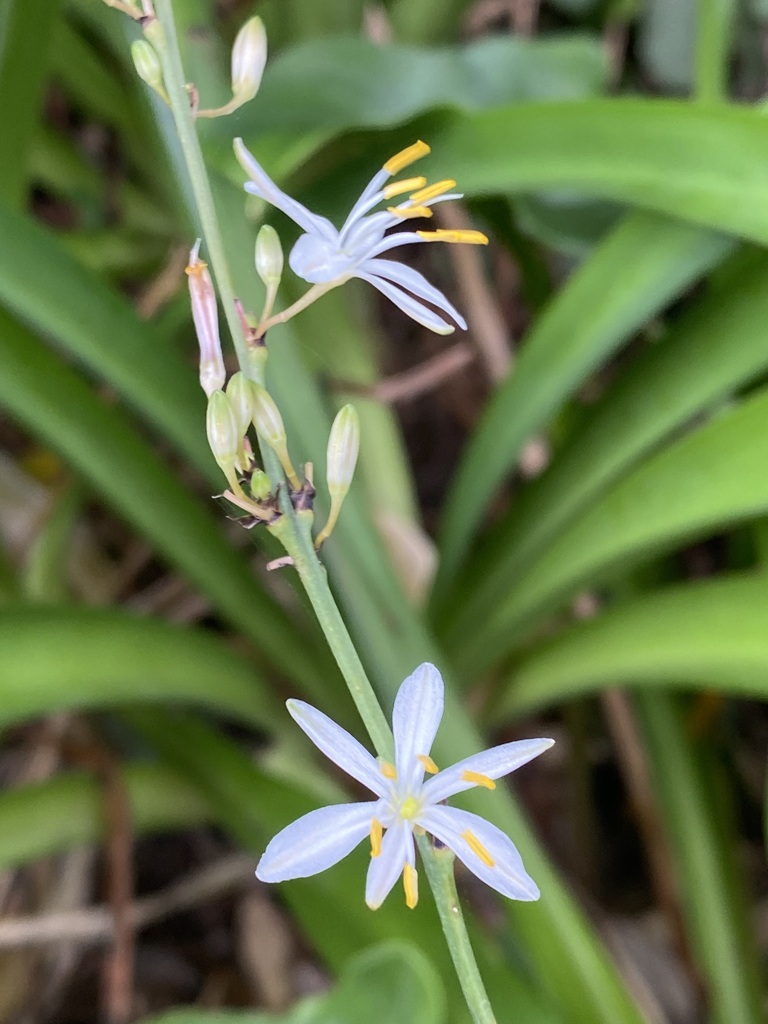
Flowers are produced in a long, branched inflorescence, which can reach a length of up to 75 cm (30 in) and eventually bends downward to meet the earth. Flowers initially occur in clusters of 1–6 at intervals along the stem (scape) of the inflorescence. Each cluster is at the base of a bract, which ranges from 2–8 cm (0.8–3.1 in) in length, becoming smaller toward the end of the inflorescence. Most of the flowers that are produced initially die off, so that relatively, the inflorescences are sparsely flowered. Individual flowers are greenish-white, borne on stalks (pedicels) some 4–8 mm (0.2–0.3 in) long. Each flower has six triply veined tepals that are 6–9 mm (0.2–0.4 in) long and slightly hooded or boat-shaped at their tips. The stamens consist of a pollen-producing anther about 3.5 mm (0.1 in) long with a filament of similar length or slightly longer. The central style is 3–8 mm (0.1–0.3 in) long. …
Range & habitat
Chlorophytum comosum has a widespread native distribution in Africa, being native to six of the ten World Geographical Scheme for Recording Plant Distributions regions of Africa (West Tropical Africa, West-Central Tropical Africa, Northeast Tropical Africa, East Tropical Africa, South Tropical Africa, and Southern Africa).
Wikipedia: “Distribution”
At the table
The tuberous roots are reportedly edible (whether raw or cooked unstated) although mild laxative effects are claimed by the Nguni people of its native South Africa.
Wikipedia: “Edibility”
How it is grown
Chlorophytum comosum is a popular houseplant. The cultivars with all-green leaves forms only a small proportion of plants sold. More common are two variegated cultivars:
C. comosum 'Vittatum' has mid-green leaves with a broad central white stripe. It is often sold in hanging baskets to display the plantlets. The long stems are white. There is also a "curly" version with this type of striping and compact size. C. comosum 'Variegatum' has darker green leaves with white margins. It is generally smaller than the previous cultivar. The long stems are green. Both cultivars have gained the Royal Horticultural Society's Award of Garden Merit (confirmed 2017). In 2021, 17 other cultivars were listed, including 'Bonnie', 'Green Bonnie' and 'Hawaiian'.
Propagation. Propagating Chlorophytum comosum commonly occurs through potting the plantlets, informally referred to as 'spiderettes', or 'pups', directly into potting soil, or pumice, attached to the main plant or cutting the running stems and then potting them. Spider plants are easy to grow, being able to thrive in a wide range of conditions. They will tolerate temperatures down to 2 °C (35 °F), but grow best at temperatures between 18 °C (65 °F) and 32 °C (90 °F). Plants can be damaged by high fluoride or boron levels.
Wikipedia: “Cultivation”
Where it lives
Recorded sightings
—
geo-referenced records in GBIF, from museums, herbaria and field observers.
Drag the globe to turn it. Dots are where records exist, not a range map; darker means more records.
In the old herbals & bestiaries

In the stacks
Searching the stacks…
Every page naming Chlorophytum comosum in the Biodiversity Heritage Library →
This page is assembled live from iNaturalist, GBIF, Wikipedia, the Source Library and the Internet Archive. It is not yet part of the hand-edited codex. iNaturalist taxon 322492.