- Plants
- ›Vascular Plants
- ›flowering plants
- ›monocots
- ›Agaves, Orchids, Irises, and Allies
- ›Orchids
- ›Orchidoid Orchids
- ›Diurideae
- ›Cryptostylidinae
- ›Cryptostylis
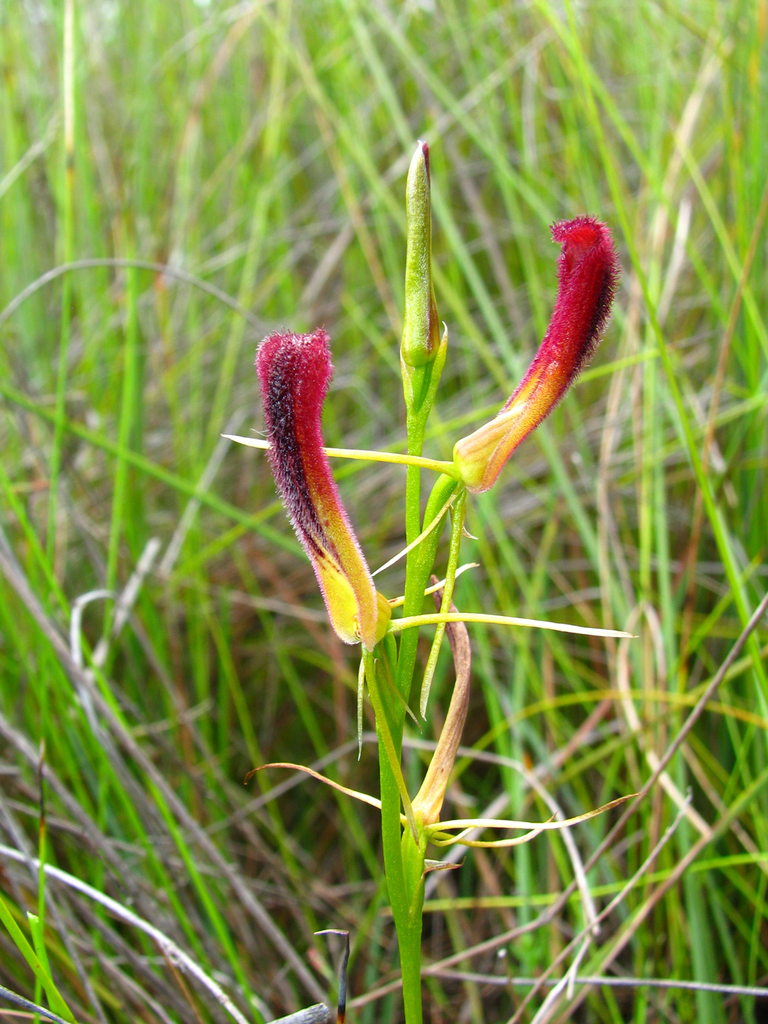
Leafless Tongue Orchid
Cryptostylis hunteriana
Cryptostylis hunteriana, commonly known as the leafless tongue-orchid is a flowering plant in the orchid family Orchidaceae and is endemic to south eastern Australia. It is leafless but has up to ten green flowers with a more or less erect, dark reddish brown labellum.
From the article Cryptostylis hunteriana on Wikipedia (CC BY-SA), quoted section by section
Description
Cryptostylis hunteriana is a terrestrial, perennial, deciduous, saprophytic herb. Up to ten flowers 20–30 mm (0.79–1.2 in) long and 6–8 mm (0.2–0.3 in) wide are borne on a flowering stem 80–450 mm (3–20 in) high. The most prominent feature of the flower is its spatula-shaped labellum which is red or maroon with a green base, and is distinctly hairy. The labellum is 20–33 mm (0.8–1 in) long and 6–8 mm (0.2–0.3 in) wide with inrolled margins and a smooth underside. Thin green sepals measuring 15–22 mm (0.6–0.9 in) in length and about 1 mm (0.04 in) wide arise from its base. The petals are similar to the sepals but shorter and narrower. Flowering mainly occurs from December to February.
Range & habitat
The leafless tongue-orchid grows singly or in small colonies in a range of habitats including wet heath and sedgeland, on grasstree plains and in woodland with scribbly gum, silvertop ash, red bloodwood and black sheoak. It often grows near the other tongue-orchids C. subulata and C. erecta. The species is found in coastal areas and nearby ranges south from the Gibraltar Range National Park in New South Wales to East Gippsland between Marlo and Genoa in Victoria. In Queensland it has been recorded from the coast at Tin Can Bay to the Glass House Mountains.
Wikipedia: “Distribution and habitat”
What it does
Like other Australian members of its genus, C. hunteriana is pollinated by the ichneumon wasp known as the orchid dupe wasp (Lissopimpla excelsa), the males of which mistake the flower parts for female wasps and copulate with it. Unlike other members of the genus, it lacks a leaf and is instead thought to have a relationship with a fungus for its metabolism.
Wikipedia: “Ecology”
Where it lives
Recorded sightings
—
geo-referenced records in GBIF, from museums, herbaria and field observers.
Drag the globe to turn it. Dots are where records exist, not a range map; darker means more records.
In the stacks
Searching the stacks…
Every page naming Cryptostylis hunteriana in the Biodiversity Heritage Library →
This page is assembled live from iNaturalist, GBIF, Wikipedia, the Source Library and the Internet Archive. It is not yet part of the hand-edited codex. iNaturalist taxon 321109.