- Animals
- ›Arthropods
- ›Hexapods
- ›Insects
- ›Winged and Once-winged Insects
- ›Butterflies and Moths
- ›Butterflies
- ›Brush-footed Butterflies
- ›Checkerspots, Anglewings, Peacocks, and Allies
- ›Ladies, Anglewings, and Allies
- ›Nymphalis
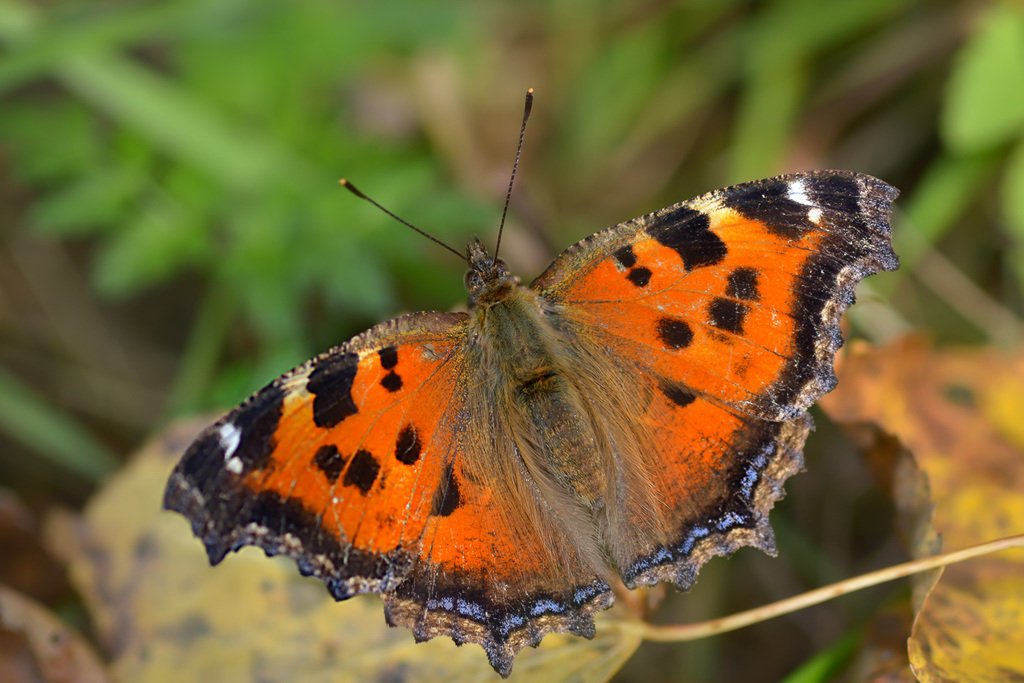
Scarce Tortoiseshell
Nymphalis xanthomelas
Nymphalis xanthomelas, the scarce tortoiseshell, is a species of nymphalid butterfly found in eastern Europe and Asia. This butterfly is also referred as yellow-legged tortoiseshell or large tortoiseshell (however, in Europe, "large tortoiseshell" is usually reserved for Nymphalis polychloros).
From the article Nymphalis xanthomelas on Wikipedia (CC BY-SA), quoted section by section
Description
Upperside rich orange yellow, forewing has costal margin dusky black on the basal half flecked with brown; two oval black spots in cell, a quadrate subcostal black patch just beyond the discocellulars, a second more oblique irregular black patch beyond this, and three large oval discal black spots, with a smaller dusky patch beyond the lowest spot. Hindwing uniform, with a large subcostal black patch. Forewings and hindwings with a common sinuous transverse subterminal black band, and a terminal dusky band flecked with golden brown; the black subterminal band on the hindwing with an outer border of blue lunules margined outwardly by a slender black line; the forewing just below the costa, between the black patches beyond the cell and between the outer black patch and subterminal band, prominently pale yellow. In the female, an incomplete series of yellow lunules also borders the subterminal black band on the outer side. Underside dull ochraceous brown, the basal half of both forewings and hindwings and a broad terminal margin darker brown; the wings entirely and thickly covered with slender transverse dark brown striae; irregular cell-marks on the forewing and a transverse highly sinuous subterminal band of dark blue lunules on both wings: these lunules defined by slender black lines on both sides. …
Range & habitat
Eastern Europe; the Himalayas from Kashmir to Mussoorie; China and Japan. In 1953, recorded by Christine Foord, British entomologist, at Shipbourne in Kent, Southeast England.
Wikipedia: “Distribution”
In human culture
"Larva. Cylindrical, slightly hairy. Head subquadrate, vertex sharply indented in front, slightly hairy, front and cheeks with several small pointed tubercles. Third to last segments armed with a dorsal row of short spines, and three lateral rows of long rigid branched spines. Colour dark pupurescent-brown, almost black, palest beneath; with two dorsal slender yellowish macular lines, and a single similar lateral line, the subdorsal and sublateral areas longitudinally speckled with numerous irregular-shaped yellow dots. Spines black; head black. Reared on willow." (Frederic Moore quoted in Bingham)
Larval host plants. Celtis australis Pistacia integerrima Salix elegans Salix excelsa
Wikipedia: “Life history”
Listen
Looking for field recordings…
Where it lives
Recorded sightings
—
geo-referenced records in GBIF, from museums, herbaria and field observers.
Drag the globe to turn it. Dots are where records exist, not a range map; darker means more records.
In the stacks
Searching the stacks…
Every page naming Nymphalis xanthomelas in the Biodiversity Heritage Library →
This page is assembled live from iNaturalist, GBIF, Wikipedia, the Source Library and the Internet Archive. It is not yet part of the hand-edited codex. iNaturalist taxon 321054.