Queen of the Bush
Pimelea linifolia
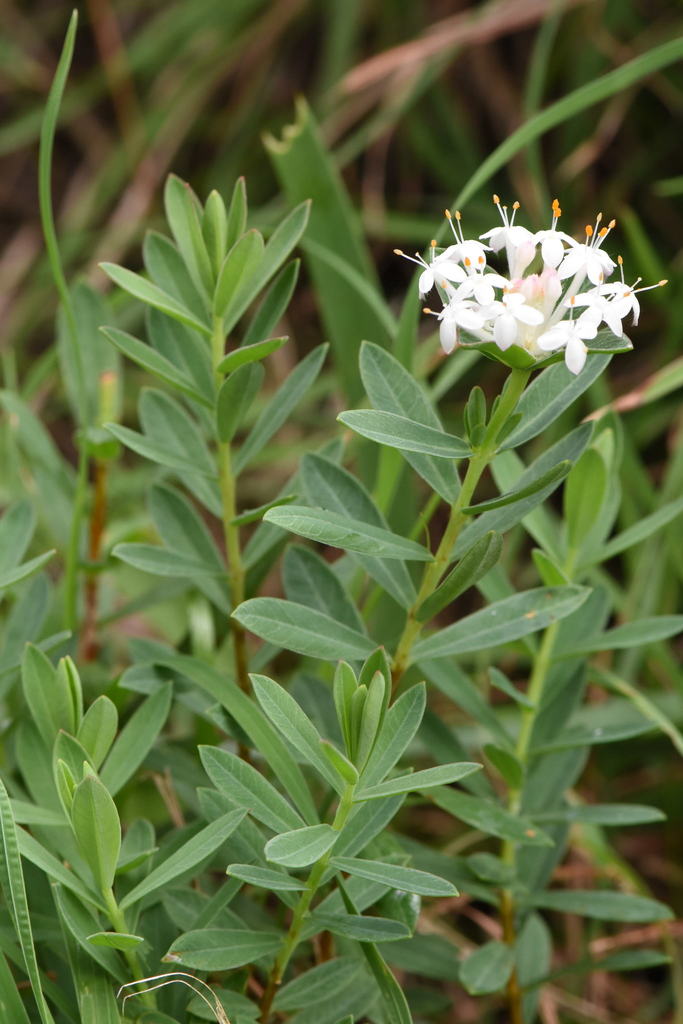
Pimelea linifolia, commonly known as slender rice flower is a common, variable shrub widespread throughout eastern Australia. It has narrow leaves arranged in opposite pairs, and usually white flowers arranged in heads of seven or more on the ends of the stems, with four lance-shaped bracts at the base of the inflorescence. The plant may be toxic to livestock.
From the article Pimelea linifolia on Wikipedia (CC BY-SA), quoted section by section
Description
Pimelea linifolia is a variable shrub, sometimes prostrate, sometimes growing to a height of 1.5 m (4 ft 11 in), with glabrous stems. The leaves are glabrous, narrow egg-shaped to elliptic, 3–40 mm (0.12–1.57 in) long and 1–9 mm (0.039–0.354 in) wide. The flowers are white, sometimes pink, mostly 10–20 mm (0.39–0.79 in) long. They are arranged in heads of between seven and sixty on the ends of the stems, with four, sometimes eight bracts at the base. Some flowers are bisexual and others are female, the female flowers shorter. The bracts are sessile, lance-shaped to egg-shaped, 7–17 mm (0.28–0.67 in) long and 3–11 mm (0.12–0.43 in) wide. The fruit is green and 3–5 mm (0.12–0.20 in) long.
Range & habitat
Slender rice flower is widespread and common in eastern Australia. It usually grows in wet forest, sometimes on the margin of rainforest. It occurs from north-east Queensland, through the eastern half of New South Wales, all but the far north-west of Victoria, the south-east of South Australia and throughout Tasmania.
Wikipedia: “Distribution and habitat”
What it does
This plant is suspected of being poisonous to sheep, but the evidence is inconclusive.
Wikipedia: “Ecology”
At the table
The bark of P. linifolia can be processed into fine strong thread for catching the bogong moth. This string, called a 'Bushman's bootlace', is produced by a traditional method that involves wetting, drying, beating and rolling the material.
== References ==
Wikipedia: “Uses”
Where it lives
Recorded sightings
—
geo-referenced records in GBIF, from museums, herbaria and field observers.
Drag the globe to turn it. Dots are where records exist, not a range map; darker means more records.
In the stacks
Searching the stacks…
Every page naming Pimelea linifolia in the Biodiversity Heritage Library →
This page is assembled live from iNaturalist, GBIF, Wikipedia, the Source Library and the Internet Archive. It is not yet part of the hand-edited codex. iNaturalist taxon 321037.