- Plants
- ›Vascular Plants
- ›flowering plants
- ›Dicots
- ›proteas, lotuses, planes, and allies
- ›Protea family
- ›Singlet Proteas
- ›Nutseed Proteoid Clade
- ›Cape Nutseed Proteoids
- ›Leucadendron
- ›Alatosperma
- ›Alata
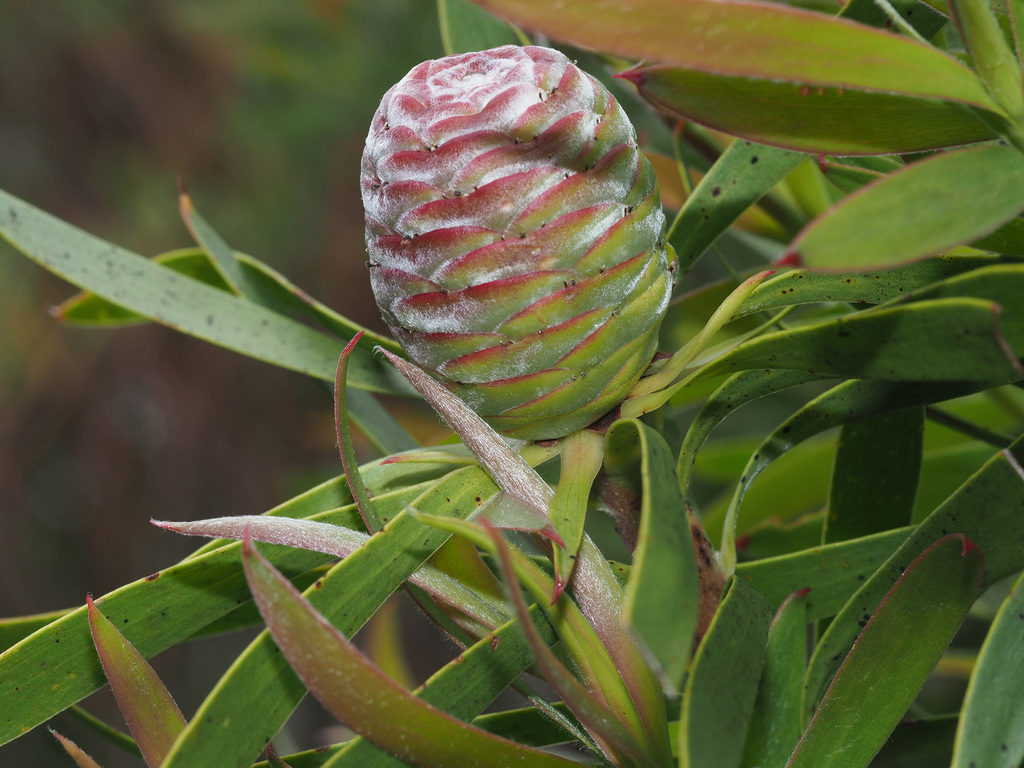
Dune Conebush
Leucadendron coniferum
Leucadendron coniferum, also known at the dune conebush, is an evergreen, dioecious shrub or small tree of up to 4 m (13 ft) high, that has been assigned to the Proteaceae family. It has a whorl of conspicuous yellow leaves subtending the flowerheads. The flowers can be found in August and September. It grows in sandy soils near the coast of the Western Cape province of South Africa.
From the article Leucadendron coniferum on Wikipedia (CC BY-SA), quoted section by section
Description
Leucadendron coniferum is an evergreen, dioecious shrub or small tree of up to 4 m (13 ft) high, that develops from a single main stem near the ground. The branches are slightly grooved lengthways and initially may have some rusty hairs pressed against its surface, while later only some powdery hairs remain. The leaves are cartilaginous in consistency, hairless or with some soft hairs, linear inverted lance-shaped, 3.2–6.4 cm (1.25–2.5 in) long and 3–5 mm (0.12–020 in) wide, ending at the tip in a rather long and sharp extension of the midvein, the surface hairless or slightly softly hairy. The male flower heads are surrounded by an involucre of few yellow leaves that gradually become shorter and broadened at the base closer to the head. The male head is cone-, egg- or almost globe-shaped and about 1.25 cm (0.5 in) in diameter. The bract subtending the individual male flower is about 1.5 mm (0.06 in) long, oblong, with a nearly pointy tip, covered in long, soft and winding hairs and a regular row of straight hairs along the upper half of the margin. The lower part of the 4-merous perianth of the male flower that remains merged upon opening called tube is about 2 mm (0.08 in) long, slightly compressed, with long, soft, straight hairs. …
Range & habitat
The dune conebush can be found from the Cape Peninsula in the west, through the coastal areas of the Kogelberg, Kleinmond, and Groenland, to the Klein River Mountains in the east near Hermanus, where it grows in dense stands on wind-blown sands, between sea level and about 300 m (900 ft) altitude. It is pollinated by small beetles. The seeds remain up to many years in the woody cones on the female plants, until these are released after a fire. The winged seeds are transported by the wind. Adult plants do not survive the wildfires that occur every decade or so in the sand fynbos and strandveld in which the dune conebush lives. Germination starts quickly after the seed are released and it has been shown that smoke promotes their germination of the seeds. The species, that naturally grows in acid and nutrient-poor environments is relatively sensitive to raised levels of phosphate.
Wikipedia: “Distribution, habitat and ecology”
At the table
The cones with their papery bracts, that look like spruce cones and are known as "sabulosum cones", are sometimes gathered and used in potpourri.
Wikipedia: “Uses”
Where it lives
Recorded sightings
—
geo-referenced records in GBIF, from museums, herbaria and field observers.
Drag the globe to turn it. Dots are where records exist, not a range map; darker means more records.
In the stacks
Searching the stacks…
Every page naming Leucadendron coniferum in the Biodiversity Heritage Library →
This page is assembled live from iNaturalist, GBIF, Wikipedia, the Source Library and the Internet Archive. It is not yet part of the hand-edited codex. iNaturalist taxon 320316.