- Animals
- ›Arthropods
- ›Hexapods
- ›Insects
- ›Winged and Once-winged Insects
- ›Beetles
- ›Water, Rove, Scarab, Long-horned, Leaf, and Snout Beetles
- ›Scarabaeiform Beetles
- ›Scarabs, Stag Beetles, and Allies
- ›Scarabs
- ›Rhinoceros Beetles
- ›Oryctini
- ›Oryctes
- ›Rykanes
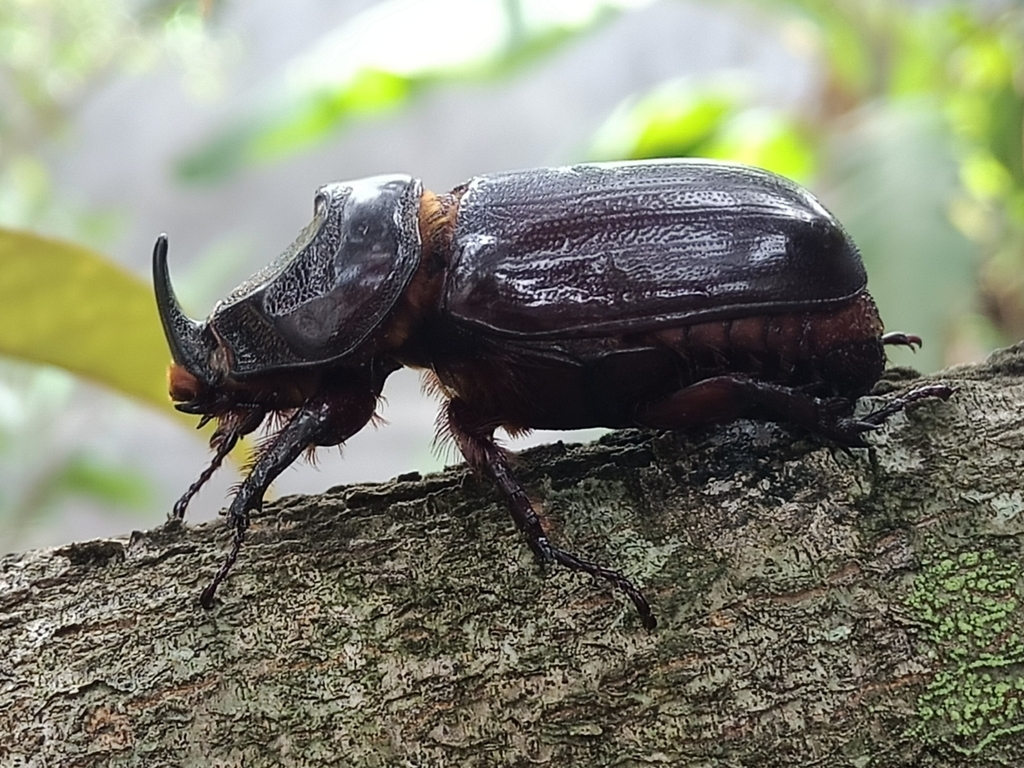
Coconut Rhinoceros Beetle
Oryctes rhinoceros
Oryctes rhinoceros, also known as coconut rhinoceros beetle, Asiatic rhinoceros beetle, and coconut palm rhinoceros beetle, is a large species of beetle (typically 4–5 cm long), belonging to the rhinoceros beetles subfamily Dynastinae. Oryctes rhinoceros attacks coconut palms and other palms such as the economically important oil palm. It can cause serious damage to the developing fronds (leaves) up to death of the palm. The beetle breeds in decaying palm trunks or other organic matter like sawdust or compost heaps.
From the article Oryctes rhinoceros on Wikipedia (CC BY-SA), quoted section by section
Description
Oryctes rhinoceros is a large dynastid beetle with a length of 35–50 mm and a dark-brown to black colour. The head has a horn which is more prominently developed in males and in larger specimens. The pronotum has a large central depression with two humps at the hind margin and the tibia of the foreleg has three large teeth. Male beetles can be reliably distinguished from females by the tip of the abdomen which is rounded, shiny and hairless in males. In females the tip is more pointed and densely covered with hair. The eggs are white and about 3 mm in diameter. The larvae are the typical C-shaped white grubs of scarab beetles. The three larval stages can be separated by the size of their head capsule which is around 2.5–3 mm (first instar), 5–6 mm (second instar) and 10–11 mm (third instar), respectively.
Range & habitat
The native distribution of this beetle covers most parts of tropical Asia, from India and the Maldives in the west to countries like Myanmar, Thailand, Malaysia, Vietnam, most parts of Indonesia, the Philippines, Taiwan and southern China in the east. Through human activity, it has been accidentally introduced into a larger number of tropical islands in the Pacific starting with Samoa where larvae arrived in 1909 with the soil of rubber seedlings from Ceylon (Sri Lanka). From Samoa, the coconut rhinoceros beetle spread to many others parts of the Pacific. Its distribution range also expanded to several islands in the Indian Ocean, in the Western Pacific, e.g. to Palau and New Britain, and most recently, the beetle invaded Guam, Hawaii, the Solomon Islands and Vanuatu.
Wikipedia: “Distribution”
What it does
The coconut rhinoceros beetle is nocturnal and flies only during the night. Its main host is the coconut palm, but other palms, especially the economically important African oil palm are also hosts. Attacks are occasionally also reported from various other crops like banana plants or screw palms. The beetle most often breeds in the decaying trunks of coconut or oil palm. These trunks become suitable for breeding after palms are felled for replanting or when the palm dies of old age. The dead standing palms are the most preferred breeding places. Other breeding sites are sawdust heaps around sawmills, compost heaps in gardens, stumps of rubber trees, and other decaying organic matter such as heaps of cocoa (cacao) pods. The breeding substrate must have reached a certain degree of decay for the females to accept it. Female beetles typically arrive first at a decaying coconut trunk for breeding and start preparing the trunk for egg laying by breaking up the wood into small particles, suitable for consumption by the freshly hatched first instar larvae. A male beetle often follows the female for mating and to help the female with preparation of the breeding site. Females deposit eggs, packing the wood particles tightly around the eggs. Males often stay behind in the trunk, breaking up additional wood. …
Wikipedia: “Biology and life cycle”
Listen
Looking for field recordings…
Where it lives
Recorded sightings
—
geo-referenced records in GBIF, from museums, herbaria and field observers.
Drag the globe to turn it. Dots are where records exist, not a range map; darker means more records.
In the stacks
Searching the stacks…
Every page naming Oryctes rhinoceros in the Biodiversity Heritage Library →
This page is assembled live from iNaturalist, GBIF, Wikipedia, the Source Library and the Internet Archive. It is not yet part of the hand-edited codex. iNaturalist taxon 320058.