- Animals
- ›Arthropods
- ›Hexapods
- ›Insects
- ›Winged and Once-winged Insects
- ›Earwigs
- ›Extant Earwigs
- ›Epidermapteran Earwigs
- ›Eteodermaptera
- ›Labiduroidea
- ›Striped Earwigs
- ›Labidurinae
- ›Labidura
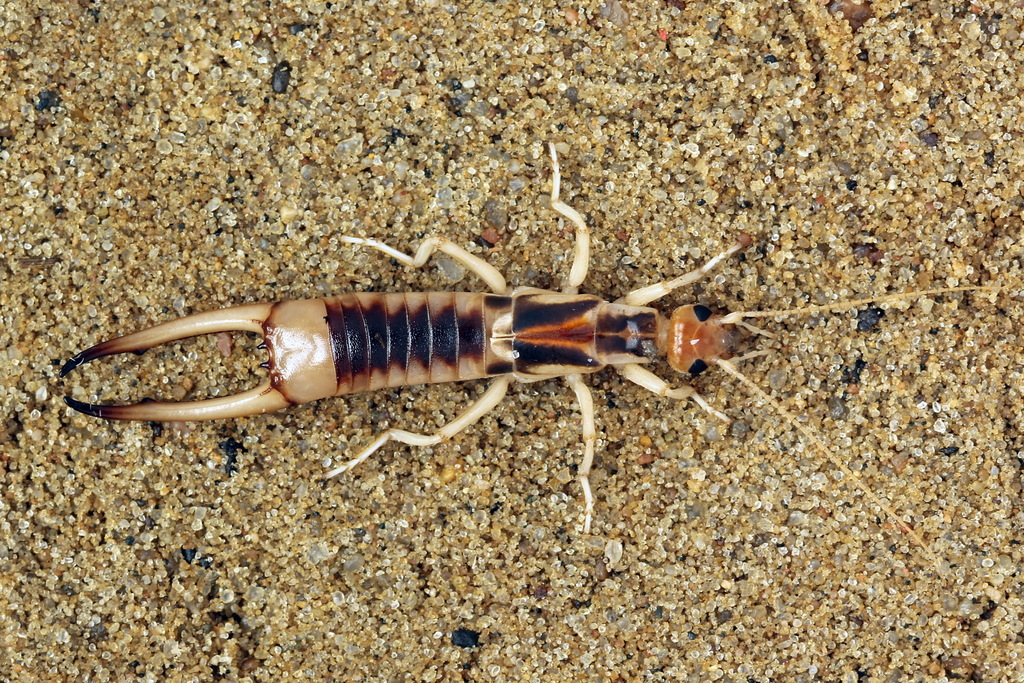
Shore Earwig
Labidura riparia
Labidura riparia is a species of earwig in the family Labiduridae characterized by their modified cerci as forceps, and light tan color. They are commonly known as the shore earwig, tawny earwig, riparian earwig, or the striped earwig due to two dark longitudinal stripes down the length of the pronotum. They are sometimes wrongly referred to as Labidura japonica, although said species is actually a subspecies, Labidura riparia japonica, found from Japan and India to Papua New Guinea. L. riparia are a cosmopolitan species primarily in tropical to subtropical regions. Body size varies greatly, ranging from 16 mm to 30 mm, with 10 abdominal segments. Males and females differ in forcep size, with males having much larger and stronger curve, while females have smaller, straighter forceps with a slight curve at the end. Earwigs use these forceps to assist in predation, defense, sexual selection, courtship and mating, and wing folding.
L. riparia are a subsocial earwig with complex maternal habits. They are voracious predators, and highly regarded as efficient for pest control in many situations. Repugnitory glands in the earwigs cause them to secrete a foul smelling pheromone to deter predators, which is said to smell like decomposition.
From the article Labidura riparia on Wikipedia (CC BY-SA), quoted section by section
What it does
The striped earwig prefers dark, moist environments with shelter that it can hide in during the daytime. They can be found in a variety of niches though, from cultured and uncultured farmlands, woodlands, and the margins of ponds and lakes. To save energy, the earwigs will occupy abandoned mole cricket burrows for brooding nests. Individuals are known to fly after a disturbance in search of a new nest as theirs may have become waterlogged or destroyed. Flight towards light has been observed due to their methods of orientation via the moon. L. riparia are generalist predators whose diet consists entirely of insects or scavenged meat. They have a preference to Lepidoptera larvae and insect eggs, but will eat any available insect. The earwig may use its long and powerful cerci to kill and immobilise larger insects. Because of their flexible eating habits, they easily adapt to any habit as long as there are insect around. In absence of a ready food supply, they have been known to eat nymphs and eggs of their own species. As nocturnal insects, earwigs only hunt after sunset, but feed primarily just after sunset occurs. Feeding habits of females depend more on their ovulatory cycle, and will go long periods of time without eating in preparation of egg laying. The primary predator to L. riparia is ants, as they prey on unattended eggs. …
Wikipedia: “Ecology”
Listen
Looking for field recordings…
Where it lives
Recorded sightings
—
geo-referenced records in GBIF, from museums, herbaria and field observers.
Drag the globe to turn it. Dots are where records exist, not a range map; darker means more records.
In the stacks
Searching the stacks…
Every page naming Labidura riparia in the Biodiversity Heritage Library →
This page is assembled live from iNaturalist, GBIF, Wikipedia, the Source Library and the Internet Archive. It is not yet part of the hand-edited codex. iNaturalist taxon 307026.