- Animals
- ›Arthropods
- ›Hexapods
- ›Insects
- ›Winged and Once-winged Insects
- ›True Bugs, Hoppers, Aphids, and allies
- ›True Bugs
- ›Pentatomomorph Bugs
- ›Stink Bugs, Shield Bugs, and Allies
- ›Stink Bugs
- ›Pentatominae
- ›Carpocorini
- ›Oebalus
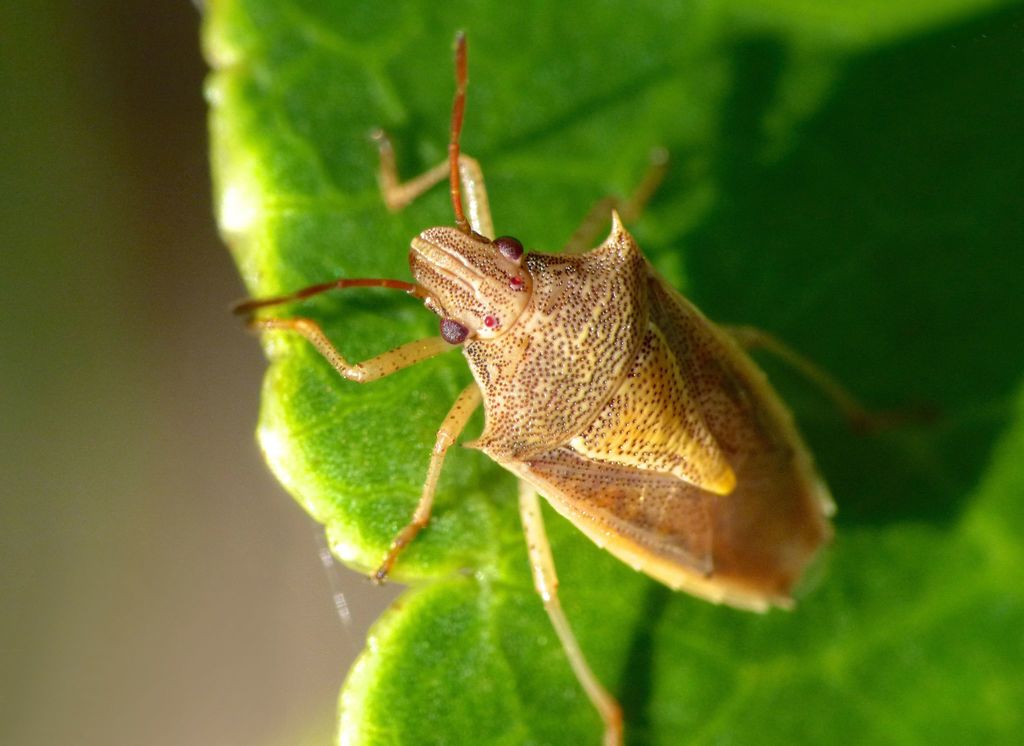
Rice Stink Bug
Oebalus pugnax
The rice stink bug, Oebalus pugnax, is a flying insect in the shield bug family Pentatomidae native to North America that has become a major agricultural pest in the Southern United States. It has been a known pest since at least the time of Johan Christian Fabricius, who described the species in 1775.
From the article Oebalus pugnax on Wikipedia (CC BY-SA), quoted section by section
Description
The adult Oebalus pugnax measures 0.375 inches (9.5 mm) to 0.50 inches (13 mm) long. It has a narrow profile that forms the shield shape characteristic of other stink bugs. These true bugs are typically straw-colored with sharp points on the apex of the shield and a yellow triangle exhibited on center of the shield. Some adults have gray coloring near the yellow triangle, while others may be a darker brown rather than straw-colored. However, the rice stink bug is easily distinguished from other stink bugs because of its narrower profile and lighter color than, for example, the brown marmorated stink bug.
What it does
The rice stink bug is a significant pest of rice crops in the southern U.S., including Mississippi, Arkansas, Louisiana, and Texas (the Rice Belt). This agricultural pest is known to attack cereal crops with small seeds, particularly wheat, sorghum, and rice. The insect also lives in wild grasses such as Johnson grass, barnyard grass, and sedge, making control of cash crops difficult. They are occasionally found on other crops in which grasses are prevalent between the rows, even though the insect may ignore the field crop. The insect is extremely mobile and is known to travel en masse in and out of fields quickly in search of more favorable foods. Non-food crop hosts of the rice stink bug include: Echinochloa crusgalli, Echinochloa colona, Digitaria sanguinalis, Panicum dicotomiflorum, Phalaris minor, Paspalum urvillei, and Sporobolus poiretti; the last two are the most common species that the bug prefers. The rice stink bug will damage a developing seed head by feeding on the seed's endosperm, leaving an empty shell or shriveled kernels. This type of damage can precipitate microorganism diseases and other crop losses, most notably discoloration, "pecky rice," and lower quality produce. …
Wikipedia: “Behavior and crop damage”
Listen
Looking for field recordings…
Where it lives
Recorded sightings
—
geo-referenced records in GBIF, from museums, herbaria and field observers.
Drag the globe to turn it. Dots are where records exist, not a range map; darker means more records.
In the stacks
Searching the stacks…
Every page naming Oebalus pugnax in the Biodiversity Heritage Library →
This page is assembled live from iNaturalist, GBIF, Wikipedia, the Source Library and the Internet Archive. It is not yet part of the hand-edited codex. iNaturalist taxon 295792.