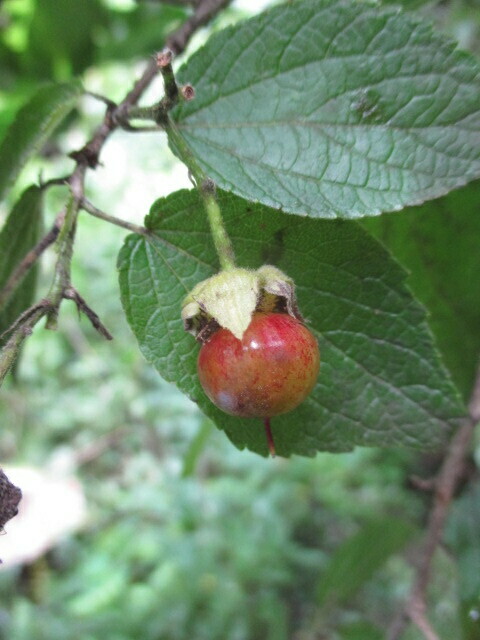
Prockia crucis
Prockia crucis, commonly known as guasimilla, is a species of flowering plant in the family Salicaceae, distributed across the Americas. As the type species of its genus, it was first named by Carl Linnaeus in 1759, but described by Patrick Browne earlier. The plant is used in medicine, food, and gardening, with a conservation status of least concern on the IUCN Red List.
From the article Prockia crucis on Wikipedia (CC BY-SA), quoted section by section
Description
Prockia crucis is a variable shrub or tree usually 1.2–10 m (3 ft 11 in – 32 ft 10 in) tall, occasionally reaching up to 20 m (66 ft). It is characterized by a globose crown supported by a crooked trunk that is up to 25 cm (9.8 in) wide, with grey or brown bark that is either glabrous or puberulous; the wood within is white, coarse, and quite brittle, reportedly having a density of 0.58 g/cm3 (0.052 oz/in3). The leaves are alternate, measuring up to 15 cm (5.9 in) long and 11 cm (4.3 in) wide; the shape is commonly elliptic, lanceolate, or ovate, the apex is acuminate, the base is often rounded or cordate, and the margins are frequently serrate or crenate. The leaf surface is either chartaceous or membranaceous, and the veins come in pairs that form an obscure reticulate pattern; the petiole is short, measuring up to 3 cm (1.2 in) long. The inflorescences are usually racemose, paniculate, or corymbose, measure up to 4 cm (1.6 in) long and 3 cm (1.2 in) wide, and contain up to 12 hermaphroditic flowers that are green or yellow in color. The stamens are yellow, numerous, and feature filaments that are up to 6 mm (0.24 in) long. The ovary is superior, either globose or ovoid in shape, and may be glabrous or puberulous; it bears a style that measures up to 4 mm (0.16 in) long, tipped by a lobed stigma. …
Range & habitat
Prockia crucis has a very broad distribution, spanning from Mexico to Argentina and encompassing an array of regions. In Mexico, it is found in several states, including Oaxaca, Chiapas, and Veracruz. Its range extends through Central America and into northern and western South America, with occurrences in Colombia, Venezuela, Ecuador, Paraguay, Peru, and Bolivia. In Brazil, the species is widespread, from Acre in the north to Paraná and Santa Catarina in the south, continuing into Uruguay and northern Argentina. Additionally, it is present on numerous Caribbean islands, such as Cuba, Puerto Rico, Hispaniola, and the Virgin Islands. Due to its large extent, Prockia crucis inhabits a decent variety of tropical and subtropical environments, present at elevations of up to 2,500 m (8,200 ft). It thrives in many forest habitats, most notably those dominated by Quercus or Araucaria, as well as gallery forests, semi-evergreen forests, and tropical rainforests. In addition to forests, Prockia crucis occurs in thorny thickets, shrublands, grasslands, and floodplains. Although seen typically growing in serpentine soil, it has been recorded on limestone.
Wikipedia: “Distribution and habitat”
What it does
Prockia crucis grows best in dappled shade, showing a moderate growth rate when young; preferring moist soil, it can tolerate seasonal flooding. The plant is known to be consumed by a few bird species, including the rufous-bellied thrush, white-browed brushfinch, tropical parula, slaty elaenia, and dot-fronted woodpecker; its fruits specifically are appreciated by native fauna. Prockia crucis is also the host of Condylorrhiza vestigialis, a species of moth.
Wikipedia: “Ecology”
At the table
Prockia crucis shows notable medicinal potential through its ethanol leaf and bark extracts, which exhibit strong antioxidant activity and acetylcholinesterase inhibition, indicating relevance for Alzheimer’s treatment. HPLC analysis revealed key phenolics such as gallic acid, luteolin, kaempferol, and coumarin. Though direct antifungal effects were limited, the extracts enhanced fluconazole efficacy against resistant Candida tropicalis, highlighting their role as antifungal modulators. Outside of testing, the leaves are said to have medicinal qualities, although they are not specified. The plant is consumed for food, but the edibility of its fruits is rather dubious; however, several species within Salicaceae produce fruits that are safe to eat, indicating that the fruits of Prockia crucis may be consumable. The exact uses of Prockia crucis in gardening are not given, but it is grown in nurseries, and is capable of being sown; it is best to do so when it ripens, where it must be done in a partially shaded nursery seedbed. The seeds must be gently sown on the soil surface due to their small size; a low germination rate is typical, with sprouting occurring within 40–60 days.
Wikipedia: “Uses”
In human culture
The generic name Prockia is in honor of Christian Leberecht von Prøck, a Danish baron. The specific epithet, crucis, is the genitive singular form of the Latin crux, which means "cross". The word crucis is used to indicate possession or relationship, therefore translating to "of the cross"; it is unclear why this epithet was chosen.
Wikipedia: “Etymology”
Where it lives
Recorded sightings
—
geo-referenced records in GBIF, from museums, herbaria and field observers.
Drag the globe to turn it. Dots are where records exist, not a range map; darker means more records.
In the stacks
Searching the stacks…
Every page naming Prockia crucis in the Biodiversity Heritage Library →
This page is assembled live from iNaturalist, GBIF, Wikipedia, the Source Library and the Internet Archive. It is not yet part of the hand-edited codex. iNaturalist taxon 291593.