- Plants
- ›Vascular Plants
- ›flowering plants
- ›Dicots
- ›Mints, Plantains, Olives, and Allies
- ›Acanthus Family
- ›Acanthoideae
- ›Ruellieae
- ›Ruelliinae
- ›Ruellia
- ›Ruellia
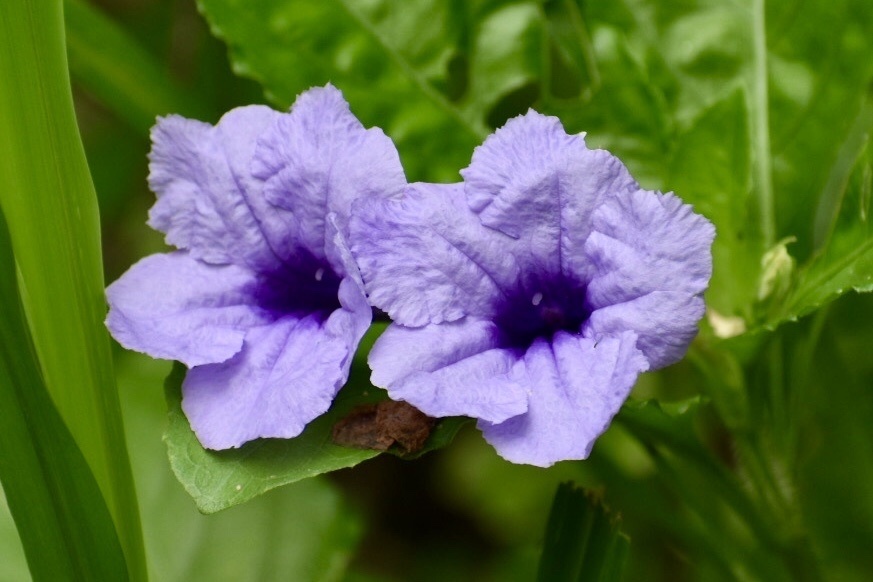
Popping Pod
Ruellia tuberosa
Ruellia tuberosa, also known as minnieroot, fever root, snapdragon root and sheep potato (Thai: ต้อยติ่ง), is a species of flowering plant in the family Acanthaceae. Its native range is in Central America but it has become naturalized in Africa (Tanzania in particular), South and Southeast Asia.
Some butterfly species, like the lemon pansy (Junonia lemonias) and the mangrove buckeye (Junonia genoveva), feed on the leaves of Ruellia tuberosa.
From the article Ruellia tuberosa on Wikipedia (CC BY-SA), quoted section by section
Description
It is a small biennial plant with thick fusiform tuberous roots and striking funnel-shaped violet-colored flowers. Its fruit is a 2 cm (0.8 in) long sessile capsule containing about 20 seeds. Some of the names of the plant such as popping pod, duppy gun and cracker plant come from the fact that children like to play with the dry pods that pop when rubbed with spit or water. Ruellia tuberosa may be found in moist and shady environments. It grows, however, preferably in grasslands and roadsides—often as a weed in cultivated fields, and also in xerophile and ruderal habitats. In folk medicine and Ayurvedic medicine it is believed to be diuretic, anti-diabetic, antipyretic, analgesic, antihypertensive, and gastroprotective, and has been used for gonorrhea. It is also used as a natural dye for textiles.
Wikipedia: “Description and properties”
Where it lives
Recorded sightings
—
geo-referenced records in GBIF, from museums, herbaria and field observers.
Drag the globe to turn it. Dots are where records exist, not a range map; darker means more records.
In the stacks
Searching the stacks…
Every page naming Ruellia tuberosa in the Biodiversity Heritage Library →
This page is assembled live from iNaturalist, GBIF, Wikipedia, the Source Library and the Internet Archive. It is not yet part of the hand-edited codex. iNaturalist taxon 291119.