- Plants
- ›Vascular Plants
- ›flowering plants
- ›Dicots
- ›Legumes, Milkworts, and Allies
- ›Legumes
- ›Faboideae
- ›Millettieae
- ›Tephrosia
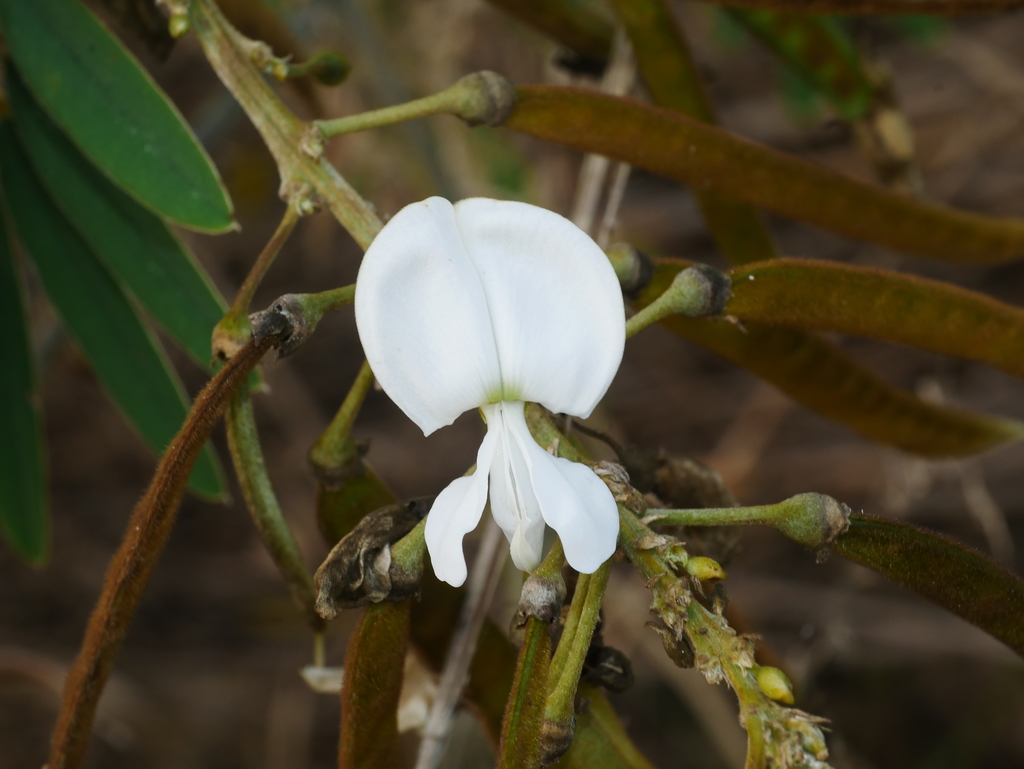
Tephrosia candida
Tephrosia candida, the white hoarypea, is a perennial shrub, native to India, in the legume family. It has been introduced to Malesia, South America, Africa, South East Asia and Australia.
From the article Tephrosia candida on Wikipedia (CC BY-SA), quoted section by section
How it is grown
In Zimbabwe, the use of different taxa of the genus Tephrosia has been studied as a way to enrich soils by intercropping when growing maize. This allows continual nourishment of the soil. Specifically, T. candida was proven to successfully grow in conditions of high population density, yet further research into this growth option is required. To further investigate the genus Tephrosia and its effective growth in stressful habitats, researchers at the University of Zimbabwe studied carbon and nitrogen mineralization patterns of this legume. Mineralization, or the decomposition of organic matter, provides fixed nitrogen for other plants to use. They found that Tephrosia released nitrogen at a slow rate. This pattern could be due to nitrogen binding to polyphenols, or natural organic molecules. This prevents subsequent loss of nitrogen and promotes crop uptake along with nitrogen release. Polyphenol to nitrogen ratios within plants can give evidence toward the quality of biomass and can predict the nitrogen release pattern. While there exist several Tephrosia taxa that exhibit slow nitrogen release, many possess rapid rates of nitrogen release as well. Rapid release is not necessarily compatible with intercropping because it does not share this pattern with maize. However, the slow release of nitrogen in the T. …
Wikipedia: “Agricultural benefits”
In human culture
The genus name, Tephrosia, derives from the Greek tephros (ash-coloured) and refers to the fact that most of the species are covered with grey hairs. The species epithet, candida, derives from the Latin adjective, candidus,-a,-um, meaning pure white.
Wikipedia: “Etymology”
Where it lives
Recorded sightings
—
geo-referenced records in GBIF, from museums, herbaria and field observers.
Drag the globe to turn it. Dots are where records exist, not a range map; darker means more records.
In the stacks
Searching the stacks…
Every page naming Tephrosia candida in the Biodiversity Heritage Library →
This page is assembled live from iNaturalist, GBIF, Wikipedia, the Source Library and the Internet Archive. It is not yet part of the hand-edited codex. iNaturalist taxon 289911.