- Plants
- ›Vascular Plants
- ›flowering plants
- ›Dicots
- ›Mints, Plantains, Olives, and Allies
- ›figwort family
- ›Buddlejeae
- ›Buddleja
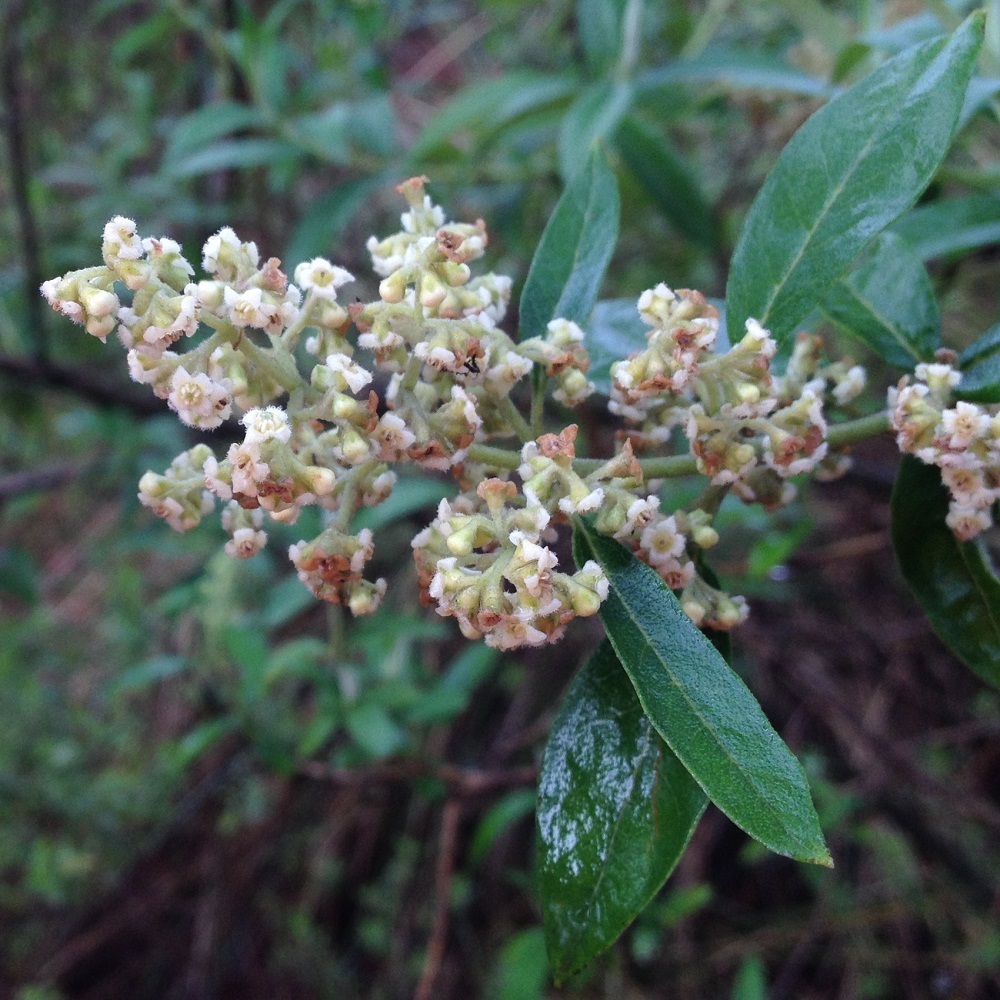
Buddleja parviflora
Buddleja parviflora is large dioecious shrub or small tree endemic to much of upland Mexico north of the Isthmus of Tehuantepec, in forests at elevations of 750 – 3500 m. The species was first named and described by Kunth in 1818....
From the article Buddleja parviflora on Wikipedia (CC BY-SA), quoted section by section
Description
Buddleja parviflora grows to a height of <10 m in the wild, with a trunk < 20 cm in diameter; the bark blackish and exfoliating. The young branches are subquadrangular and tomentose, bearing opposite subcoriaceous leaves of variable shape, 3 – 12 cm long by 1 – 4.5 cm wide. The white to greenish-white inflorescences are paniculate, 3 – 18 cm long by 2 – 12 cm comprising 2 – 3 orders of branches subtended by small leaves and bearing small cymules with 3 – 5 tiny flowers, the campanulate corollas 1 – 1.5 mm long. Ploidy: 2n = 76.
How it is grown
The species is uncommon in cultivation. Hardiness: USDA zones 8–9.
== References ==
Wikipedia: “Cultivation”
Where it lives
Recorded sightings
—
geo-referenced records in GBIF, from museums, herbaria and field observers.
Drag the globe to turn it. Dots are where records exist, not a range map; darker means more records.
In the stacks
Searching the stacks…
Every page naming Buddleja parviflora in the Biodiversity Heritage Library →
This page is assembled live from iNaturalist, GBIF, Wikipedia, the Source Library and the Internet Archive. It is not yet part of the hand-edited codex. iNaturalist taxon 287035.