- Plants
- ›Vascular Plants
- ›flowering plants
- ›Dicots
- ›Mints, Plantains, Olives, and Allies
- ›figwort family
- ›Buddlejeae
- ›Buddleja
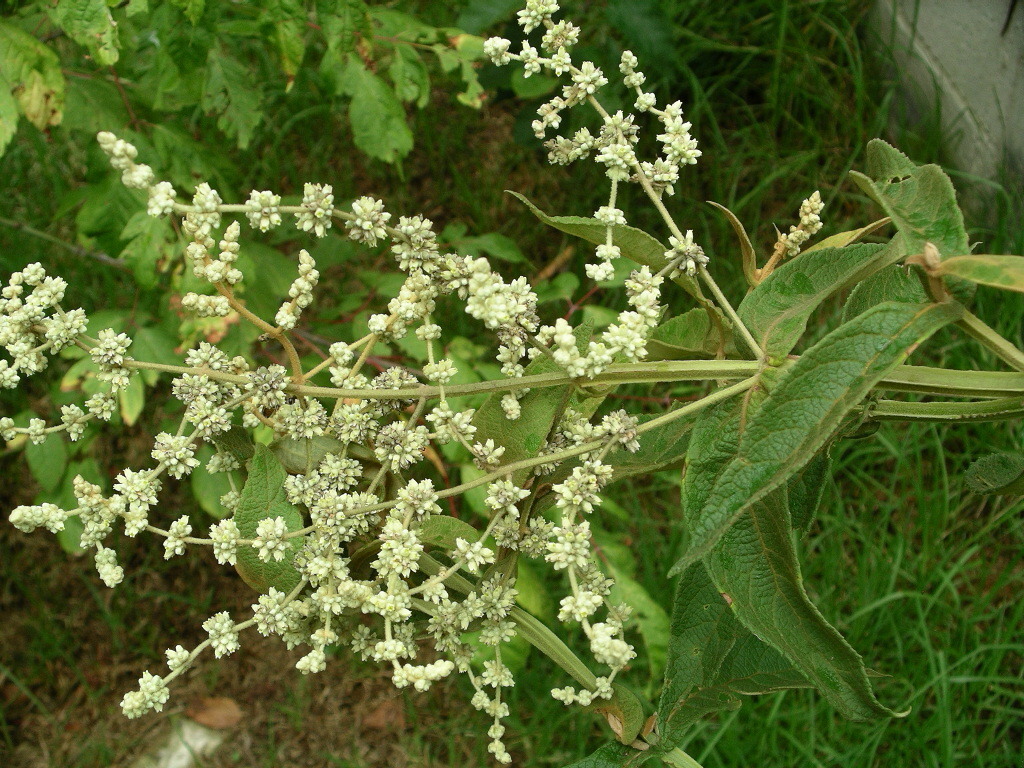
Buddleja americana
Buddleja americana is the most widespread of all the Buddleja species native to the Americas, its range extending south from Tamaulipas, Mexico, through Central America and much of the West Indies into South America, reaching eastward to Venezuela, westward as far as the Galapagos, and south to Bolivia. It occurs at elevations from sea level to 2500 m, in a variety of habitats, including cloud forest, mountain savanna, pine–oak forest, and rocky slopes near rivers. It also invades fields and roadsides.
The species was originally named and described by Linnaeus in 1753.
From the article Buddleja americana on Wikipedia (CC BY-SA), quoted section by section
Description
B. americana is a trioecious shrub, 2–5 m tall with light brown fissured bark. The young branches are sub quadrangular, and tomentose, bearing leaves which vary greatly in size, shape and indumentum. The inflorescences are 5–25 cm long, with one or two orders of branches. The flowers are borne in cymules, the short (< 2.5 mm) corollas yellow inside and white outside. Unlike many American species of Buddleja, which are often diploid, B. americana is tetraploid (2n = 76).
How it is grown
The species is not cold hardy, and quickly killed by temperatures only marginally below freezing. Hardiness: USDA zone 9.
== References ==
Wikipedia: “Cultivation”
Where it lives
Recorded sightings
—
geo-referenced records in GBIF, from museums, herbaria and field observers.
Drag the globe to turn it. Dots are where records exist, not a range map; darker means more records.
In the stacks
Searching the stacks…
Every page naming Buddleja americana in the Biodiversity Heritage Library →
This page is assembled live from iNaturalist, GBIF, Wikipedia, the Source Library and the Internet Archive. It is not yet part of the hand-edited codex. iNaturalist taxon 287034.