- Plants
- ›Vascular Plants
- ›flowering plants
- ›Dicots
- ›Mustards, Capers, and Allies
- ›mustard family
- ›Brassicoideae
- ›Brassicodae
- ›Brassiceae
- ›Eruca
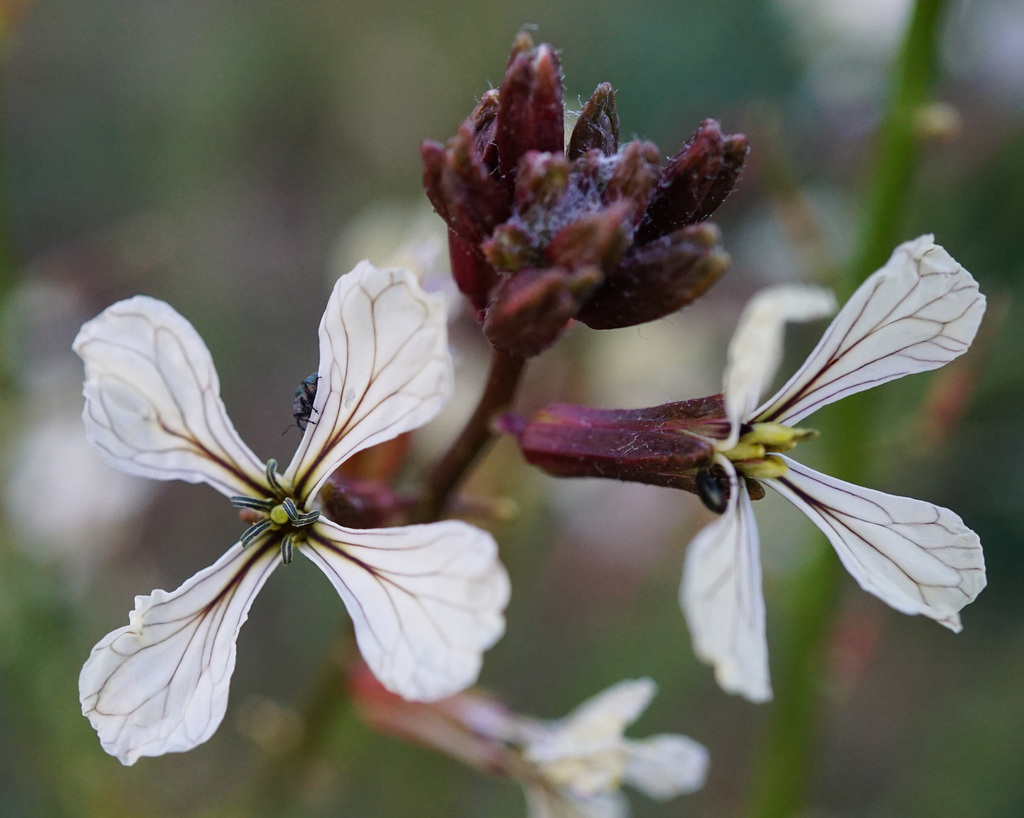
Rocket Salad
Eruca sativa
Eruca sativa (also known as arugula, rocket, or eruca,) is an edible annual plant in the family Brassicaceae. Other common names include salad rocket, garden rocket, colewort, roquette, ruchetta, rucola, rucoli, and rugula.
Eruca sativa is native to the Mediterranean and Asia. Its wide availability and sharp flavor (slightly bitter and peppery) make it widely popular as a leaf vegetable, including in salads.
From the article Eruca sativa on Wikipedia (CC BY-SA), quoted section by section
Description
Eruca sativa is an annual plant growing to 20 to 100 cm (8 to 40 in) in height. The pinnate leaves are deeply lobed with four to ten small, lateral lobes and a large terminal lobe. The flowers are 2 to 4 cm (3⁄4 to 1+1⁄2 in) in diameter, arranged in a corymb, with the typical Brassicaceae flower structure. The petals are creamy white with purple veins, and the stamens are yellow. The fruit is a siliqua (pod) 12 to 25 mm (1⁄2 to 1 in) long with an apical beak, containing several seeds. The species has a chromosome number of 2n = 22.
Range & habitat
Eruca sativa is native to parts of the Mediterranean and Asia, including southern Europe, North Africa and the Middle East.
Wikipedia: “Distribution and habitat”
What it does
The species typically grows on dry, disturbed ground. It is a source of food for the larvae of some moth species, including the garden carpet. Its roots are susceptible to nematode infestation. As an invasive species, Eruca sativa is widespread and scattered, but is prolific and noxious in the Sonoran desert of Arizona and California.
Wikipedia: “Ecology”
At the table
Raw arugula is 92% water, 4% carbohydrates, 2.5% protein, and contains a negligible amount of fat (table). In a reference amount of 100 grams (3.5 oz), arugula provides 25 calories of food energy, and is a rich source (20% or more of the Daily Value, DV) of folate and vitamin K. It is also a good source (10–19% of DV) of vitamin A, vitamin C, and the dietary minerals, calcium, magnesium, manganese, and potassium (table).
Wikipedia: “Nutrition”
How it is grown
The plant was traditionally collected in the wild or grown in home gardens along with herbs, such as parsley and basil. Arugula is grown commercially and is naturalized as a wild plant outside its native range in temperate regions around the world, including northern Europe and North America. Arugula prefers full sun, cool temperatures, and moist, fertile soil. Hot weather changes its flavor and stops leaf growth. Seedlings are planted 6 in (15 cm) apart, and plants can self-seed in the garden. Plants mature and can be harvested within 40 to 50 days, with young leaves preferred for flavor. Mild frost conditions hinder the plant's growth and turn the green leaves to red.
Wikipedia: “Cultivation”
In human culture
The species name sativa is from Latin supine satum, meaning "sown, planted", indicating that the plant is cultivated in gardens. The English common name rocket derives from French roquette, itself a borrowing from Italian ruchetta, a diminutive of ruca, from the Latin word eruca, meaning "caterpillar". "Arugula" (), the common name now widespread in the United States and Canada, entered American English from a nonstandard dialect of Italian. The standard Italian word is "rucola". The Oxford English Dictionary dates the first known appearance of "arugula" in American English to a 1960 article in The New York Times by food editor and prolific cookbook writer Craig Claiborne.
Similarly named plants. Rocket is sometimes conflated with Diplotaxis tenuifolia, known as 'perennial wall rocket', another plant of the family Brassicaceae that is used in the same manner. Species of Barbarea may be known as 'yellow rocket'.
Wikipedia: “Etymology”
Where it lives
Recorded sightings
—
geo-referenced records in GBIF, from museums, herbaria and field observers.
Drag the globe to turn it. Dots are where records exist, not a range map; darker means more records.
In the old herbals & bestiaries


In the stacks
Searching the stacks…
Every page naming Eruca sativa in the Biodiversity Heritage Library →
This page is assembled live from iNaturalist, GBIF, Wikipedia, the Source Library and the Internet Archive. It is not yet part of the hand-edited codex. iNaturalist taxon 284707.