- Plants
- ›Vascular Plants
- ›flowering plants
- ›Dicots
- ›magnolias, nutmegs, and allies
- ›custard-apples
- ›Annonoideae
- ›Annoneae
- ›Annona
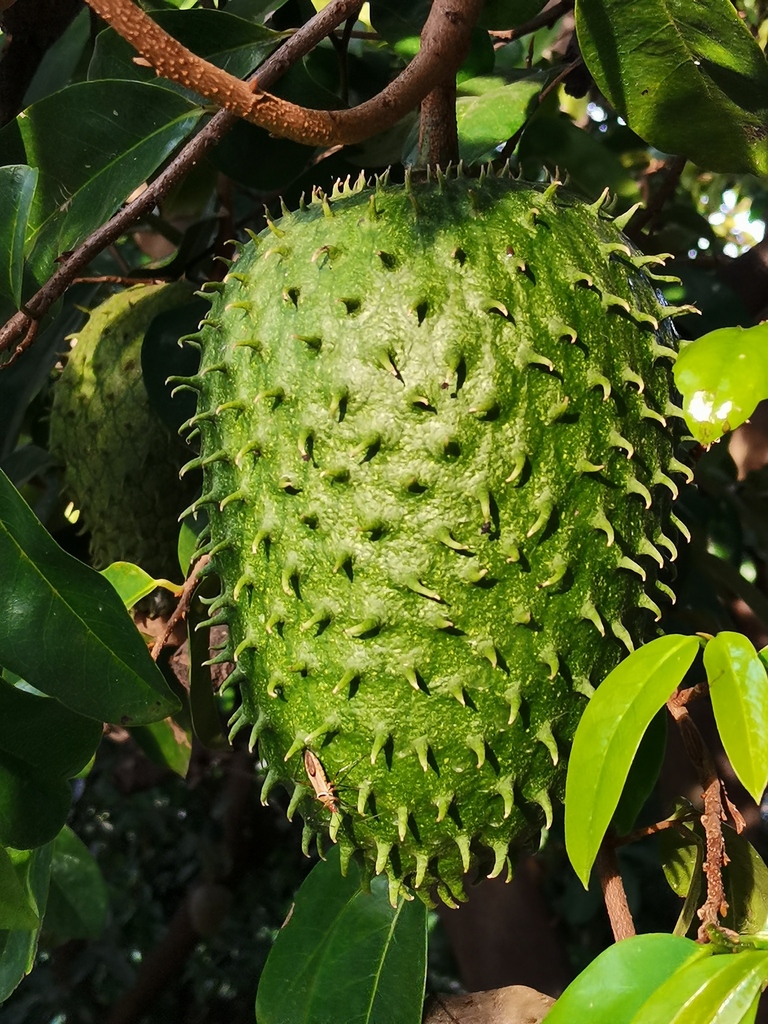
Soursop
Annona muricata
Soursop (also called graviola, guyabano, and in Hispanic America guanábana) is the fruit of Annona muricata, a broadleaf, flowering, evergreen tree. It is native to the tropical Americas and is widely propagated. It is in the same genus, Annona, as cherimoya and is in the Annonaceae family.
The soursop is adapted to areas of high humidity and relatively warm winters; temperatures below 5 °C (41 °F) will cause damage to leaves and small branches, and temperatures below 3 °C (37 °F) can be fatal. The fruit becomes dry and is no longer good for concentrate.
From the article Soursop on Wikipedia (CC BY-SA), quoted section by section
Range & habitat
Annona muricata is tolerant of poor soil and prefers lowland areas between the altitudes of 0 to 1,200 m (3,900 ft). The exact origin is unknown; it is native to the tropical regions of the continental Americas and is widely propagated. It is an introduced species on all temperate continents, especially in subtropical regions.
Wikipedia: “Distribution”
At the table
The flesh of the fruit consists of an edible, white pulp, some fiber, and a core of indigestible black seeds. The pulp is also used to make fruit nectar, smoothies, fruit juice drinks, as well as candies, sorbets, and ice cream flavorings.
Wikipedia: “Culinary”
In medicine
The neurotoxin annonacin is contained in the fruit, seeds, and leaves of soursop. The leaves of Annona muricata contain annonamine, which is an aporphine-class alkaloid containing a quaternary ammonium group. The plant also contains lichexanthone, a compound in the xanthone class.
Neurotoxicity. The Memorial Sloan-Kettering Cancer Center cautions, "alkaloids extracted from graviola may cause neuronal dysfunction". Annonacin has been shown in laboratory research to be neurotoxic. In 2010, the French food safety agency concluded that "it is not possible to confirm that the observed cases of atypical Parkinson syndrome ... are linked to the consumption of Annona muricata".
Controversy. In 2008, the Federal Trade Commission in the United States stated that use of soursop to treat cancer was "bogus", and there was "no credible scientific evidence" that the extract of soursop sold by Bioque Technologies "can prevent, cure, or treat cancer of any kind." Also in 2008, a UK court case relating to the sale of Triamazon, a soursop product, resulted in the criminal conviction of a man under the terms of the UK Cancer Act for offering to treat people for cancer. …
Wikipedia: “Phytochemicals”
How it is grown
The plant is grown for its 10–35 cm (3.9–13.8 in) long, prickly, green fruit, which can weigh up to 10 kg (22 lb), making it the largest Annona fruit, though not as large as the related junglesop Anonidium mannii. Away from its native area, some limited production occurs as far north as southern Florida within USDA Zone 10; however, these are mostly garden plantings for local consumption. It is also grown in parts of China and Southeast Asia and is abundant on the Island of Mauritius. The main suppliers of the fruit are Mexico followed by Peru, Brazil, Ecuador, Guatemala, and Haiti. To aid soursop breeders and stimulate further development of genomic resources for this globally important plant family, the complete genome for Annona muricata was sequenced in 2021.
Wikipedia: “Cultivation”
Where it lives
Recorded sightings
—
geo-referenced records in GBIF, from museums, herbaria and field observers.
Drag the globe to turn it. Dots are where records exist, not a range map; darker means more records.
In the old herbals & bestiaries


In the stacks
Searching the stacks…
Every page naming Annona muricata in the Biodiversity Heritage Library →
This page is assembled live from iNaturalist, GBIF, Wikipedia, the Source Library and the Internet Archive. It is not yet part of the hand-edited codex. iNaturalist taxon 284503.