- Plants
- ›Vascular Plants
- ›flowering plants
- ›Dicots
- ›Mints, Plantains, Olives, and Allies
- ›Plantain Family
- ›Toadflaxes and Allies
- ›Maurandya
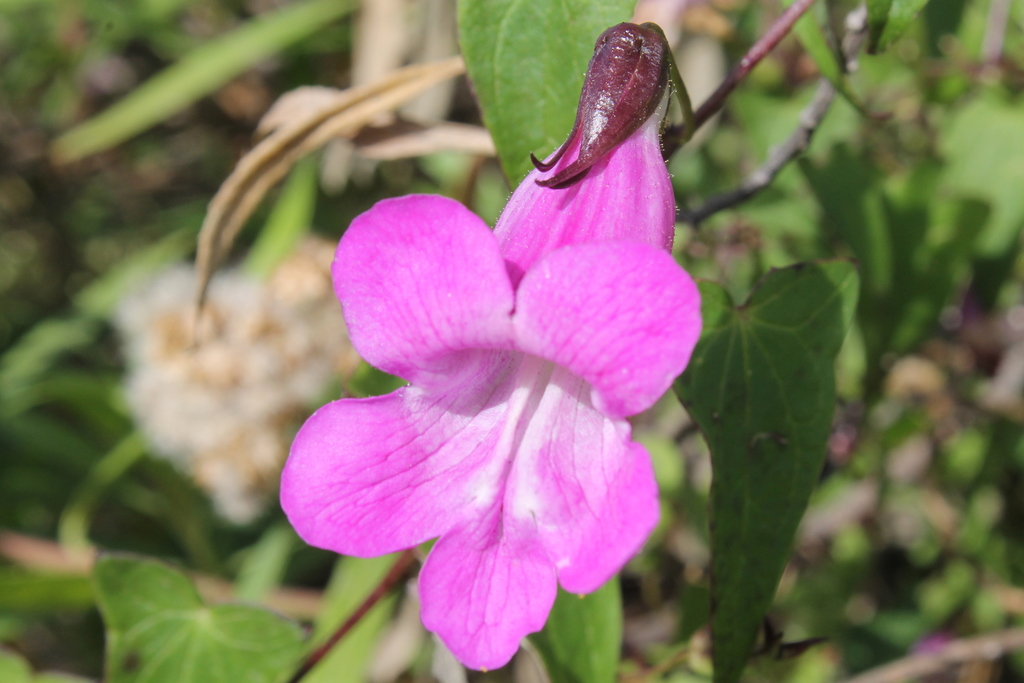
Pink Snapdragon Vine
Maurandya scandens
Maurandya scandens is a climbing herbaceous perennial native to Mexico, with pink and white tubular flowers and untoothed leaves. It is grown as an ornamental plant in many parts of the world, and has commonly escaped from cultivation to become naturalized. It has been confused with Lophospermum scandens, which has longer flowers and larger, toothed leaves. It resembles Maurandya barclayana, which has blue-violet flowers and hairy rather than hairless sepals.
From the article Maurandya scandens on Wikipedia (CC BY-SA), quoted section by section
Description
The perennial plant grows up to 2-3 meters tall or long. The alternate, lanceolate to arrow-shaped, entire and lobed to coarsely toothed, pointed, on the lobes, teeth often fine-pointed leaves sit on 8 to 42 millimeters long petioles. The bare leaf blades are 11 to 62 long and 4 to 45 millimeters wide. The shoot axes often form adventitious roots. It has been confused with Lophospermum scandens, which has longer flowers and larger, toothed leaves. It resembles Maurandya barclayana, which has blue-violet flowers and hairy rather than hairless sepals. It is semi-deciduous in the colder areas.
Flowers and reproduction. The hermaphrodite, tubular flowers appear axillary and solitary, and come in many different colours including rose pink, violet, indigo blue or white, with double perianth. The fivefold flowers feature a wide throat on long, glabrous pedicels, 30 to 85 millimeters long. The small, ovate-lanceolate and just overgrown tips of the calyx are 10 to 15 millimeters long. They are 2 to 4 millimeters wide at the base and they are bare to sparsely covered with glandular hairs. The crown, slightly hairy on the outside, with shorter, rounded to indented, expansive lobes has two lips. The 4 short, dynamic stamens are included. The superior, two-chambered ovary is usually bald and the bald, enclosed, relatively short style is 13 to 16 millimeters long. …
Range & habitat
The original distribution area are rocky slopes, canyons and disturbed areas in tropical and subtropical forests in southern Mexico at 1200 to 2200 meters above sea level. The species prefers a medium-humid (mesic) biotope. It seems to have established its habitat from the north along the calcareous Sierra Madre and south into the volcanic belt. Due to human displacement, occurrences are now found worldwide.
Wikipedia: “Range”
How it is grown
Cultivars include Joan Lorraine with velvety purple flowers, Snow White with white flowers and Mystic Rose with fuchsia flowers.
== References ==
Wikipedia: “Cultivation”
Where it lives
Recorded sightings
—
geo-referenced records in GBIF, from museums, herbaria and field observers.
Drag the globe to turn it. Dots are where records exist, not a range map; darker means more records.
In the stacks
Searching the stacks…
Every page naming Maurandya scandens in the Biodiversity Heritage Library →
This page is assembled live from iNaturalist, GBIF, Wikipedia, the Source Library and the Internet Archive. It is not yet part of the hand-edited codex. iNaturalist taxon 282923.