- Plants
- ›Vascular Plants
- ›flowering plants
- ›Dicots
- ›Gentians, Dogbanes, Madders, and Allies
- ›Dogbane Family
- ›milkweeds
- ›Asclepiadeae
- ›Asclepiadinae
- ›Gomphocarpus
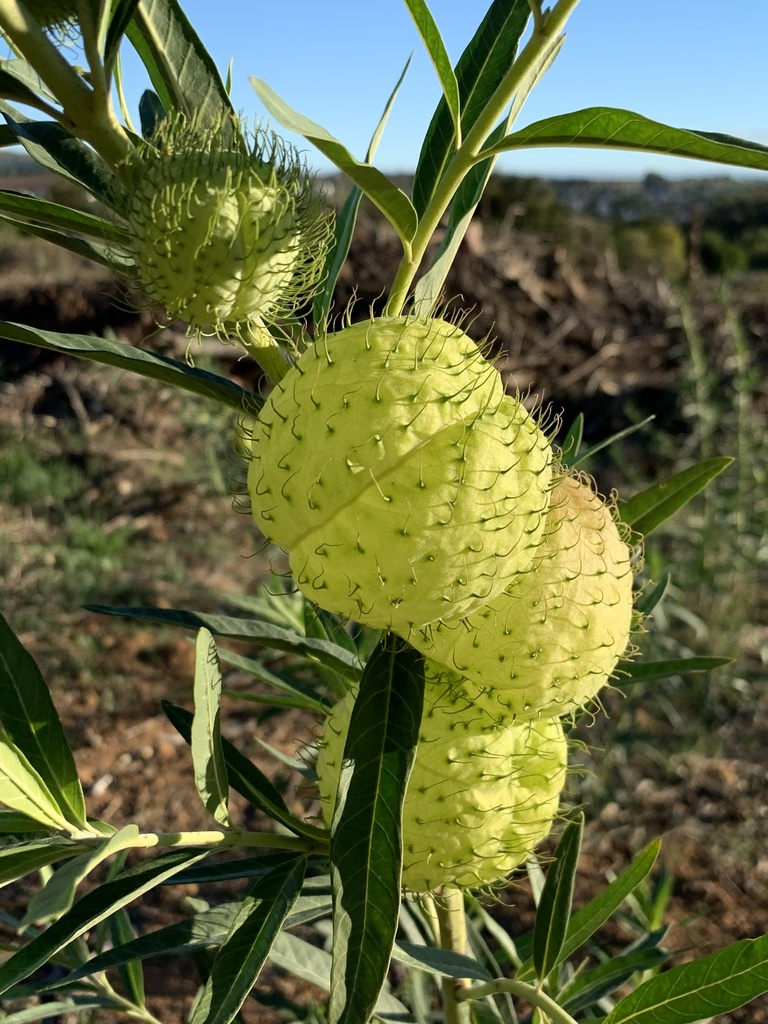
balloonplant
Gomphocarpus physocarpus
Gomphocarpus physocarpus, commonly known as balloonplant, balloon cotton-bush, bishop's balls, nailhead, or swan plant, is a species of milkweed. The plant is native to southeast Africa, but it has been widely naturalized. It is often used as an ornamental plant. The name "balloonplant" is an allusion to the swelling bladder-like follicles which are full of seeds.
From the article Gomphocarpus physocarpus on Wikipedia (CC BY-SA), quoted section by section
Description
Gomphocarpus physocarpus is an undershrub perennial herb, that can grow to 2 m (6 ft 7 in) tall with narrow lanceolate leaves. The plant blooms in warm months. It grows on roadside banks, at altitudes of 850–1,500 m (2,790–4,920 ft) above sea level. The plant prefers moderate moisture, as well as sandy and well-drained soil and full sun. Its propagation can be done by seeds or by cuttings. The seeds can be sown in a light, well-drained substrate. Cuttings about 10 cm long with the basal leaves removed can be planted in a pot with light, well-draining substrate. Gomphocarpus physocarpus is traditionally used to produce ointments for the treatment of warts and the seeds are used in rituals. The leaves and stems produce milky latex that contains carbohydrates, cardiac glycosides (cardenolides), terpenoids, alkaloids, and phenols. The flowers are small, with white hoods and about 1 cm across. The follicle (a type of fruit) is a pale green, in shape an inflated spheroid, and filled with air. It is covered with rough hairs. It reaches 8 cm (3.1 in) diameter. The leaves are light green, linear to lanceolate and 7–10 cm (2.8–3.9 in) long, 1.2 cm (0.47 in) broad. …
What it does
The plant's stamens are fused to the head of the style and all the pollen of each stamen is within two pollinia. The pouch-like structure formed by the petals that surrounds the reproductive organs encourages pollinia to stick to the legs or proboscis of pollinating insects. As a result, the pollen packets are carried from plant to plant. The species is self-incompatible, and these specialised structures support this reproduction. Gomphocarpus physocarpus is a food of the caterpillars of Danaus butterflies, including the African monarch butterfly (Danaus chrysippus orientis). They store the unpleasant tasting and toxic cardenolides from the plants to deter predators. Distinctive colouration alerts predators before they attack.
Wikipedia: “Ecology”
Toxicity
The sap produced by the plants is toxic, and if ingested all parts can potentially affect the heart, breathing, central nervous system and the stomach. It may also cause eye injuries. In 2017 a Northland, New Zealand man was reported to have become temporarily blind after getting sap in his eyes, with one eye still affected nine months later.
Where it lives
Recorded sightings
—
geo-referenced records in GBIF, from museums, herbaria and field observers.
Drag the globe to turn it. Dots are where records exist, not a range map; darker means more records.
In the stacks
Searching the stacks…
Every page naming Gomphocarpus physocarpus in the Biodiversity Heritage Library →
This page is assembled live from iNaturalist, GBIF, Wikipedia, the Source Library and the Internet Archive. It is not yet part of the hand-edited codex. iNaturalist taxon 281273.