- Plants
- ›Vascular Plants
- ›flowering plants
- ›Dicots
- ›pinks, cactuses, and allies
- ›cacti
- ›globular cacti, moonlight cacti, torch cacti, and allies
- ›Pachycereae
- ›Stenocereus
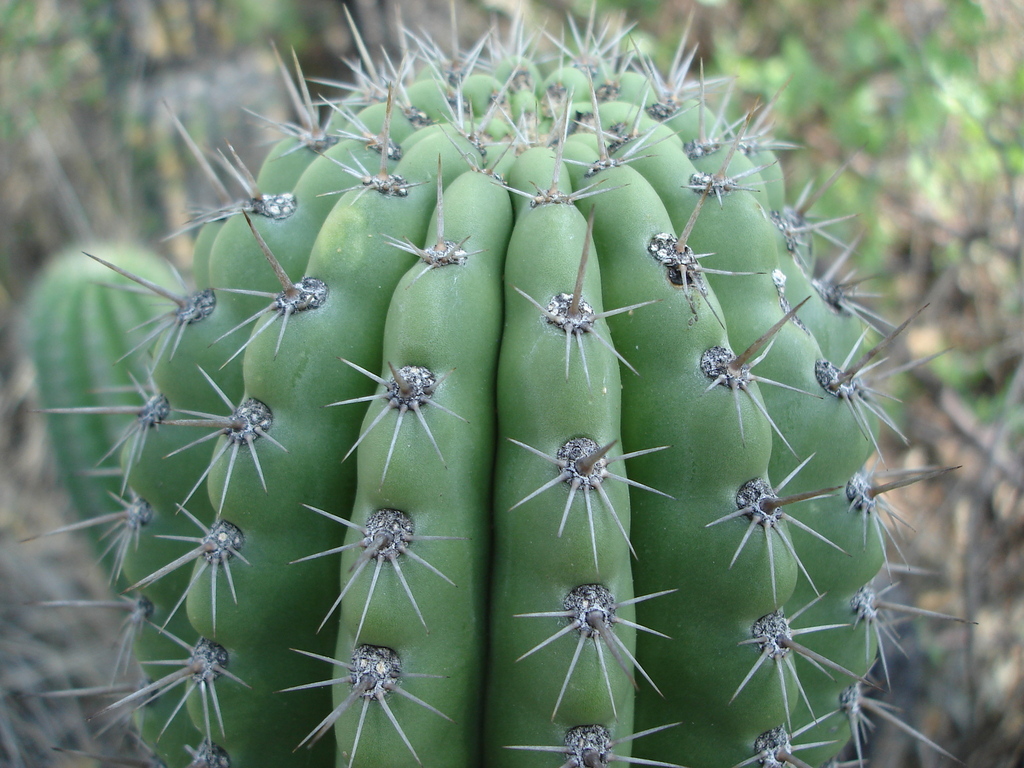
Stenocereus treleasei
Stenocereus treleasei, commonly known as tunillo, is a species of flowering plant in the family Cactaceae, native to Oaxaca in Mexico.
From the article Stenocereus treleasei on Wikipedia (CC BY-SA), quoted section by section
Description
A shrubby, candelabriform cactus. Individuals can reach 15 m (49 ft) in height, with several branches emerging from a central trunk or base. Branches are dark to bluish green with a diameter of up to 22 cm (8.7 in) and 15 to 20 blunt and slightly curved ribs. Areoles are pale and circular, 2 cm (0.79 in) to 2.5 cm (0.98 in) apart, with more than ten radial spines. Spines are 0.4 cm (0.16 in) to 1.3 cm (0.51 in) in length and gray in color. Flowers have pink or red tepals, with numerous, yellowish white stamens. Fruits are ellipsoid or spherical 3 cm (1.2 in) to 5 cm (2.0 in) in length, 2.5 cm (0.98 in) to 4 cm (1.6 in) in width, red peel and red, orange, yellow, or purple pulp, and black seeds.
Fruit. The fruit grown is a type of dragon fruit, and is referred to as pitaya to the locals. Its fruit is edible, giving it economically value for trade in the region. The fruit can be used for medicine giving it more value to the Latin American region. By being able to grow a fruit makes the species part of the Magnoliophyta phylum and the plant seed group of Angiosperms. It has mutualistic relation to the lesser long-nosed bat. The bat will migrate down South in Mexico to its region. When food is scarce the bat will eat the fruits produced from columnar cacti, including Stenocereus treleasei. …
Range & habitat
Distributed in the Mexican state of Oaxaca at altitudes of 1,300 to 1,800 meters.
Habitat. A species characteristic of the Central Valleys of Oaxaca. Found at elevations between approximately 1,200 metres (3,900 ft) and 2,000 metres (6,600 ft). It forms part of the thorn-scrub and tropical dry forests in valleys and slopes in soils derived from volcanic rocks and limestones. In some areas, S. treleasei becomes the dominant component in the plant associations called pitayeras or tunillales by local people. There, it is commonly associated with several species of Bursera, Ceiba aesculifolia, Vachellia cochlyacantha, Vachellia acatlensis, Mimosa spp., Senna spp., Parkinsonia praecox, Ipomoea arborescens, Ipomoea murucoides, Agave americana, Agave potatorum, Agave karwinski, and several species of columnar cacti such as Lophocereus marginatus, Myrtillocactus geometrizans, and Myrtillocactus schenckii, among others.
Wikipedia: “Distribution”
Where it lives
Recorded sightings
—
geo-referenced records in GBIF, from museums, herbaria and field observers.
Drag the globe to turn it. Dots are where records exist, not a range map; darker means more records.
In the stacks
Searching the stacks…
Every page naming Stenocereus treleasei in the Biodiversity Heritage Library →
This page is assembled live from iNaturalist, GBIF, Wikipedia, the Source Library and the Internet Archive. It is not yet part of the hand-edited codex. iNaturalist taxon 274267.