- Animals
- ›Arthropods
- ›Hexapods
- ›Insects
- ›Winged and Once-winged Insects
- ›Butterflies and Moths
- ›Geometrid and Swallowtail Moths
- ›Geometer Moths
- ›Ennominae
- ›Boarmiini
- ›Biston
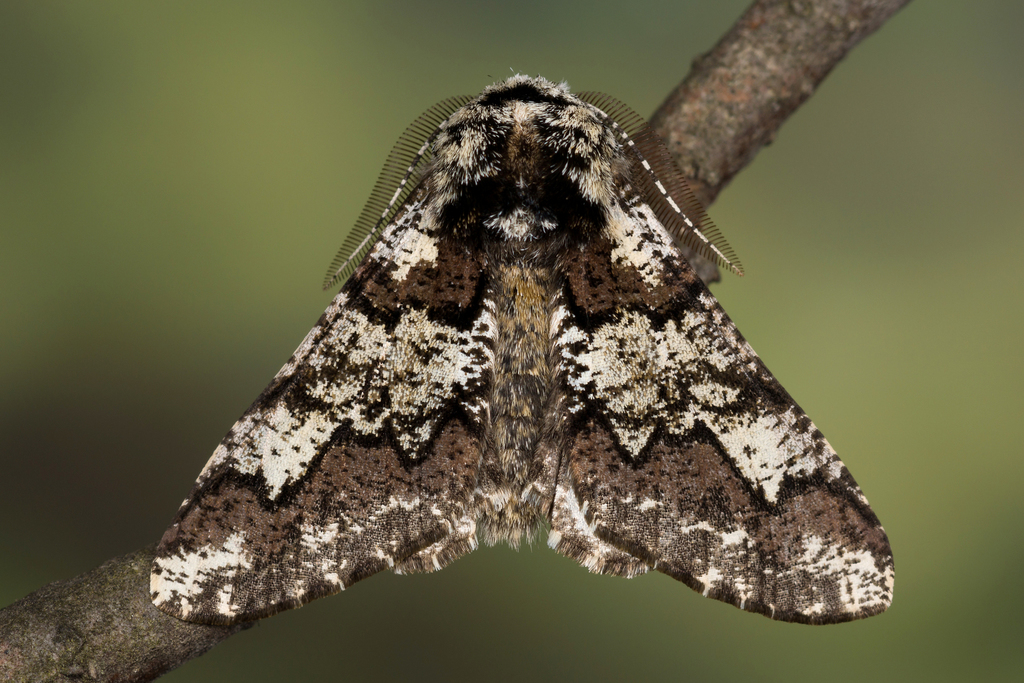
European Oak Beauty
Biston strataria
Biston strataria, the oak beauty, is a moth of the family Geometridae. It is native to Europe, the Balkan countries and the Black Sea region as far as Asia Minor and the Caucasus. The species was first described by Johann Siegfried Hufnagel in 1767. B. strataria is found in a variety of habitats, but is mostly found in woodlands where it rests on the bark of trees, camouflaged by its mottled black and grey wings. The male has feather-like antennae while those of the female are more thread-like. The moth has a wingspan of 40 to 56 mm (1.6 to 2.2 in).
The larvae are mainly brown with three lumps near the end of the abdomen. They have evolved to resemble sticks which helps protect them from predators. The larvae feed on many species of trees, but the most commonly used host plants are oaks.
From the article Biston strataria on Wikipedia (CC BY-SA), quoted section by section
Description
The oak beauty has white forewings with two irregular broad brown bands along each wing. The first band is short, located near the base of the wing, and surrounded with a black border. The second band is located near the outer margin with a black border surrounding the inner edge. Between these two bands is a white space sprinkled with black dots as well as a crescent-shaped black mark near the middle. The overall appearance gives the oak beauty a mottled look. B. strataria‘s forewings are 17–27 mm (0.67–1.06 in) in diameter, while its wingspan ranges from 40–56 mm (1.6–2.2 in). The oak beauty's hind wings are paler than its fore wings and have transverse black bands. The forehead and the front of the thorax are white while its sides are a white-grey blend. Its body is covered with many hairs. The back of the thorax and the body are a darker shade of brown. The oak beauty exhibits melanism and comes in two different variations; a dark (melanic) form and light (typica) form. The melanic form is prevalent in the Netherlands, but this form has not been observed in Britain. Details explaining this discrepancy are not yet known. The closest relative to B. strataria is the peppered moth (Biston betularia), which also has two forms. The proportion of melanics is higher in B. betularia compared to B. strataria. This is unusual since, between the two species, it is B. …
Wikipedia: “Morphology”
Range & habitat
It is common throughout Europe, with the exception of the far north and the far south. In the south, its range extends through the entire Mediterranean, the Balkan countries and the Black Sea region as far as Asia Minor and the Caucasus. In the north it reaches the southern Fennoscandia. It is found in the British Isles including Ireland. In July and August, the larvae can be found feeding on various host plants. B. strataria is prevalent in wooded areas including parks, gardens, and other suburban habitats. It is usually found on the trunk of trees where it can blend with its surroundings
Wikipedia: “Distribution and habitat”
What it does
Adults emerge in early spring. B. strataria begins its flight period from mid-March to April, which is an early flight period compared to other moth species. B. strataria usually flies at night and is readily attracted to light. Its mottled appearance aids in its concealment from predators when it rests on tree trunks during the day Although the adult camouflages well with its surroundings, predators may occasionally spot the moth. In these circumstances the moth has one last defense mechanism – its hindwings, which were previously hidden in the resting position, carries shocking markings which may warn off predators when suddenly exposed.
Wikipedia: “Behavior”
Listen
Looking for field recordings…
Where it lives
Recorded sightings
—
geo-referenced records in GBIF, from museums, herbaria and field observers.
Drag the globe to turn it. Dots are where records exist, not a range map; darker means more records.
In the stacks
Searching the stacks…
Every page naming Biston strataria in the Biodiversity Heritage Library →
This page is assembled live from iNaturalist, GBIF, Wikipedia, the Source Library and the Internet Archive. It is not yet part of the hand-edited codex. iNaturalist taxon 244816.