- Plants
- ›Vascular Plants
- ›flowering plants
- ›Dicots
- ›saxifrages, stonecrops, and allies
- ›saxifrage family
- ›alumroot tribe
- ›Tiarella
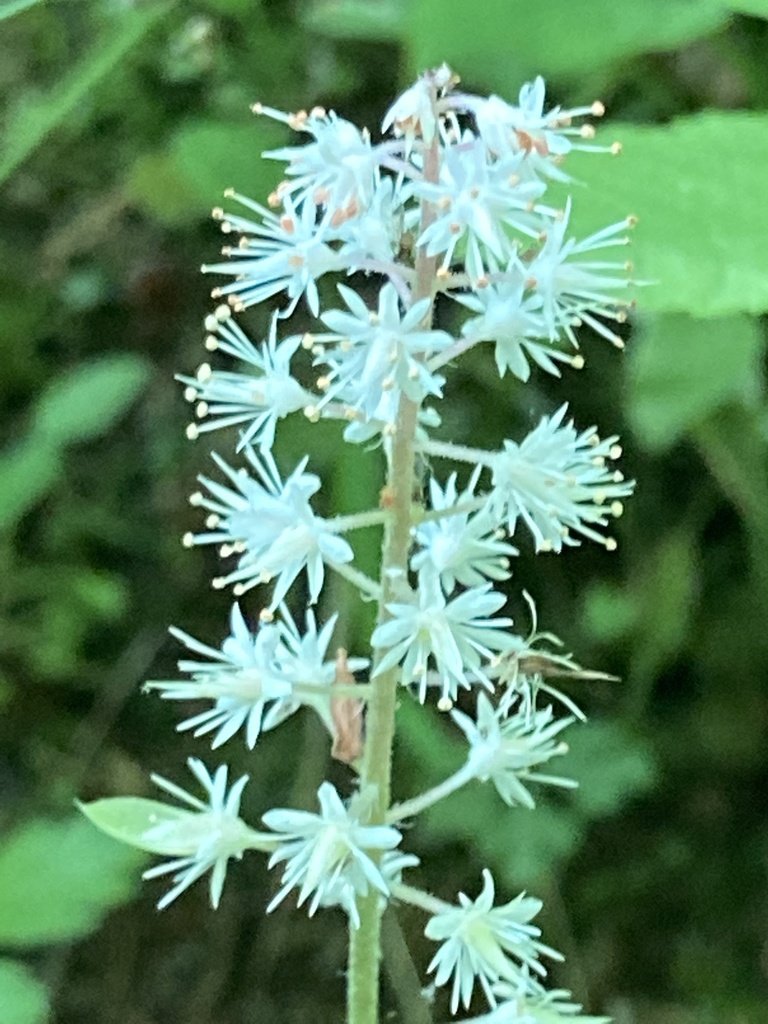
Wherry's Foamflower
Tiarella wherryi
Tiarella wherryi is a species of flowering plant in the family Saxifragaceae. The specific name wherryi recognizes Edgar Wherry, the botanist who collected some of the first specimens in the early 1930s. Commonly called Wherry's foamflower, it is the southernmost of all species of Tiarella in the southeastern United States, where its range approaches the Gulf Coast in southern Alabama.
From the article Tiarella wherryi on Wikipedia (CC BY-SA), quoted section by section
Description
Tiarella wherryi is a perennial, herbaceous plant with a short, slender rhizome. It has a leafless flowering stem and relatively large basal leaves, each with an extended terminal lobe. Most importantly, the species lacks the ability to produce stolons.
Identification. To positively identify Tiarella wherryi, all of the following key features must be verified (in any order):
Stolon always absent Basal leaves usually longer than wide Basal leaf lobes usually acute-acuminate with the terminal lobe prominently extended Flowering stem without leaves or foliaceous bracts If the plant in question has a stolon, it is not Tiarella wherryi. In that case, it is either Tiarella stolonifera or Tiarella austrina. Except for the flowering stem, the key features listed above are identical to those of Tiarella nautila, so distinguishing the two species may be difficult. Also note that Tiarella wherryi is similar to Tiarella cordifolia, differing only in the basal leaves.
Range & habitat
Tiarella wherryi is endemic to the southeastern United States, ranging from southern Kentucky to southern Alabama, and from there eastward into Georgia. Counties where the species is known to occur include:
Alabama: Baldwin, Barbour, Blount, Calhoun, Cherokee, Clarke, Clay, Cleburne, Colbert, Conecuh, Coosa, Cullman, DeKalb, Elmore, Etowah, Franklin, Hale, Henry, Houston, Jackson, Lauderdale, Lawrence, Lee, Madison, Marengo, Marion, Marshall, Monroe, Morgan, Randolph, Russell, Saint Clair, Talladega, Tallapoosa, Tuscaloosa, Walker, Winston Georgia: Bartow, Carroll, Catoosa, Clay, Clayton, Dade, Decatur, Early, Floyd, Fulton, Gordon, Haralson, Harris, Polk, Quitman, Randolph, Upson, Walker, Whitfield Kentucky: Clinton, Cumberland, Edmonson, Hart, Laurel, McCreary, Metcalfe, Pulaski, Wayne Mississippi: Choctaw, Itawamba, Monroe, Tishomingo Tennessee: Anderson, Bedford, Bledsoe, Bradley, Campbell, Cannon, Coffee, Cumberland, Davidson, DeKalb, Fentress, Franklin, Giles, Grundy, Hamilton, Hickman, Jackson, Knox, Lawrence, Lewis, Lincoln, Loudon, Macon, Marion, Marshall, Maury, McMinn, Meigs, Monroe, Moore, Morgan, Overton, Pickett, Polk, Putnam, Rutherford, Rhea, Roane, Scott, Sequatchie, Smith, Sumner, Trousdale, Van Buren, Warren, Wayne, White, Williamson, Wilson The range of Tiarella wherryi overlaps with that of T. …
Wikipedia: “Distribution”
Where it lives
Recorded sightings
—
geo-referenced records in GBIF, from museums, herbaria and field observers.
Drag the globe to turn it. Dots are where records exist, not a range map; darker means more records.
In the stacks
Searching the stacks…
Every page naming Tiarella wherryi in the Biodiversity Heritage Library →
This page is assembled live from iNaturalist, GBIF, Wikipedia, the Source Library and the Internet Archive. It is not yet part of the hand-edited codex. iNaturalist taxon 244487.