- Plants
- ›Vascular Plants
- ›flowering plants
- ›monocots
- ›Agaves, Orchids, Irises, and Allies
- ›agave and allies
- ›Hyacinth subfamily
- ›hyacinth tribe
- ›Scilla
- ›Basaltogeton
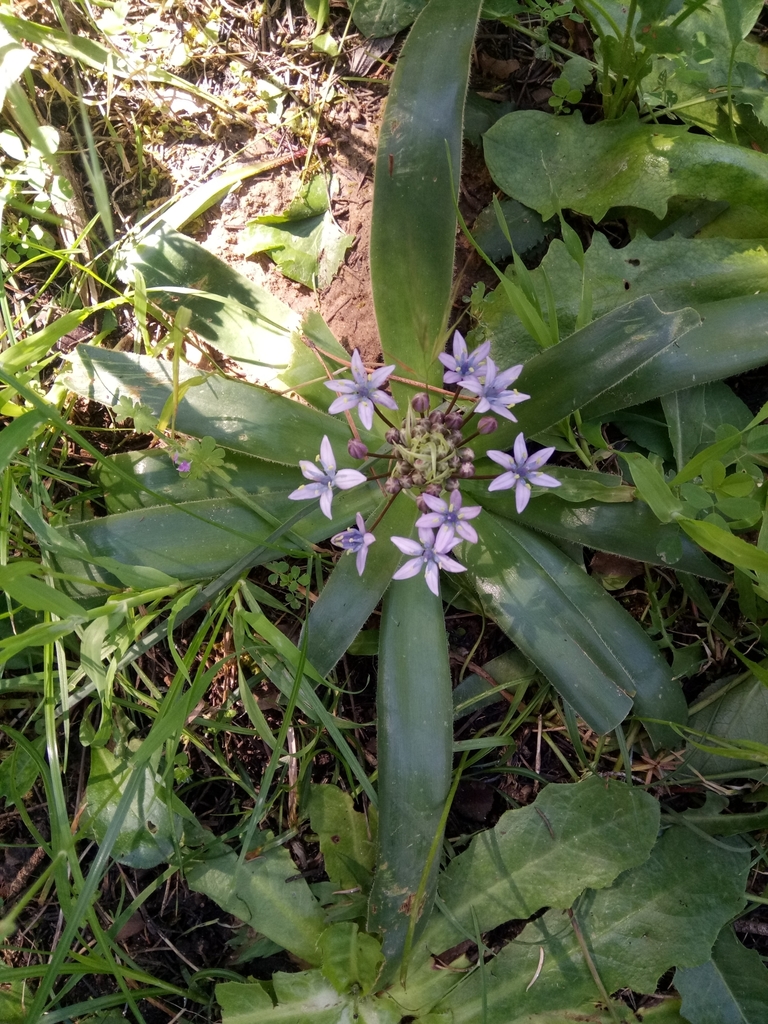
Portuguese squill
Scilla peruviana
Scilla peruviana (synonyms including Oncostema peruvianum), the Cuban lily, Peruvian hyacinth or Portuguese squill, is a species of Scilla native to the western Mediterranean region in Iberia, Italy, and northwest Africa. It is a bulb-bearing herbaceous perennial plant. The bulb is 6–8 cm in diameter, white with a covering of brown scales. The leaves are linear, 20–60 cm long and 1–4 cm broad, with 5-15 leaves produced each spring. The flowering stem is 15–40 cm tall, bearing a dense pyramidal raceme of 40-100 flowers; each flower is blue, 1–2 cm in diameter, with six tepals. The foliage dies down in summer, re-appearing in the autumn.
From the article Scilla peruviana on Wikipedia (CC BY-SA), quoted section by section
At the table
It is commonly grown as an ornamental plant for its spring flowers; several cultivars are available ranging in colour from white to light or dark blue, or violet. In some areas it is also known as hyacinth-of-Peru, Cuban-lily, or Peruvian scilla. It is not entirely hardy, suffering from prolonged frost. The best environment is a warm mediterranean climate similar to its native habitat.
Wikipedia: “Cultivation and uses”
Where it lives
Recorded sightings
—
geo-referenced records in GBIF, from museums, herbaria and field observers.
Drag the globe to turn it. Dots are where records exist, not a range map; darker means more records.
In the stacks
Searching the stacks…
Every page naming Scilla peruviana in the Biodiversity Heritage Library →
This page is assembled live from iNaturalist, GBIF, Wikipedia, the Source Library and the Internet Archive. It is not yet part of the hand-edited codex. iNaturalist taxon 244096.