- Animals
- ›Arthropods
- ›Hexapods
- ›Insects
- ›Winged and Once-winged Insects
- ›Flies
- ›Brachyceran Flies
- ›Cyclorrhaphan Flies
- ›Schizophoran Flies
- ›Acalyptrate Flies
- ›Opomyzoidea
- ›Leaf-miner Flies
- ›Phytomyzinae
- ›Liriomyza
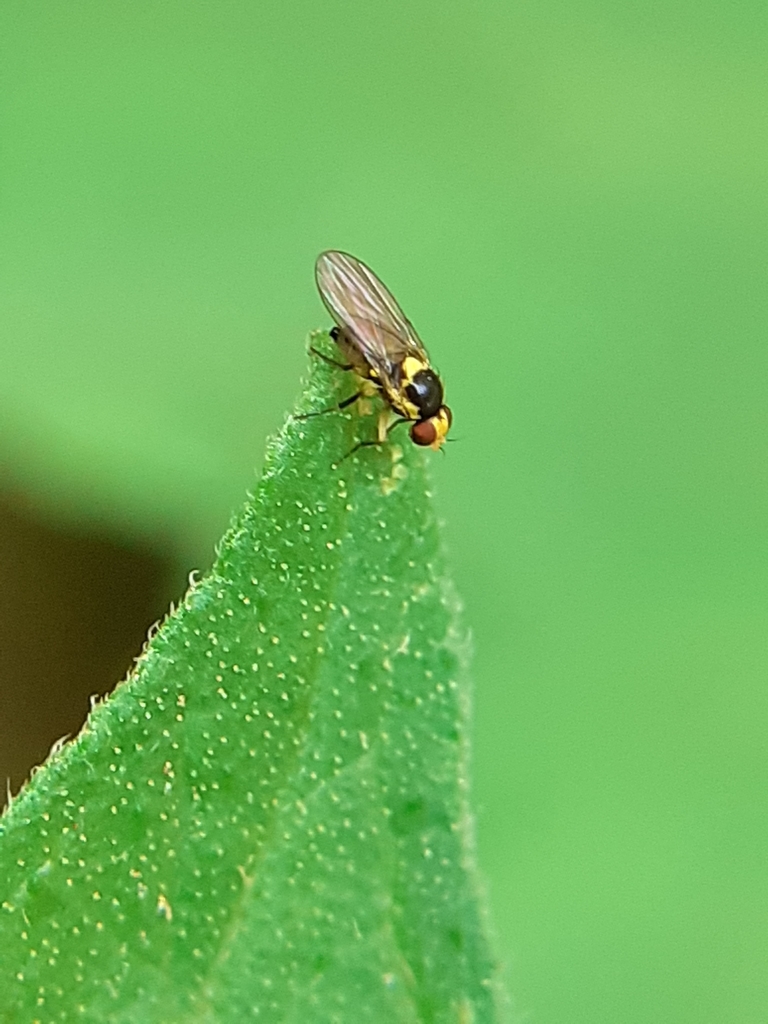
Vegetable Leafminer
Liriomyza sativae
Liriomyza sativae, commonly known as the vegetable leaf miner, is a species of insect, a fly in the family Agromyzidae. The larvae of this fly mine the leaves of a range of vegetables and weeds, but seem to favour plants in the families Cucurbitaceae, Fabaceae and Solanaceae.
From the article Liriomyza sativae on Wikipedia (CC BY-SA), quoted section by section
Description
Eggs of L. sativae measure approximately 0.25 by 0.12 mm (0.010 by 0.005 in) and are translucent and whitish. The larvae are legless grubs, with no head capsule. They are translucent at first, but become yellowish-orange in later instars. The pupae are oval and slightly flattened and vary in colour from yellowish-orange to a darker golden brown when the adults are nearly ready to emerge. The adults are up to 1.7 mm (0.07 in) long, with females being larger than males; the face, frons, third segment of the antenna and scutellum are yellow, and the mesothorax and abdomen are black, although the edges of some plates on the abdomen are yellow. This unique mesonotum is useful in distinguishing L. sativae from their close relatives L. trifolii. The limbs are brown with yellow femora and coxa. The flight mechanism of this insect is of interest, as it makes partial use of the unusual mechanism of clap and fling, mainly employed by very small insects such as thrips. L. sativae uses the mechanism only on the outer part of the wing to increase lift by some 7% when hovering.
Range & habitat
L. sativae occurs in the southern part of the United States, in Central America and in much of South America. It is sometimes detected in more northerly parts of the United States having been transported there in plant material, but it is unable to survive in cold weather (apart from in glasshouses).
Wikipedia: “Distribution”
What it does
The female lays eggs inside the leaf tissues of a susceptible plant, creating small puncture holes. The developing larva feeds on the leaf tissue, creating a tunnel between the upper and lower surfaces as it advances. This starts small but gets wider as the larva increases in size. After three instars, the larva cuts a slit, usually in the upper leaf surface, and falls to the ground where it pupates. At 25 to 30 °C (77 to 86 °F), the larval stage lasts for about eight days with a similar period for the pupal stage, whereas at 15 °C (59 °F), the whole cycle takes twenty-five days. A female may lay several hundred eggs over the course of her life-span of a month.
Wikipedia: “Life cycle”
Listen
Looking for field recordings…
Where it lives
Recorded sightings
—
geo-referenced records in GBIF, from museums, herbaria and field observers.
Drag the globe to turn it. Dots are where records exist, not a range map; darker means more records.
In the stacks
Searching the stacks…
Every page naming Liriomyza sativae in the Biodiversity Heritage Library →
This page is assembled live from iNaturalist, GBIF, Wikipedia, the Source Library and the Internet Archive. It is not yet part of the hand-edited codex. iNaturalist taxon 243752.