- Animals
- ›Arthropods
- ›Hexapods
- ›Insects
- ›Winged and Once-winged Insects
- ›Butterflies and Moths
- ›Owlet Moths and Allies
- ›Underwing, Tiger, Tussock, and Allied Moths
- ›Erebinae
- ›Omopterini
- ›Zale
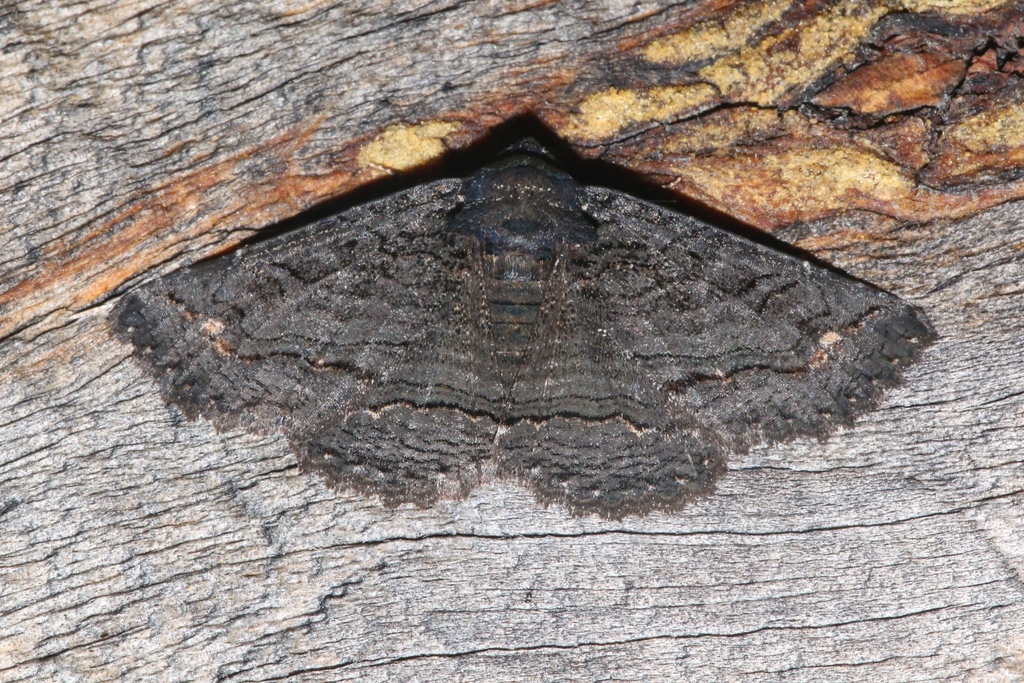
Black Zale Moth
Zale undularis
Zale undularis, the black zale moth, is a moth of the family Noctuidae (or in some classifications, Erebidae). The species was first described by Dru Drury in 1773. It is found in the eastern United States and southern Ontario.
From the article Zale undularis on Wikipedia (CC BY-SA), quoted section by section
Description
Upperside: the antennae are brown and thread like. The head, body, abdomen, and wings are of a very dark brown, bordering on black, and appear somewhat glossy. All the wings are a little dentated, and on the anterior ones, from the base to the extremity, is a series of black indented lines or bars, whereof the last or outer one is strong and conspicuous, crossing the wing from the anterior to the posterior edges, about a quarter of an inch from the external margin. The posterior wings are marked exactly like the superior. The underside is of a lighter colour, with the same kind of markings, but fainter. The wingspan is about 2 inches (5 cm).
== References ==
Listen
Looking for field recordings…
Where it lives
Recorded sightings
—
geo-referenced records in GBIF, from museums, herbaria and field observers.
Drag the globe to turn it. Dots are where records exist, not a range map; darker means more records.
In the stacks
Searching the stacks…
Every page naming Zale undularis in the Biodiversity Heritage Library →
This page is assembled live from iNaturalist, GBIF, Wikipedia, the Source Library and the Internet Archive. It is not yet part of the hand-edited codex. iNaturalist taxon 233944.