- Animals
- ›Arthropods
- ›Hexapods
- ›Insects
- ›Winged and Once-winged Insects
- ›Ants, Bees, Wasps, and Sawflies
- ›Narrow-waisted Wasps, Ants, and Bees
- ›Ants, Bees, and Stinging Wasps
- ›Vespoid Wasps
- ›Hornets, Paper Wasps, Potter Wasps, and Allies
- ›Hornets and Yellowjackets
- ›Vespula
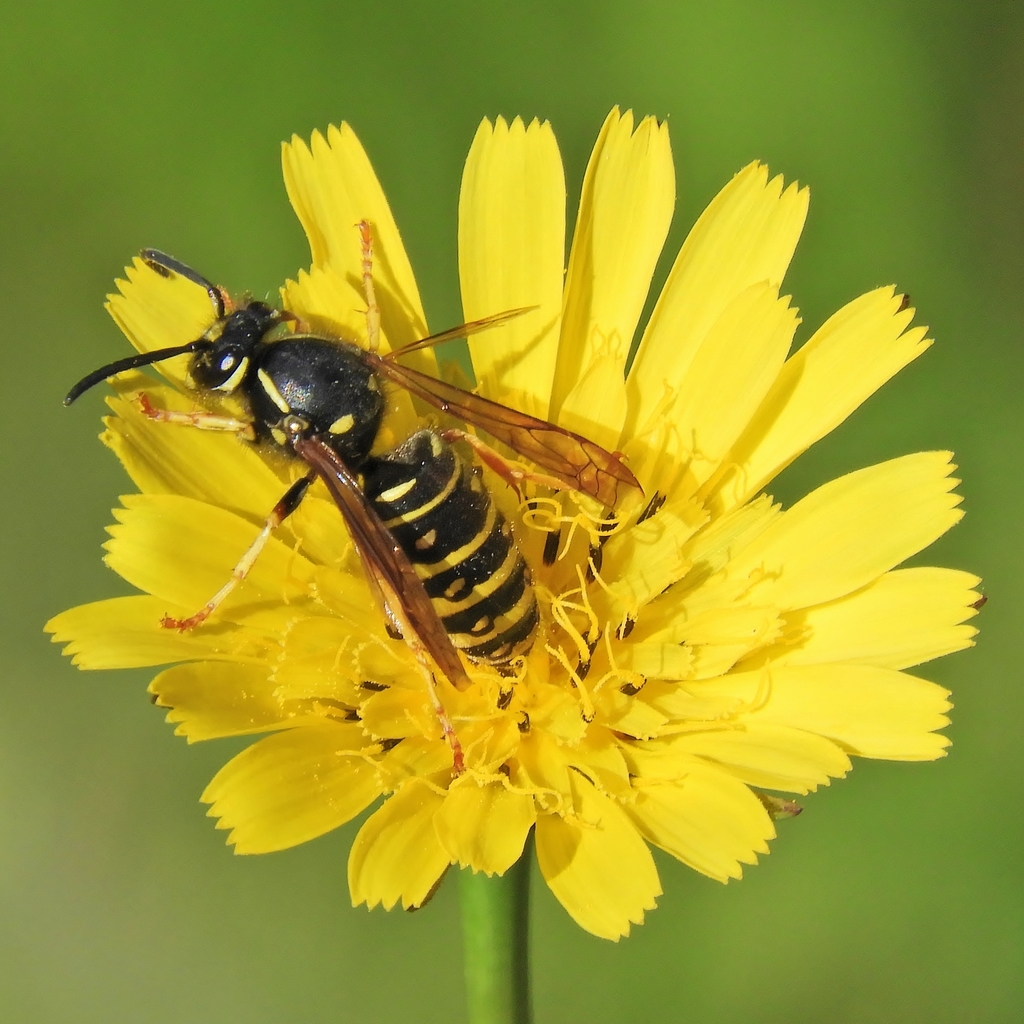
Forest Yellowjacket
Vespula acadica
Vespula acadica, also known as the forest yellowjacket, is a North American species of eusocial wasp which is part of the "rufa" group within the genus Vespula. It is a black and yellow wasp that is found in arboreal areas and builds its nests most often in decaying vegetation like logs, but has occasionally been found to build aerial nests. Due to its preference for forests V. acadica does not normally come into contact with humans; however, when colonies are disturbed, workers of this yellowjacket may be quite aggressive and persistent and sting repeatedly.
From the article Vespula acadica on Wikipedia (CC BY-SA), quoted section by section
Description
V. acadica is black with yellow markings and ranges from 10-15mm in length (AKA 1-1.5cm). The underside of its scape is yellow, rather than completely black. It is very similar in appearance to V. atropilosa but the apex of the middle black region of the second gastral segment is rounded; whereas it is pointed in V. atropilosa.
Wikipedia: “Description and identification”
Range & habitat
V. acadica is distributed throughout Boreal North America. Its range stretches from Alaska down the West Coast to southern California, and into the southwest United States. In the east it has a more northerly distribution through the Great Lakes, and also to the east coast as far south as the Carolinas.
Wikipedia: “Distribution and habitat”
What it does
V. acadica males readily attempt to mate with the queens. Males approach the queens from the side and attempt to mount the dorsum of the queen's gaster. The queen often attempts to turn and face the male in order to bite him. The male continues to follow the queen, and mounts her while grasping her thorax with all six of his legs. He then curls his gaster under the abdomen of the queen in order to insert his genitalia. If the queen is unreceptive, she will curl her gaster toward her head to form a C-shape to prevent penetration and use her legs to dislodge the male.
Wikipedia: “Mating behavior”
Listen
Looking for field recordings…
Where it lives
Recorded sightings
—
geo-referenced records in GBIF, from museums, herbaria and field observers.
Drag the globe to turn it. Dots are where records exist, not a range map; darker means more records.
In the stacks
Searching the stacks…
Every page naming Vespula acadica in the Biodiversity Heritage Library →
This page is assembled live from iNaturalist, GBIF, Wikipedia, the Source Library and the Internet Archive. It is not yet part of the hand-edited codex. iNaturalist taxon 233556.