- Animals
- ›Arthropods
- ›Hexapods
- ›Insects
- ›Winged and Once-winged Insects
- ›Beetles
- ›Water, Rove, Scarab, Long-horned, Leaf, and Snout Beetles
- ›Cucujiform Beetles
- ›Cucujoidea
- ›Pleasing Fungus Beetles
- ›Erotylinae
- ›Tritomini
- ›Triplax
- ›Triplax thoracica
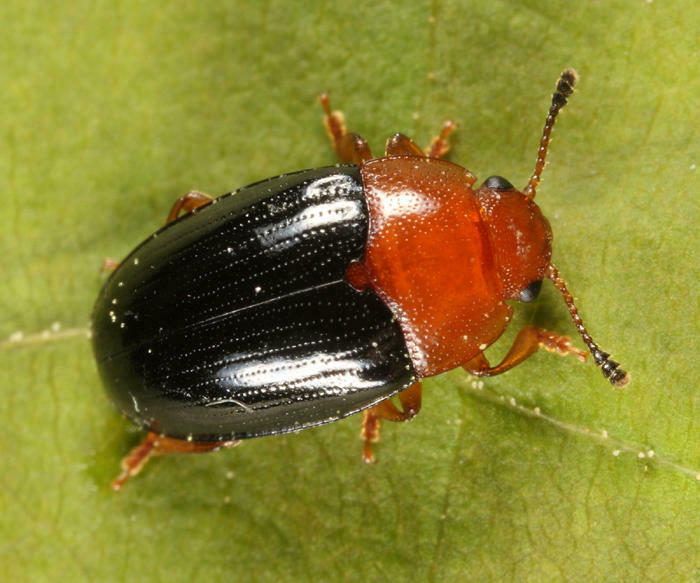
Triplax frosti
Triplax frosti is a North American species of small pleasing fungus beetle (family Erotylidae). It is placed in subfamily Tritominae (formerly Triplacinae), or – in taxonomic arrangements that prefer a more comprehensive subfamily Erotylinae – in tribe Tritomini of the Erotylinae.
At first, this beetle was considered nothing more than a chance variant of T.thoracica, its presumed closest relative. Due to the comprehensive study of Thomas Casey Jr., these two cryptic species can now be reliably separated. The scientific name honors C.A.Frost, who on June 2, 1912, collected the type specimen (USNM 48810, an adult of undetermined sex) in Hopkinton, Massachusetts.
From the article Triplax frosti on Wikipedia (CC BY-SA), quoted section by section
Description
Adults of this beetle are about 3.3-5.4 mm long and 1.6-2.9 mm wide. Their elongated body has smoothly curving sides and strongly shiny elytra. Like in many of their relatives, head and pronotum are reddish-orange, while the elytra are black. The scutellum is orange-yellow, lighter than the pronotum if anything, providing an easy distinguishing trait against T.thoracica (albeit only obvious with a magnifying glass). As usual for the members of the "breast-plated" species complex, T.frosti has orange legs and antenna bases and lacks a conspicuous margin to the forehead sides, which also form a well-rounded obtuse angle towards the mouth. The "stems" of its antennae are reddish-orange up to segment 7, with segment 8 dark chestnut brown, and the black segments 9-11 forming elongated "clubs". It can be distinguished from most other Triplax – even very close relatives – by having an all-orange underside, no distinct margin at the base of the elytra, and conspicuously expanded maxillary palps; T.thoracica is identical in these regards, but apart from the dark scutellum color differs in having the spaces between the lengthwise lines of large punctures on the elytra strewn with smaller punctures all the way from the elytra base (instead of smooth and unpunctuated at the base as in T.frosti). …
Range & habitat
T.frosti is found in the USA and Canada from Nova Scotia to Virginia, west at least to Manitoba and Nebraska, and from there more sparsely northwest to British Columbia. Unlike most of its relatives, it avoids subtropical climates, ranging south only to Virginia and perhaps Tennessee. Altogether, though it is by no means rare, its range is not well understood; it appears to occur in an arc running southeast to west along the former massive prehistoric Lake Agassiz-Ojibway.
The northernmost limits are at least Upper Canard, Nova Scotia, Kouchibouguac National Park in New Brunswick, Duparquet, Quebec, Malachi, Ontario, Teulon, Manitoba, Redfield, Saskatchewan, and Edwand and Fort McMurray in Alberta. In the west, it ranges at least to Grand Forks, North Dakota (where it occurs on the university campus) and Sioux County, Nebraska. From its southern limit, there are few records; it occurs at least to Pennington Gap, Virginia, but its limits due west are essentially conjectural. This beetle is most rarely encountered outside late May to mid-September; most often, it is seen from June to early August. …
Wikipedia: “Distribution and ecology”
Listen
Looking for field recordings…
Where it lives
Recorded sightings
—
geo-referenced records in GBIF, from museums, herbaria and field observers.
Drag the globe to turn it. Dots are where records exist, not a range map; darker means more records.
In the stacks
Searching the stacks…
Every page naming Triplax frosti in the Biodiversity Heritage Library →
This page is assembled live from iNaturalist, GBIF, Wikipedia, the Source Library and the Internet Archive. It is not yet part of the hand-edited codex. iNaturalist taxon 233015.