- Animals
- ›Arthropods
- ›Hexapods
- ›Insects
- ›Winged and Once-winged Insects
- ›Ants, Bees, Wasps, and Sawflies
- ›Narrow-waisted Wasps, Ants, and Bees
- ›Ants, Bees, and Stinging Wasps
- ›Formicoidea
- ›Ants
- ›Myrmicine Ants
- ›Pogonomyrmecini
- ›Pogonomyrmex
- ›Pogonomyrmex californicus
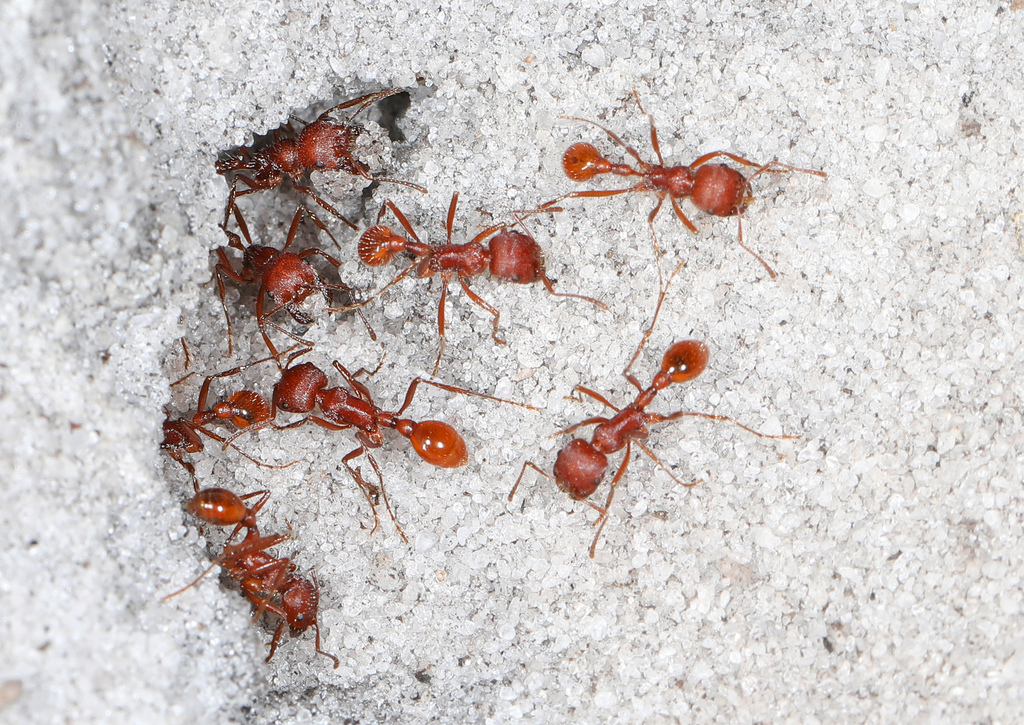
Florida Harvester Ant
Pogonomyrmex badius
Pogonomyrmex badius, or the Florida harvester ant, is a species of harvester ant in the genus Pogonomyrmex. It is the only Pogonomyrmex species found on the east coast of the United States and the only one in North America known to be polymorphic. The Florida Harvester ant is commonly found in Florida scrub and other similar habitats within the Atlantic coastal plain states.
From the article Pogonomyrmex badius on Wikipedia (CC BY-SA), quoted section by section
Description
P. badius is a relatively large species of harvester ant present throughout Florida scrub and are one of the most notable and unique inhabitants of the ecoregion. The workers are highly polymorphic, ranging from 6.35 mm for the smallest workers to 9.52 mm for the largest majors which can rival the queen (10 - 12 mm) in size. Both queens, majors and intermediates have disproportionately large heads, while minors have a more narrow complexion when viewed at the front. Under normal circumstances this species lacks epinotal spines which sit parallel on the propodeum though these spines may occasionally be present.
What it does
The Florida Harvester ant is a highly active diurnal species well adapted to the hot and dry habitats of the southeastern United States. Colonies are near exclusively found nesting within well drained sandy soils in xeric shrublands, grasslands, woodlands, and intact coastal dunes. Open sandy ground with sparse vegetation exposed to full sun is preferred as nesting sites. The nests of mature colonies are very deep, usually 2.5 to 3.0 meters deep with seeds being stored about 40 - 100 cm below ground in large flat granaries. On the surface the flat mound is free of peripheral vegetation and is decorated with detritus and charred plant matter, the purpose of which is poorly understood. Alongside the nest also exists short foraging trails which extend into the surrounding area, usually in the opposite direction of any neighboring colonies. Labor partitioning in the colony is organized spatially in respect to the vertical axis of the nest as a result of age polyethism. The youngest workers, which care for the brood and queen, reside in the deepest portions of the nest and as they age move closer to the surface and take up the typically more perilous activities of maintaining and defending the nest as well as foraging for food. The result is a division of the worker population along age demographics that's strongly stratified with depth. …
Wikipedia: “Behavior”
Toxicity
Like most species belonging to the genus Pogonomyrmex, P. badius is equipped with a stinger capable of delivering a highly potent and painful neurotoxic venom adapted for defense against predatory vertebrates. The venom of this species is considerably toxic, with a mice LD50 of 0·42 μg/g—comparable to the most toxic snake venoms. Despite being so toxic, the yield per sting is significantly low, with dozens of stings being required to cause potential harm to a healthy adult. P. badius is also a rather docile ant, being reluctant to sting unless forced to, with stings usually occurring when the ant is trapped against the skin in some way. Along with a few other Pogonomyrmex species, badius workers exhibit stinger autotomy in which the barbed stinger and venom sac is left embedded in the skin to continuously pump venom. The cost of this autotomy is the demise of the ant due to the internal damage from the stinger being pulled out, much like in honey bees.
Wikipedia: “Venom toxicity”
Listen
Looking for field recordings…
Where it lives
Recorded sightings
—
geo-referenced records in GBIF, from museums, herbaria and field observers.
Drag the globe to turn it. Dots are where records exist, not a range map; darker means more records.
In the stacks
Searching the stacks…
Every page naming Pogonomyrmex badius in the Biodiversity Heritage Library →
This page is assembled live from iNaturalist, GBIF, Wikipedia, the Source Library and the Internet Archive. It is not yet part of the hand-edited codex. iNaturalist taxon 228477.