- Animals
- ›Chordates
- ›Vertebrates
- ›Amphibians
- ›Frogs and Toads
- ›Terraranas
- ›Rain Frogs
- ›Eleutherodactylinae
- ›Eleutherodactylus
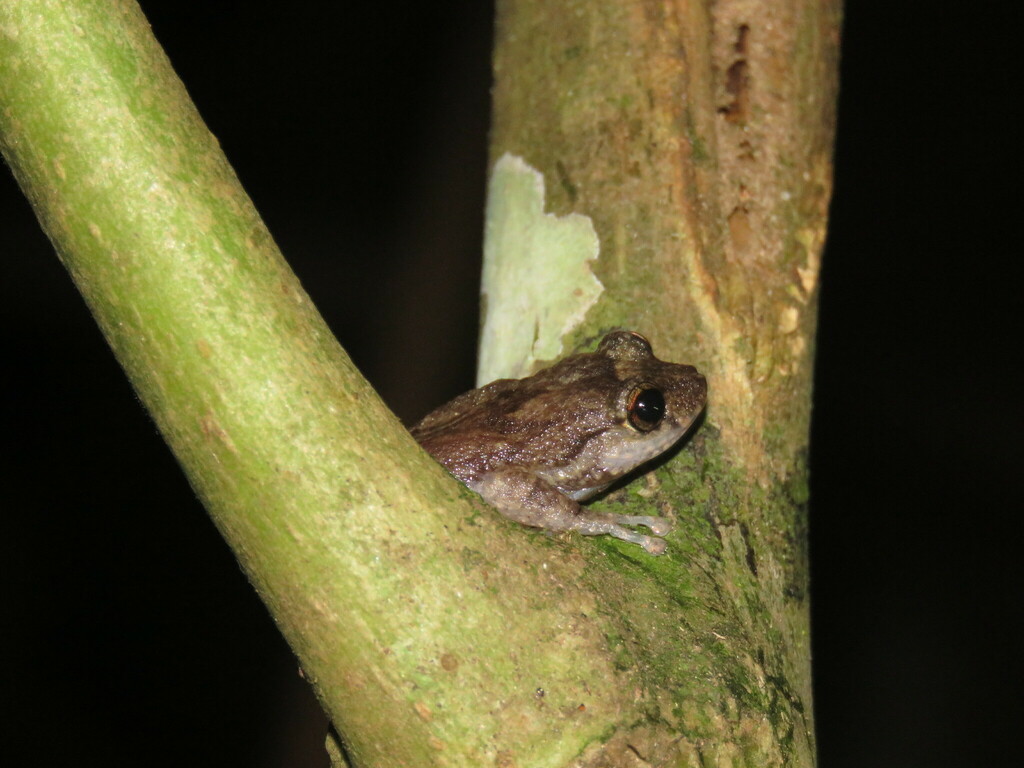
Tree-hole Coqui
Eleutherodactylus hedricki
Hedrick's coqui, the treehole coqui, or coqui de Hedrick (Eleutherodactylus hedricki) is a species of frog in the Eleutherodactylidae family endemic to Puerto Rico. Its natural habitats are subtropical or tropical moist lowland forests and subtropical or tropical moist montane forests.
From the article Hedrick's coquí on Wikipedia (CC BY-SA), quoted section by section
Description
Its distinctive features are the pronounced constriction in the back of the head (as if the waist were in the back of the head), a shallow furrow along the middle of the back from between the eyes to near the sacral hump, and the short, rounded snout. Other distinguishing but not necessarily exclusive characteristics are: the small eyes, with narrow upper eyelids, the uniformerly granular dorsum, the pair of light, externally concave lines on the back (not too distinct in very dark animals), the blackish throat of males, and the absence of dark streaks along the sides of the snout. The basic dorsal color may be brown or dark gray, almost uniform or with obscure variegation or vermiculations of lighter gray. The males average 32.8 mm in length, while females average 34.6 mm. The treehole coqui is a mountain-dwelling, arboreal species that rests in and calls from holes and crevices in tree trunks and branches, often as high 20 or 30 ft from ground. The call of E. hedricki is a resonant "ping, ping, ping". The species may be heard during the day, but by midnight, most of the callers have become silent. The call has not been heard below about 1,000 ft.
Range & habitat
The species is found in lower-elevation forest in the Luquillo Mountains (El Yunque), Cayey Mountain Range and Central Mountain Range.
Wikipedia: “Distribution”
In human culture
E. hedricki was discovered in 1962, when finding a new species of frog seemed very improbable. It is named in honor of Hedrick J. Rivero at age 9, who declared himself assistant to his father and followed him through creeks, caves, and mountains during any time of the day or night.
Wikipedia: “History”
Listen
Looking for field recordings…
Where it lives
Recorded sightings
—
geo-referenced records in GBIF, from museums, herbaria and field observers.
Drag the globe to turn it. Dots are where records exist, not a range map; darker means more records.
In the stacks
Searching the stacks…
Every page naming Eleutherodactylus hedricki in the Biodiversity Heritage Library →
This page is assembled live from iNaturalist, GBIF, Wikipedia, the Source Library and the Internet Archive. It is not yet part of the hand-edited codex. iNaturalist taxon 22619.