- Plants
- ›Vascular Plants
- ›flowering plants
- ›monocots
- ›lilies, supplejacks, and allies
- ›lily family
- ›true lily subfamily
- ›true lilies and allies
- ›Lilium
- ›Pseudolirium
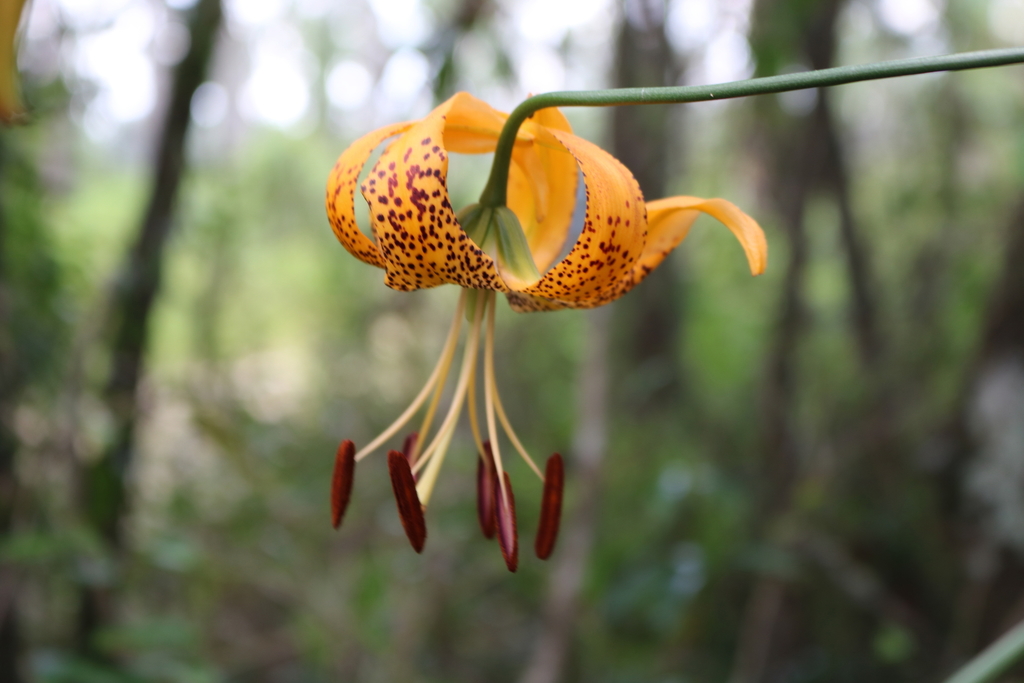
Pot-of-Gold Lily
Lilium iridollae
Lilium iridollae is a species of Lilium or lily. It is a perennial forb. This species is considered one of five known Lilium species native to specific sites in the United States' southeast region. In 1940, this species was discovered by Mary Henry in its habitat. She named the lily in reference to a "pot of gold at the end of the rainbow".
From the article Lilium iridollae on Wikipedia (CC BY-SA), quoted section by section
Description
The flower stalk may grow to be 6 feet tall, but more often they are a foot or two shorter. The individual flower stalks only create one solitary flower that hangs downward from the stem. Each flower is about 3-4 inches wide. The colors of the flowers ranges from a pale yellow to a rich orange. The petals on the flower are recurved that causes them to touch each other over the back of the stem while the stamens and the stigma hang downward in the open space. In addition, the petals also have heavy brownish-black spots. The flowers are non-fragrant.
Range & habitat
Lilium iridollae grows along streams in wet pine woodlands and in pitcher plant bogs in the southeastern United States. It is mainly found in Florida, North Carolina, South Carolina, Alabama, and Virginia. This species has become endangered in Florida and threatened in North Carolina. The balance of the habitat of this endangered plant, Lilium iridollae, is reliant on episodic, naturally occurring fires caused by lightning strikes. The fires reduce competition from other plants and release nutrients and organic substance from burned peat moss and leaves into the acidic, nutrient-poor soil. Lilium iridollae’s sensitivity to changes in drainage patterns and water quality make them predominantly susceptible to disturbances in its ecosystem. For example, they might be overgrazed by livestock and urban development in nearby areas.
Wikipedia: “Distribution”
What it does
Lilium iridollae and many other related species are pollinated mostly by large swallowtail butterflies. In addition, this plant is also attractive to bees and/or birds. When pollination occurs, a large seed capsule ultimately develops that can contain many hundreds of seeds.
Wikipedia: “Pollination”
How it is grown
Lilium iridollae requires specific conditions, one reason why this lily has been elusive to many enthusiasts. In general, the southeastern region of the United States is not considered "lily growing country" since it has warm winter temperatures and high humidity which are not suitable conditions for garden lilies.
Wikipedia: “Cultivation”
Where it lives
Recorded sightings
—
geo-referenced records in GBIF, from museums, herbaria and field observers.
Drag the globe to turn it. Dots are where records exist, not a range map; darker means more records.
In the stacks
Searching the stacks…
Every page naming Lilium iridollae in the Biodiversity Heritage Library →
This page is assembled live from iNaturalist, GBIF, Wikipedia, the Source Library and the Internet Archive. It is not yet part of the hand-edited codex. iNaturalist taxon 223668.